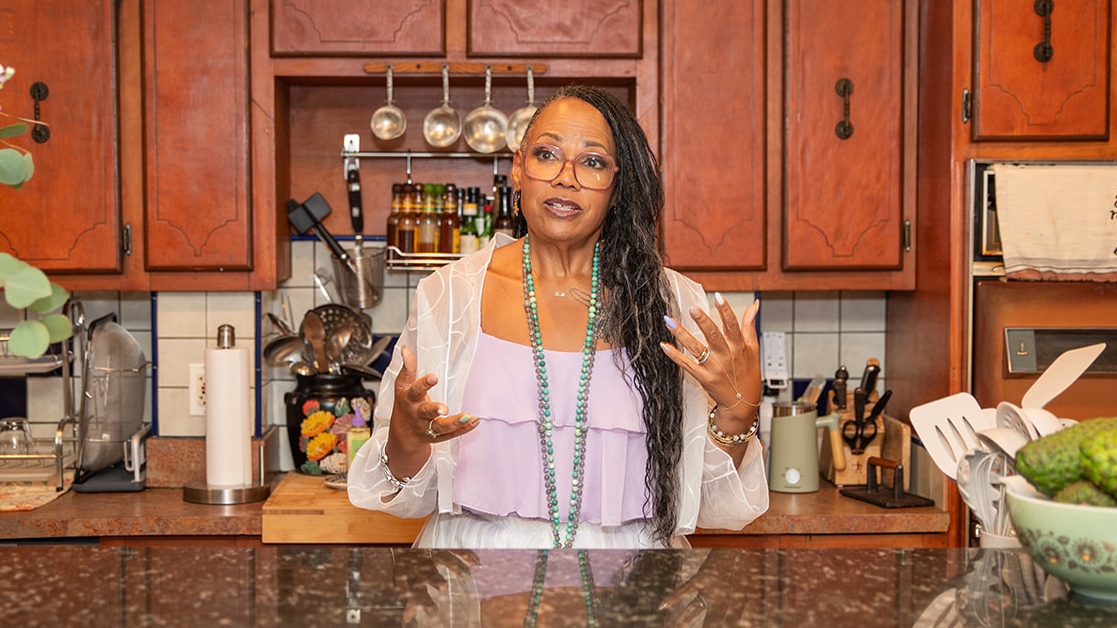
The very first Carol’s Daughter haircare recipes were whipped up in founder Lisa Price’s home in Brooklyn. Since 1996, she’s been the textured hair chef of her neighborhood, cooking up collections. Now, after 10 years under L’Oréal ownership, Price has officially reclaimed her brand as an independent owner again. And, her first collection back invites us to the place that started it all: Lisa’s kitchen.

“Very few people have actually got to stand where it happened,” Price says to the intimate group of editors standing in front of her granite island. 30 years later, “some of the ideas are still born here because I still come into this kitchen and cook and play and have fun.” Her new Lisa’s Kitchen Scalp & Edge Care collection is on display like the rack on spices hanging above her stove. But, instead of soul food, the four-product collection—Edge Treatment Balm, Scalp Balancing Serum, Scalp & Edge Cleansing Oil, and Scalp Detox Cleansing Nectar—is the recipe to healthy hair. Her family secret? It’s simple: Start at the root.
While she just ended her ownership with L’Oréal, her kitchen has always been the root, serving as her brand’s corporate HQ for years. “I learned about the love of a kitchen from my grandmother who actually lived in the house next door,” she says. Back then, her living room was the store where Carol’s Daughter was sold. “People came in there and shopped and then they would traipse through [the kitchen] to go use the restroom.” This memory is the root of the brand, which is why her latest collection honors the actual root of our hair.

The Scalp Balancing Serum, for example, mixes niacinamide, hyaluronic acid, and rice protein for daily scalp hydration. Meanwhile, the Scalp Detox Cleansing Nectar lifts away build up, excess oil, and impurities without the dryness you get from most clarifying shampoos. As for the balm-to-oil Edge Treatment Balm, even the most fragile edges benefit from the product’s green coffee butter formula, which can be layered under other edge controls or gels for more hold. Then, there’s the oil. Instead of locking in dryness, the oil dissolves edge control residue while stretching your styles between wash days (which traditionally begins in the kitchen, too).

“First I was solving my problem and then I ended up solving other people’s problems,” she says. For decades, her haircare recipes have represented what Black women’s hair deserves: The same care, intention, and of course, love, we put into our kitchens. So, standing in her Brooklyn kitchen, she makes one thing clear: “When people say ‘What is it like to be back?’ I remind them that I never left.”