Spain Won The Trophy. Cabo Verde Won The World Cup.

It started in 3rd grade, when I would grab every history textbook and flip to the map to see if Cabo Verde , my parents’ birthplace, would be shown. Most often, it wasn’t, to my disappointment. I would wonder if our archipelago had disappeared into the binding of the book.
Spain Won The Trophy. Cabo Verde Won The World Cup.
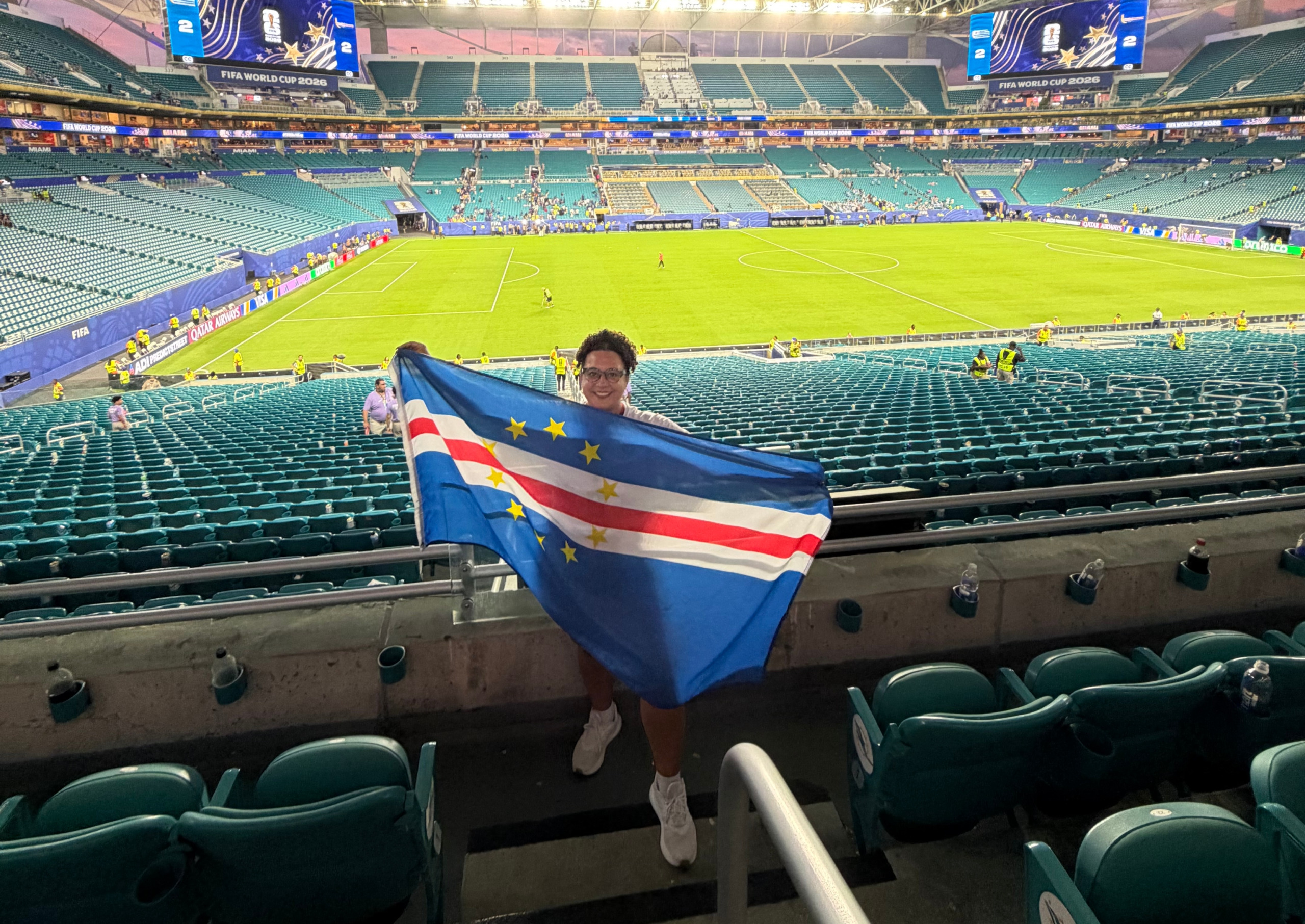
It started in 3rd grade, when I would grab every history textbook and flip to the map to see if Cabo Verde , my parents’ birthplace, would be shown. Most often, it wasn’t, to my disappointment. I would wonder if our archipelago had disappeared into the binding of the book. Then, I’d look for a key to see if we would at least be named. Most times, I didn’t see my ancestors’ country on the map: a small way to show our existence. This was the tale for most of my life. Wanting the world to acknowledge that we existed, and to know that when I said I was Cabo Verdean, it was a real place. I was born in Boston, where I spent my free time with my Vovo (grandmother). My neighborhood was diverse, filled with my people who spoke the same language as my family: Cabo Verdean Creole or Kriolu. I was surrounded by our culture and food. Cesária Évora playing on Saturdays, cachupa on Sundays, and stories from my elders. When I moved to a suburb of Boston, this immersive experience shifted from belonging to longing. I lost some of the language. I started looking for representation in the media , hoping that one of the Black women I admired would say they were Cabo Verdean. That moment never came. The author in Cabo Verde. Instead, I was constantly asked, “What are you?” When I answered, “I’m Cape Verdean.” I was usually met with blank stares. I’d elaborate, “Cape Verde, a group of islands off the West Coast of Africa.” Responses would follow: “There are islands off of the West Coast of Africa?” or “I’ve never heard it.” As a light-skinned Black woman of African descent, I often felt like I had to explain every part of my identity before people understood who I was. Those experiences, similar to flipping through the map, often led me to feel isolated or question why people didn’t know us. Yet, I never faulted people for not knowing. We were a young country, gaining our independence from Portugal in 1975, after generations of colonization. Despite our size, our history is one of extraordinary resilience, shaped by generations who endured slavery, famine, drought, migration, and the fight for freedom led by Amilcar Cabral. That isolation created a desire for wanting to know more about my country and my people, so I traveled to Cabo Verde twice. I dug my toes into Fogo’s black sand beaches and explored Santiago’s mountains. I ate pastel made by elders, played Bisca, and again, witnessed the resilience of a people who survived many hardships. I’ve always been proud of being Cabo Verdean, whether we were visible or not. I launched my business on our Independence Day. I wore Kriola (CV woman) shirts and presented at the Poderoza Conference . I proudly shared this part of my identity wherever I went, even when it was followed by a mini history lesson. I was creating the visibility of Cabo Verde that I wanted to see. Then, global visibility came to us. One month ago, the world was introduced to Cabo Verde during our World Cup debut against Spain. We were called underdogs and given a one percent chance to advance to the knockout round. We stepped on the biggest stage and demonstrated our resilience, our courage, and our fight, drawing against the 2026 champions. We showed up again and again, even testing the limits of the 2022 champions, Argentina. We showcased our talent and discipline, but more importantly, showed the world we belonged on the biggest stage. I saw myself reflected in our national team: Black West Africans from the Diaspora who approached their craft with heart and skill. They embodied much of what I was taught: you cannot let your size determine your fight; an ode to our freedom fighters. This moment has been more than soccer. The last month brought me back to the younger Rachel who felt a sense of belonging. Blank stares turned to clarity and excitement: “I love Cabo Verde. We’re cheering for you!” In Miami, people stopped me as I carried our flag, sharing inspiration from our team. Across the Diaspora, people are reclaiming their Kriolu heritage. Then, a special moment happened: I heard our national team speak Kriolu in interviews. A language I’ve only spoken with Vovo, seen as secondary to Portuguese, was what Bubista, our manager, mandated for players to use while training. I felt seen and heard. Last week on CBS Mornings, Gayle King asked Vozinha , the team’s beloved goalkeeper, what this moment had felt like. He explained that the greatest change was no longer having to explain where Cabo Verde was. That captured what I’d been feeling this last month. People now know us. Our run and story is continuously mentioned in all World Cup conversations. People fell in love with our talent, courage, and fearlessness. The world has been inspired by who we are and what we’ve always known about ourselves. Cabo Verde has always been a country worthy of recognition, that deserved to be on every single map, even if it meant shifting the binding of the book. As the world comes to know us, I hope they come to know our history, our resilience, and our joy. I hope they come to understand why we’ve always believed in this moment. As we say, “É nos ki ta manda.” We are the ones in charge.
Need Support?

Find verified resources for reproductive healthcare, support services, and advocacy organizations.

Find Resources