My journey to the World Cup was about more than soccer.
I have learned to travel with a level of preparation most people never have to consider. Before I leave home, I calculate distance, timing, energy, accessibility, and what I will do if something does not go as planned. I think about how far I will need to move, where I can rest, whether the entrance I was promised is actually usable, and who I may need to advocate to along the way. Airports, events, and even opportunities come with invisible questions: Will I be able to move through this space safely? Will I be welcomed? Will I be seen, or simply noticed?
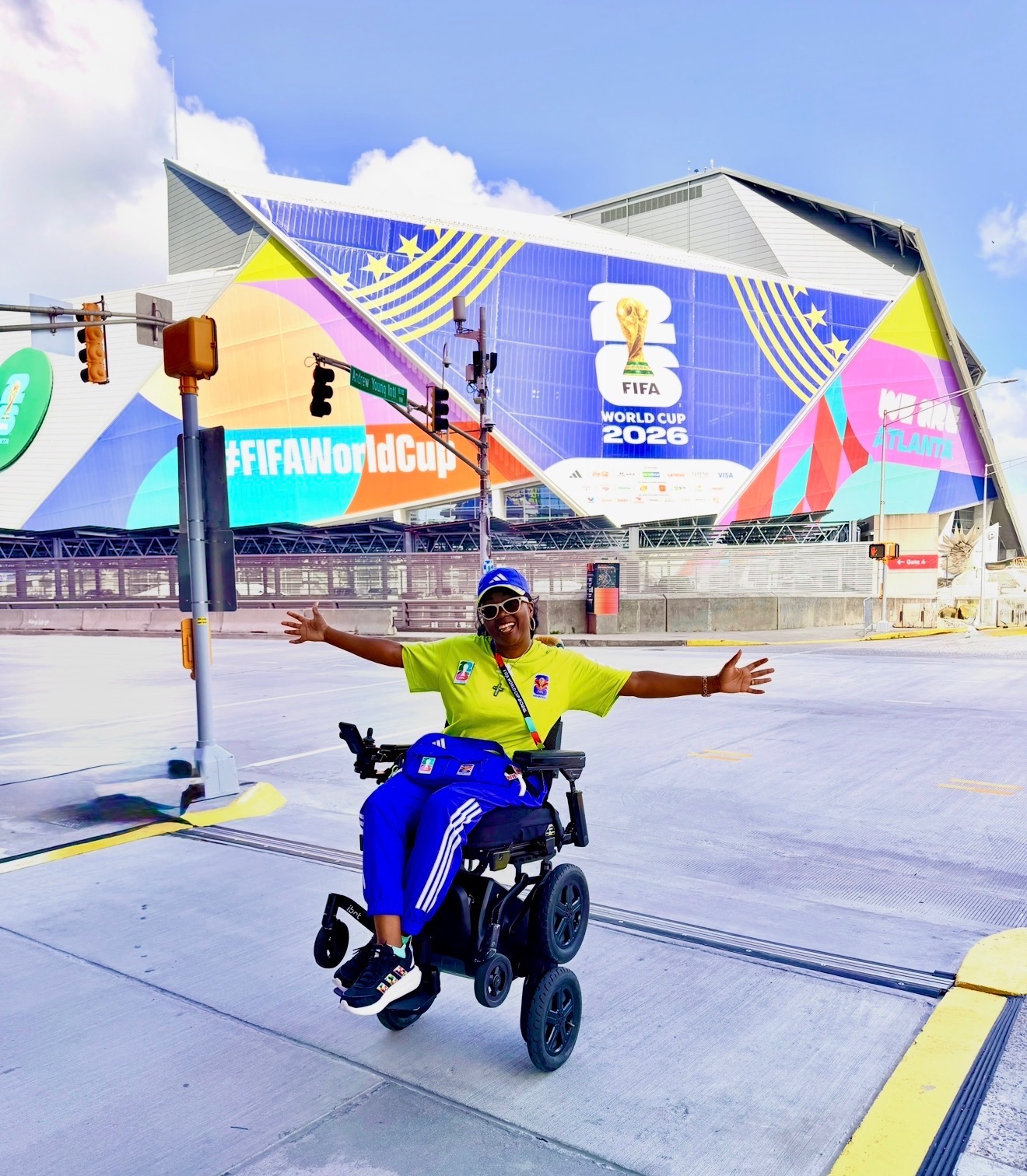
That has been my reality for much of my life as a Black woman in STEM living with a disability. I know what it feels like to be highly visible while still not being fully considered. I have entered spaces where accessibility existed on paper but failed in practice, and professional environments where quietly conforming became part of how I survived and succeeded. Over time, I became skilled at preparing myself for places that had not necessarily prepared for someone like me.

Being chosen as a FIFA City Ambassador for Atlanta changed everything.
That is why receiving the email saying I had been selected as a City Ambassador for the 2026 FIFA World Cup carried so much weight. My first response was joy, but it was also awareness. This was more than a volunteer assignment connected to one of the largest sporting events in the world. It represented presence. It represented service. It represented stepping into a global moment where Black women and disabled women are not always historically visible beyond the audience.
I have loved soccer for years, not only because of my culture and kids, but because of what it can create between people. Soccer crosses cultures, languages, neighborhoods, and generations. Service has always carried that same spirit for me. Both ask us to pay attention, work as a team, and contribute to something larger than ourselves. Volunteering for the World Cup felt like several parts of my life meeting in one place: my love of soccer, my commitment to service, my disability advocacy, and my belief that everyone should have a meaningful role.

Soccer is often called the world’s game, but access to its strongest pathways in the United States has not always been equal. Club fees, travel costs, transportation, geography, and limited representation have shaped who could easily imagine themselves on the field. Black women such as Kim Crabbe and Briana Scurry, both pioneers on the pitch, helped widen that picture long before I ever put on a World Cup volunteer uniform. Their visibility mattered because seeing someone who reflects part of your own story can quietly expand what you believe is possible.
During volunteer training in Atlanta, that truth became personal. I found myself surrounded by people from different countries, backgrounds, and experiences, all preparing to support the world’s most significant sporting event. As I entered the space, I instinctively checked in with myself the way I always do in unfamiliar places. Could I navigate the room comfortably? Would I need help? Has the environment truly been designed for me to participate fully?
Then something shifted. I was not thinking about whether I looked out of place. I was simply present. I was not there as a symbol, an exception, or an inspirational side note. I was there as part of the experience. In that moment, I became deeply aware of everything I carried into the room: a Black woman, a wheelchair user, a STEM professional, a soccer fan, and a person who understands what it means to arrive prepared for spaces that do not always prepare for you.

The U.S. National Power Soccer team proves that soccer really is for all.
People often see only the visible part of moments like this. They see the FIFA credentials, the uniform, the smiling photos, and the opportunity. They do not see the calculations, backup plans, physical effort, and emotional energy required before arrival. For many disabled people, “just being there” is never as simple as it sounds. Showing up requires intention, adaptability, and the belief that you deserve to occupy spaces that may not have fully considered you.
That is also why power soccer, a form of the sport designed for power wheelchair users, matters to me. Disabled people do not belong outside the game, limited to watching from accessible seating. We are athletes, strategists, volunteers, leaders, and fans. The United States Power Soccer Association (USPA) national team proves that access is not only about where we are allowed to sit. It is about whether we are recognized as people with something valuable to contribute.
Every step toward the World Cup has reminded me that belonging is not always handed to us. Sometimes, we learn to carry it into the room ourselves. Visibility is not always loud or performative. Sometimes it is simply allowing yourself to be fully present, knowing that someone else may see you and begin to imagine a wider future for themselves. A future that resembles what they see in the mirror, their neighborhoods, and their wildest dreams.
Black women have always found ways to build futures inside spaces that were never designed with us in mind. Disabled people have always found ways to participate, even when the invitation came late—or not at all. Being all of me at the World Cup reminded me that I am part of that legacy. My job isn’t to wait until every door opens. My job is to walk—or in my case, roll—through the ones that do, take them off the hinges, and make it easier for the next person to gain access.
Yvette Pegues, Ed.D., is founder and Chief Prevention Officer of Your Invisible DisAbility Group, where she helps organizations prevent accessibility failures in high-visibility environments. A STEM professional, disability advocate, and lifelong soccer fan, she has participated in more than 25 adaptive amateur sports since becoming a wheelchair user. After a competitive, months-long selection and training process, she was chosen from more than 37,000 Atlanta applicants to serve as a 2026 FIFA World Cup Host City Ambassador.