A brewing tariff refund battle

Welcome to June – for SCOTUSblog, the busiest month of the year. At the Court On Thursday, the justices met in a private conference to discuss cases and vote on petitions for review . Orders from that conference are expected this morning at 9:30 a.m. EDT.

A brewing tariff refund battle

Welcome to June – for SCOTUSblog, the busiest month of the year.

At the Court

On Thursday, the justices met in a private conference to discuss cases and vote on petitions for review. Orders from that conference are expected this morning at 9:30 a.m. EDT.
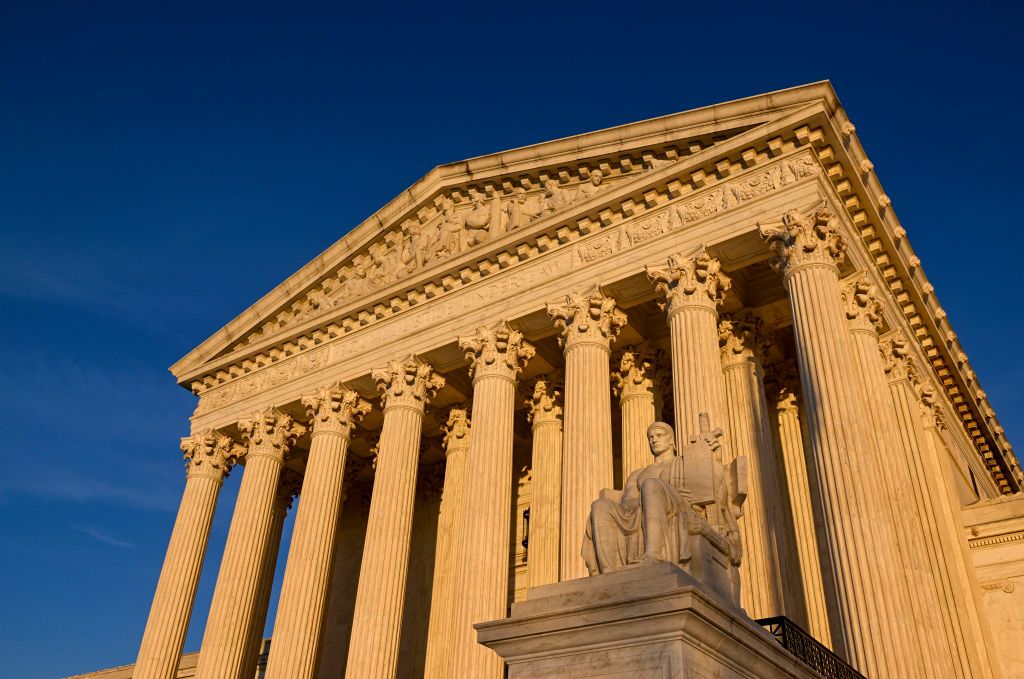

Alabama has asked the court on its interim docket to allow it to use a congressional map in this year’s elections that was struck by a lower court as racially discriminatory. Responses to that request are due today by 4 p.m. EDT.

The court has indicated that it may announce opinions on Thursday, June 4, at 10 a.m. EDT. We will be live blogging that morning beginning at 9:30 a.m.

Morning Reads

US to Appeal Judge’s Order for Broad Refund of Trump Tariffs

Laura Curtis, Zoe Tillman, and Erik Larson, Bloomberg (paywalled)

On Friday, the Justice Department filed notice with the Court of International Trade that “it will appeal a judge’s authority to order across-the-board refunds of all tariffs ruled illegal by the US Supreme Court” to the U.S. Court of Appeals for the Federal Circuit, according to Bloomberg. “At the heart of the dispute is whether the judge has authority to order refunds nationwide for all importers who paid tariffs issued under the International Emergency Economic Powers Act, or IEEPA, even if they did not file suit in the trade court. The US has suggested that the government need only refund importers who sue, and that the judge’s order is effectively a nationwide injunction that is barred by a recent Supreme Court ruling in the fight over birthright citizenship.” Bloomberg noted that Trump administration’s appeal could “inject[] legal chaos into a claims process that’s already underway.”

There are no Supreme Court vacancies, but some judges are acting like there might be

Julian Mark, The Washington Post (paywalled)

Although sources close to Justice Samuel Alito have said he will not retire this year, “a growing number of firebrand conservative judges” appear to be intentionally seeking the national spotlight, potentially to increase their odds of being picked by President Donald Trump to fill a Supreme Court vacancy if one opens up, according to The Washington Post. These judges are “making a splash through their opinions, as well as their statements off the bench,” such as by writing “‘[t]his is a case about swinging dicks’” in case concerning “a female-only nude spa in the Seattle area whose owners refused service to transgender women with male genitalia” or stating in dissent that judges “‘don’t get to demand the President’s homework’” in “a decision invalidating Trump’s use of the 1798 Alien Enemies Act to send Venezuelan immigrants whom the president accused of being gang members to prison in El Salvador.” “Trump, and the people around Trump, are going to try to look for people that they have more confidence in even than the previous set of nominees, and that is going to require some kind of further signals of loyalty to the agenda,” said Daniel Epps, a law professor at Washington University, to The Washington Post. “That just increases the incentives to audition as much as possible.”

Louisiana passes new congressional map, dismantling one majority-Black district

Jane C. Timm, NBC News

After the Supreme Court ruled in Louisiana v. Callais on April 29 that Louisiana’s “existing congressional map” was an unconstitutional racial gerrymander, “Louisiana delayed its House primaries that were scheduled for May 16 to give state lawmakers time to redraw congressional maps there,” according to NBC News. On Friday, lawmakers finished that process, approving a new map “eliminating one of the state’s two majority-Black districts and drawing an additional Republican-leaning district in its place.” NBC news noted that the “map is likely the last one implemented by a state legislature ahead of the 2026 election, as primary season is well underway across the country.”

Federal judge upholds constitutionality of nitrogen gas executions

Kim Chandler, Associated Press

U.S. District Judge Emily C. Marks on Thursday “ruled that execution by nitrogen gas does not violate the constitutional ban on cruel and unusual punishment, rejecting an Alabama inmate’s claim that it causes excessive suffering,” according to the Associated Press. “The ruling came after the first bench trial in the country to examine the constitutionality of the execution method that has now been used to put eight people to death. ... Inmates executed by nitrogen gas have displayed various levels of shaking during the executions, and lawyers for the state and inmates have disagreed on whether those are involuntary or a sign of suffering.” In her ruling, Marks noted that the inmate, Jeffery Lee, “faced a high legal bar because the U.S. Supreme Court has yet to find a state’s method of execution qualifies as cruel and unusual.”

The battles continue for Casey Martin, decades after Supreme Court case

Mark Schlabach, ESPN

ESPN profiled Casey Martin to mark the 25th anniversary of his Supreme Court win. In 2001, the Supreme Court ruled 7-2 in favor of Martin, a professional golfer who was born “with a rare and degenerative birth defect called Klippel-Trenaunay-Weber Syndrome,” which “affects the circulatory system in his leg.” Martin had challenged the PGA Tour’s refusal to allow him to use a cart during golf tournaments, contending that the tour was violating the Americans with Disabilities Act. As a result of the court’s ruling, “Martin was free to ride a cart in PGA Tour events.” Since 2006, Martin has served as golf coach at the University of Oregon and found success in that role, but he’s been struggling in recent years with new health challenges and “isn’t sure how much longer he can coach the Ducks.”

On Site

Opinion Analysis

Justices validate arbitration exemption for “last-mile” drivers

Justices validate arbitration exemption for “last-mile” drivers

Thursday’s decision in Flowers Foods v. Brock held that an exemption from the Federal Arbitration Act for interstate transportation workers extends to “last-mile” drivers who don’t themselves cross state lines, even though the goods they are delivering are on an interstate journey. That holding protects them from the FAA’s requirement that they litigate disputes with their employers in arbitration as opposed to before a court.

Contributor Corner

The Supreme Court’s common sense problem

The Supreme Court’s common sense problem

In a Controlling Opinions column, Richard Re and Will Baude explored the rise of “common sense” reasoning at the Supreme Court – that is, reliance on common sense inferences rather than other sources of authority, such as the plain meaning of a statutory text. They contended that this approach is problematic. “Even if judges should indeed have a good measure of common sense, and should use it sometimes, it has gone too far.”

Podcasts

Advisory Opinions

District Map Fights Before the 2026 Midterms

David Lat joined Sarah Isgur to discuss the three-judge panel overturning Alabama’s congressional maps, a new lawsuit against President Donald Trump’s slush fund, and a lying judge.

A Closer Look

How SCOTUSblog Live Blogs Supreme Court Opinions

As we enter the heart of opinion season, we thought it would be helpful to revisit past Closer Looks on how SCOTUSblog covers opinion announcements. This piece was originally published on Feb. 4.

One question we often get at SCOTUSblog is how in the world we live blog the announcement of Supreme Court opinions when electronic devices are prohibited in the courtroom.

Before answering that, let’s back up a bit. On days when the court announces opinions, the action is divided between two different venues. The main event is in the courtroom, where justices enter to the traditional “Oyez!” cry from the court’s marshal, Gail Curley. Once the justices are seated, Chief Justice John Roberts indicates that “Justice [X] has our opinion in [No.-XX, case name].” That justice then reads a summary of the decision, which can range in length from quite short (especially if Justice Samuel Alito is doing the reading – for example, as in 2024’s Brown v. United States) to fairly long, as often happens in high-profile cases such as Trump v. United States, in which Roberts’ summary of the majority opinion took nearly 14 minutes.

If there are concurring or dissenting opinions, a justice may also opt to read from his or her separate opinion. That said, this is relatively rare and typically a sign that the reading justice sees the case as extremely important or believes the majority has gone terribly astray. For example, in her 2024 dissent from the majority opinion in Loper Bright Enterprises v. Raimondo, which overturned the Chevron doctrine, Justice Elena Kagan said the majority put courts at the “apex of the administrative process” and that overruling Chevron threatens “a massive shock to the system.”

If there is more than one opinion, the court typically announces its opinions in order of reverse seniority, with the chief justice, who is always the most senior justice, going last. Once the first opinion announcement is complete, Roberts indicates who has the next opinion. He repeats this process until all of the day’s opinions have been released. At that point, the court moves on to any further proceedings for the day (like admitting new lawyers to the Supreme Court bar or scheduled oral arguments) before the marshal gavels the session to a close.

Now back to our original question. While all of this is occurring, some reporters choose to sit in the courtroom for the opinion announcements. Because, as noted, electronic devices are prohibited in the courtroom, they can only bring in a blank pad of paper and pens and must frantically scribble down anything they hear.

But other reporters – including Amy – gather on the first floor of the court building, in the court’s press room, immediately adjacent to the court’s Public Information Office. Shortly before 10 a.m. EDT, the reporters gather in the Public Information Office, where the opinions are waiting in boxes to be distributed. (The boxes give us a rough idea of how many opinions we can expect for the day.)

As the opinion announcements begin, audio from the courtroom is projected into the PIO. Once the chief justice indicates that a particular justice has the opinion in a particular case, the staff in the PIO begin to distribute the opinions to the waiting reporters from two desks. Once Amy has her paper copy of the opinion, she returns to her desk in the next room, where she determines how the court has ruled and types the result into the platform that we use for our live blog. While this is occurring, Amy also can hear (although not very clearly) the audio of the opinion announcement in the next room. When it sounds like the author is almost finished reading his or her summary of the opinion, Amy then returns to the PIO to wait for the next opinion – assuming there is one. And on it goes, until opinion announcements for the day come to a close.

SCOTUS Quote

JUSTICE SOTOMAYOR: “Mr. Katyal, assuming the incredulity of my colleagues continues with your argument, which way would you rather lose?”

Kansas v. Cheever (2013)

Need Support?

Find verified resources for reproductive healthcare, support services, and advocacy organizations.

Find Resources