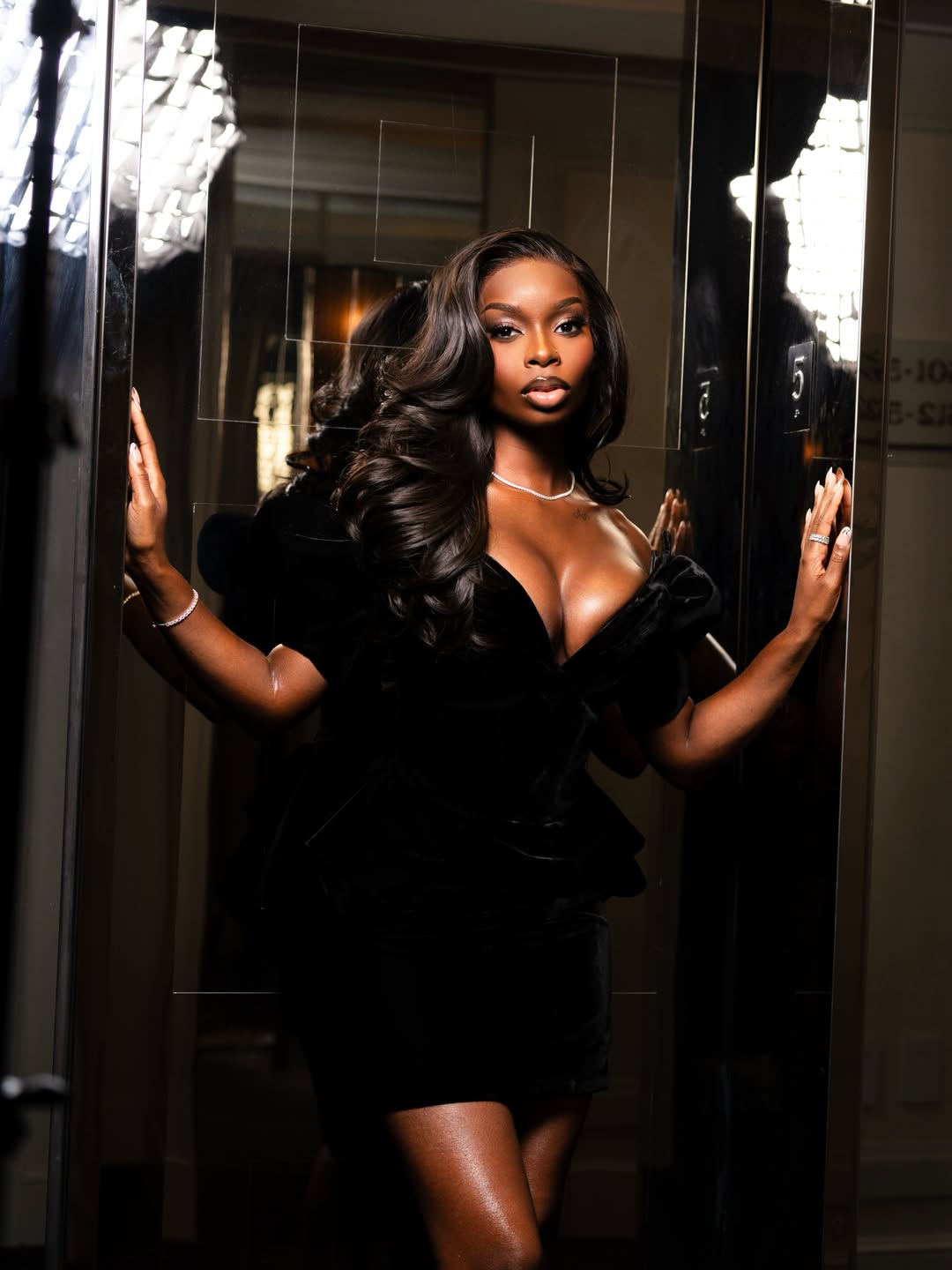
Ashley Etienne has spent her career inside the most consequential rooms in American politics. Now she’s seated at one of its most visible tables. The veteran communications strategist recently joined NBC News as a political contributor, making her debut on Meet the Press with Kristen Welker, and marking the first time in the show’s history that two Black women have held central roles on the broadcast: one as host, one as contributing analyst.
For Etienne, the milestone carries the weight of a full-circle moment. “It’s incredibly humbling. It still gives me chills through my body, because I remember being a young politico and coming to D.C. and obsessing over Meet the Press,” she says. “I never anticipated working for presidents, or a speaker, or impeaching a president, and now I’m on the most iconic political show in American history.”
Her seat at that table was decades in the making. Etienne, CEO of Etienne & Saint, a communications, marketing, and digital strategy firm, has worked with Presidents Barack Obama and Joe Biden, and been a trusted adviser as communications director for Vice President Kamala Harris and Speaker Nancy Pelosi. For more than 15 years, she has executed high-stakes communications strategies on issues ranging from national security to domestic policy. As Communications Director for Vice President Harris, she directed the team that secured Time Magazine’s Person of the Year cover. During the impeachment and trial of President Trump, she led communications, legal, and legislative strategy for Speaker Pelosi, running the operation Vanity Fair would later memorialize by crowning her the “queen of the war room.”
She describes that impeachment work as “the culmination of everything I had done. When I look back on my career, everything was preparing me for that moment.” Yet when the “queen of the war room” title came about, her first instinct was not to celebrate it. “When I first read it, I was embarrassed. And it kind of still makes me a little embarrassed, but I earned it,” she says.

That tension, between the magnitude of her accomplishments and her comfort claiming them publicly, sits at the center of this new chapter. After years of building power for some of the most prominent figures in American politics, Etienne is now front and center on camera. “Part of my challenge is I’ve transitioned from out of the shadows of these really big figures to stepping into my own light. I have to embrace that power,” she says.
The significance of her arrival extends well beyond her own career. “It’s the only show where you have two Black women at that table, her leading it and me being a part of it,” Etienne says of herself and Welker. “And what I think it speaks to is the fact that we’re ready. It’s our moment.”
The timing makes the image all the more striking. “Both of us are in these positions at the moment in which Black women are under severe attack in a way that we’ve never seen before in our lifetime,” she says. “To me, it’s a powerful statement to have both of us at that table.”
Etienne wasted no time putting the platform to use. In her debut, she helped open a broader conversation about the DNC autopsy report, pressing on when it would be released and what it still needs to answer. Her position is unambiguous: given what is at stake and what has already been lost politically and economically, Black voters are owed transparency around how the money was spent, who benefited, and what Democrats intend to change moving forward. “Black voters in particular need to become more transactional,” she says, citing her former boss, Vice President Kamala Harris.
It’s the kind of accountability she believes Sunday-morning political television has lacked, in part because the people most affected have rarely had a voice in those conversations. Etienne sees her role as a chance to change that, bringing long-ignored perspectives into a much larger political conversation. The conviction is not new. It has anchored her at every stage of her career, through every room she fought her way into. “I understood that I was in those rooms for a reason, that God opened those doors to me, and because of that, I had an obligation to weather the storm,” she says.
Now those rooms include millions of living rooms on Sunday mornings, and Etienne is clear about what her visibility signals to Black women across the country. “No one can carry and deliver on that burden like Black women. We are the strongest people on Earth, the most resilient people on Earth, the most loving and caring and compassionate people on Earth,” she says. “That’s why I think it’s important in this moment, because it affirms the notion that, again, we can do anything, and that we’ve got this power in our gut to handle any situation, any war room.”
After a career spent crafting a message for others, Ashley Etienne is finally delivering her own. “It’s coming into my own power and realizing that anything is possible with effort,” she says, “and with God.” On Sunday mornings, from one of the most influential tables in American media, that power is now on full display.