It’s hard to put into words what Earth, Wind & Fire means to me. I was first introduced to their music on a rainy Saturday morning in New Orleans—I was helping my mother rearrange some of the old vinyl records that sat in our living room. Similar to most Black families, the Soul sounds of the 1970s and 80s served as the backdrop to a home in need of a bit of tidying up. Anita Baker, Marvin Gaye, Ben Vereen; all of which got burn in the Jones household, but it was something about the frequency of “That’s the Way of the World” that really caught my attention. I was about 9 years old at the time, and I still remember my reaction to the title track from the album many consider the group’s magnum opus. Following the song’s 30-second instrumental introduction and the lyrics, “Hearts afire, creates love desire / Take you high and higher to the world you belong,” I felt completely transported. From that moment on, I was hooked.
“Is this your first time hearing Earth, Wind & Fire?” my mother asked me at the time. “Boy, have I got some things for you to hear.”
That conversation nearly three decades ago sparked a journey that I’m still on today. Before long, I had worked my way through albums like Head to the Sky, Spirit, All ’N All, I Am, and Raise!, each one revealing something different about the group’s brilliance. So, of course, I was excited when I learned that the good brother Ahmir “Questlove” Thompson would be turning his attention to the band in the new HBO documentary Earth, Wind & Fire (To Be Celestial vs. That’s the Weight of the World). Following the critical acclaim of Summer of Soul and Sly Lives! (aka The Burden of Black Genius), Questlove now examines the story of one of the most important groups in American music.
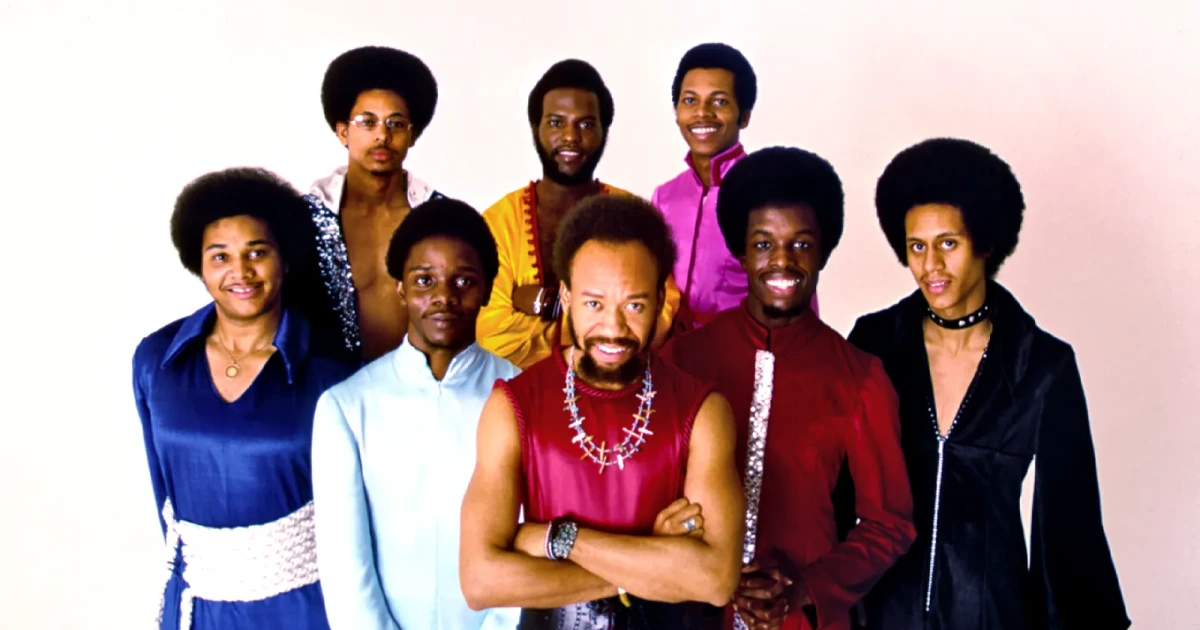
“This is a band who knows how to deal in the darkest times in post-modern history,” Questlove told me during our call. “That’s what I want people to learn from this film.” Through archival footage, interviews with band members, family, friends, and admirers, the film traces the group’s rise from Maurice White’s early years to their emergence as global icons. It also explores the philosophy behind the music, the challenges that came with sustaining success, and the legacy of a band who many consider to be the greatest to ever do it.
For three of the group’s original members—Verdine White, Ralph Johnson, and Philip Bailey, to be specific—Thompson was the perfect person to take on the task of telling the full story of The Elements. “Quest is a music historian,” Johnson says. “He’s also an incredible musician. His mind is very astute, and he’s a critical thinker. Watching the other documentaries that he’s worked on, they have a rhythm to them and they have depth, and he’s also a fan. So you can’t really do any better than that.”
In my opinion, one of the most remarkable things about the group was their willingness to take risks. Few bands were as committed to pushing their sound forward. (This is with all due respect to collectives such as Parliament and Funkadelic, of course.) Members arrived with different musical backgrounds and experiences, but together they developed a style that was distinctly their own. They drew inspiration from jazz, funk, soul, gospel, African rhythms, and pop, and never sounded confined by any one genre.
“We were big fans of the music that’s come before us, the artists that have come before us,” Bailey said. “We copied and mimicked them and then we were able to fuse those elements together. Maurice’s concept, his creativity was just so on point because when I first heard his first experiment with Earth Wind & Fire, it was something new. It was something that I hadn’t heard before and you couldn’t put a face on it.”
When Bailey references Maurice White, the group’s longtime leader, I notice a reverent smile spread across Verdine White’s face. Verdine, who is Maurice’s younger brother, was able to experience his older sibling’s creativity up close, watching many of the early ideas that molded Earth, Wind & Fire take shape in real time. More than anything, Earth, Wind & Fire (To Be Celestial vs. That’s the Weight of the World) also serves as an ode to Maurice White, nearly a decade after his passing, highlighting the vision that fueled the band and the legacy he left behind.
“I think it’s really important for the generation that never saw Maurice to see the work and see the idea and to see his role and his mission to make great music,” Verdine tells me. “And of course, people that have seen this before, it’ll get a chance to revisit Maurice and revisit the work that he did. And for us, I know for myself personally, it just makes me feel so great that he’s actually getting his just due as an artist, as a creator and as a humanitarian.”
Before our conversation concluded, I began thinking about just how much Earth, Wind & Fire has accomplished over the years. Multiple Grammy Awards. A Grammy Lifetime Achievement Award. Induction into the Rock & Roll Hall of Fame. A star on the Hollywood Walk of Fame. Most artists would spend a lifetime chasing even one of those achievements. Naturally, I asked them if there was anything left on the band’s bucket list.
“There’s nothing for me that comes to mind,” Johnson says with a laugh. “Being with Earth, Wind & Fire for over 50 years, there’s not too much left for me to do, unless I go for a ride with the Blue Angels.” Bailey quickly chimes in.
“At 75 years old, we’re living the dream,” he says. “We’re healthy. We’re strong. We’re still out there doing what we love to do on a very high level. We’re selling out everywhere that we go. We’re flying in planes and living in first class and stuff. We’re making good money. We’re thankful.”
Johnson nods in agreement before adding, “Yes. Amen. The attitude of gratitude.”Earth, Wind & Fire (To Be Celestial vs. That’s the Weight of the World) premieres June 7 at 9pm ET on HBO Max.