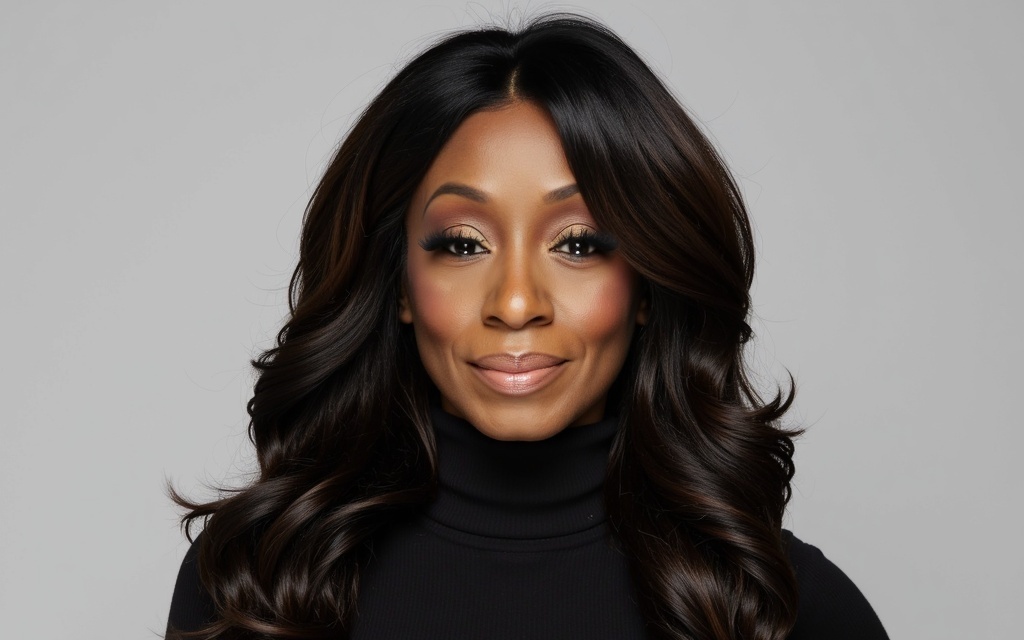
ATLANTA — Kecia Ellick doesn’t see herself as having much in common with Keisha Lance Bottoms, beyond them both being Black women in their 50s who are mothers and neighbors — and having names that sound the same.
Ellick is a laid-off public health researcher trying to rebuild her career. Bottoms is a former Atlanta mayor and the Georgia Democratic gubernatorial nominee, running to become the first Black woman governor in America.

But Ellick does recognize something familiar in Bottoms’ candidacy: the experience of being a high-achieving, highly qualified Black woman whose accomplishments and capability are dismissed or diminished.
It’s part of the reason Kecia is voting for Keisha in November.
Ellick said she sees her vote as a way to prove people wrong, to send a message about who Black women are and what they can accomplish. It’s also a way for them to “use the bit of power that we have left,” she said.
Among President Donald Trump’s first acts when he returned to the White House in 2025 was a national assault on diversity, equity and inclusion (DEI). Ellick is among at least 300,000 Black women who have lost jobs in the wake of that move.
Black women were the group of voters who most strongly rejected Trump in the 2024 election; they’re also the voters who have most consistently done the work of expanding and protecting democracy. Though Trump won’t be on the ballot again, their experience in his second term could galvanize and reengage these Black women to show up at the polls in even greater numbers, in the midterms and beyond.
At 19, Ellick was already a married mother of three.
She moved to Atlanta from Chicago at 25 and ended her marriage four years later. Looking around Atlanta, she saw high-achieving Black women and felt empowered to pursue her own dreams.
“Everyone had a dream, and everyone was doing something, and I was like, OK, I wanted to catch up,” Ellick said. “Especially Black women, they were progressive and doing their own thing and stepping out on faith and trying different things, and that was exciting for me.”
At 30, as her only son and oldest child headed to college, she decided to do the same, determined not to let him become the first in the family to earn a degree. She beat him to a bachelor’s degree and kept going; Ellick earned her master’s, and at 45, in the middle of a pandemic, she earned her Ph.D. in family science.
There was professional success along the way, too. Before going back to school, she’d always considered herself to have had “good jobs,” working in the medical and insurance fields. But as she got her degrees, she began to build a career. When she got a role researching opioid use among pregnant and postpartum patients at the CDC Foundation — an independent nonprofit that supports the work of the federal Centers for Disease Control and Prevention — she felt like she had made it.
“That was the first time where I felt like I made grown-up money, the highest salary I’d had at the time, and it felt good because I felt like I was doing important work,” Ellick recalled.
From there, Ellick was hired in 2022 at a Black-owned firm that relied heavily on federal grants to research and evaluate public health issues from substance abuse to maternal health — much of which addressed racial and gender disparities. Her salary doubled, the role was remote, and it was work she found gratifying.
Two years into her job, Trump was elected president. Within days of taking office, he signed executive orders restricting diversity, equity and inclusion efforts. Federal contractors were ordered to exclude programs addressing race, gender and sexuality — the very issues Ellick and her colleagues were working on.
Almost immediately Ellick went from being a full-time employee to having her hours reduced to five to 10 hours a week. Reports she wrote couldn’t include words like “bias,” “discrimination” or “women.” She remembers much of 2025 as “a rough and confusing time.”
“It made it very hard to do the job, because it made it difficult to be honest about the work we were doing,” Ellick said. “It almost minimizes the role that structural or social determinants of health may place on different groups of people.”
In October, Ellick was laid off, losing her income and healthcare benefits. She has been out of full-time work since but has picked up part-time and contracting jobs.
“It feels horrible,” Ellick said. “I didn’t tell a lot of people at first. I felt like I finally made it to a place where I felt equal amongst my circle. I was able to buy my house, take care of my family differently, and then for that to so easily be threatened to be taken away from me … maybe I just didn’t want to deal with it, hoping this will pass quickly.”
Black women have long seen education as an equalizer that has been key for them to unlock the American Dream. Now, a presidency and administration hostile to people of color and women has created uncertainty around the possibilities of success.
The anti-DEI backlash changed the terms of the bargain Ellick and others had long believed in, showing how quickly and easily gains that felt permanent could be reversed.
“I had done all the things I was supposed to do,” Ellick said. “I got the degree, I developed an expertise in my field. I’m really good at what I do.”
With the stroke of a pen, none of that mattered.
Voting for Bottoms is a way for Ellick to make her voice heard on her priorities, issues tied to the work she has done around reproductive rights, abortion rights, maternal care and maternal mortality. She’s also a strong proponent of public schools and wants Bottoms to push for more funding.
Ellick is a relatively new homeowner, so the issue of affordable housing is another priority — specifically making sure Black women who are the heads of their households like she is will still have a path to buying a home.
Bottoms bucked expectations in May when she won the Georgia gubernatorial primary outright, avoiding a runoff, fending off her four main challengers and capturing nearly 57 percent of the vote. Her Republican opponent in November, Rick Jackson, spent more than $50 million in the primary, which he won in a runoff election last month. Bottoms has raised less than $3 million in her race and is seeking to accomplish something no Black woman in the country has ever done.
On the campaign trail, Bottoms is championing many of the issues Ellick cares about, including maternal health, Medicaid expansion and lowering costs for patients — support for public schools, universal pre-K and affordable housing.
On his first full day in office, Trump claimed he “fired” Bottoms from her role in President Joe Biden’s administration in a Truth Social post. But Bottoms had already submitted her resignation to Biden on January 4, 2025, 16 days earlier.
Though they’re on very different paths, both Bottoms and Ellick are facing uphill battles as they look for their next wins.
Most days, Ellick is in her home office, searching for contract work or a new job in her field. She has scrubbed her résumé of references to DEI in an effort to improve her chances of being hired. Ellick also teaches as an adjunct professor. Her parents, who live with her and whom she takes care of, still have no idea she has lost her job. If they found out, it would only add to the stress and frustration of knowing that she cannot fully do the work she loves because of a political decision.
Over the past several months, Ellick has leaned on friends for support. It has helped her stay positive and not give in to anger about what has happened to her and, as she has learned, thousands of Black women across the country.
The experience has also made Ellick think more deeply about what voting — something she has done since she turned 18 — means to her. She’s looking more closely at candidates and where they stand on the issues that could directly affect her.
“I remember at one point in my life, I was more focused on local politics than I was on who was in the White House because I felt like, ‘That’s not going to impact me directly.’ This is the first time in my life where it was a direct and immediate impact. It feels like an attack,” Ellick said.
As part of her work, Ellick goes into communities and tries to get people to use their voices to make a difference. Now, she sees her vote as a way she and others can show that their representation matters.
“There’s an automatic lack of respect, low expectations, without any real rationale,” Ellick said about how Black women are often perceived.
“This is how everyone always feels about us, even when we prove them wrong, it’s still going to be the same attitude, the same low expectation, even though we always exceed expectations,” Ellick said, adding that voting is “something that we have control of right now, the way we choose to use it and exert it.”
This fall, Kecia’s vote for Keisha is as much about her own representation as the candidate she’s casting her ballot for. It won’t bring her job back, but it’s a way for her to say she still matters.