Michelle Buteau Brings ESSENCE Into Final Season Of ‘Survival Of The Thickest’

On July 2nd, Survival of the Thickest released its third and final season on Netflix, and the show is definitely closing out on a fashionably high note. This season, Mavis truly steps into her own, on her own terms, and has some major career breakthroughs.
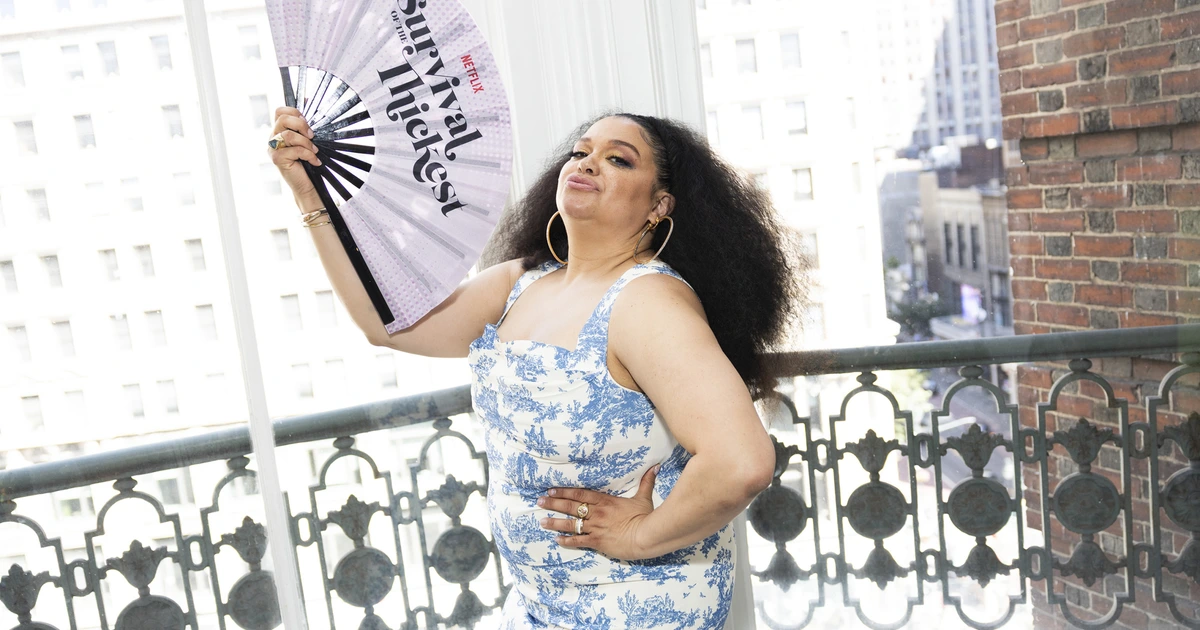
Michelle Buteau Brings ESSENCE Into Final Season Of ‘Survival Of The Thickest’

On July 2nd, Survival of the Thickest released its third and final season on Netflix, and the show is definitely closing out on a fashionably high note. This season, Mavis truly steps into her own, on her own terms, and has some major career breakthroughs. As a classic and trendsetting publication, ESSENCE has played a key role throughout the show. In Season 3, viewers will see Mavis (Michelle Buteau) execute a major cover shoot alongside the extremely talented designers and stylists LaQuan Smith and Charles Elliott Harbison, who will be appearing as themselves. In one of the most important scenes in the final series, both Mavis and ESSENCE magazine take center stage. This season’s cast is stellar, with some new yet familiar faces that viewers will recognize. 
In addition to Buteau, the full season 3 cast includes Tone Bell (Trigger Warning, Coyote vs. Acme), Marouane Zotti (I May Destroy You, Bodkin), and shifting to series regular Liza Treyger (Liza Treyger: Night Owl), Peppermint (Harlem), Alecsys Proctor-Turner, RonReaco Lee (Fight Night, Friends and Lovers), Garcelle Beauvais (Black Girl Missing, Spider-Man: Homecoming), Wanda Sykes (The Upshaws, Please & Thank You tour), D.L. Hughley (The D.L. Hughley Show), Ashley Graham (Chicago on Broadway), Ronny Chieng (The Daily Show), Ice-T (Law & Order: SVU), Jenna Lyons (designer and creative entrepreneur), LaQuan Smith (designer), Charles Harbison (designer), Ashley Romans (Y: The Last Man, The Pitt), Wyatt Cenac (Problem Areas, Medicine for Melancholy), Anthony Michael Lopez (Broad City, Mapplethorpe), and Kandi Burruss.

On a set visit this past winter, ESSENCE had the opportunity to speak with Buteau, the show’s lead, and Amy Aniobi, the showrunner and executive producer. Buteau and Aniobi candidly shared some of the major themes present this season: the freedom that comes with having autonomy over how stories are written about Black women and marginalized communities, and the positive affirmation that can come from seeing inspirational representation. With the television show being based on stories from Survival of the Thickest: Essays, Buteau shared that many parts of the show are autobiographical and that many scenes were written from a place of necessity. 

“As a young Black woman, looking at ESSENCE covers was really the only thing that I had [in terms of representation that she felt she could identify with]. It was Essence and like two or three sitcoms. And I was really hungry for diversity, representation, and conversations about Black Hollywood and what Black Music royalty sounded like and what they did. There wasn’t a lot of space, and late-night talk shows that talked about the lives of Black people. So, I always loved ESSENCE as a beacon and touchpoint [on Black life].”

On centering ESSENCE as a classic publication, Aniobi chimed in, “When Danielle Sanchez-Witzel and Michelle Buteau co-created the show and decided that Mavis was going to be a stylist, it felt very important that that character was centered in her community. We, as Black people, care so much about our culture accepting us, and we wanted to put a shine on Black journalism and legacy media, because everyone knows that journalism is dying. Absolutely. But there’s so much that we can do as a medium that is progressive. And with a voice like Michelle’s to center the publications that mattered to us growing up, ESSENCE magazine was definitely one of those.”

This is a full-circle moment for Buteau to have written her reality and include the ESSENCE publication as a main highlight. “I was featured in ESSENCE 10 years ago in a piece about six female comedians doing something. And it was like the littlest square in the back of the magazine that I was so proud to be in. The person who styled me for that was Wouri Vice, and I hadn’t seen him since. So, when we were doing this storyline, I’m like, I know exactly who I want to be on the cover with me. I love that because he has been out in the trenches for all types of body sizes. Before plus size was even a thing, which was great.”

Similarly, Buteau is intentional about how she uses the medium of storytelling to archive culture, spotlighting legacy media, and not waiting for someone else to create opportunities for her. On the night of the set visit, it felt like walking through a Black Hall of Fame, as magazine covers (with beautiful Black faces on the cover) lined the festive walls of the room, which was decorated in beautiful shades of pink, lavender, and purple. The scene was a pinnacle of the season and showcases both the power of journalism (and the significance of upholding culture and standards) and the good impact that the media can have. Buteau shared, “I mean, if we don’t do it, who will?”

When thinking about the responsibility that comes along with storytelling and visual representation, Aniobi did not hesitate to share that it all begins in the writer’s room. “This season, we have an all-Black writers’ room, which is almost unheard of. It wasn’t on purpose, but we were intentional in choosing the voices that most closely matched the show and Michelle’s voice. And here’s the thing—I’ve always said this as a writer, but more importantly, as a Black writer, whenever a showrunner hires a Black writer, they’re getting two writers in one, because any Black writer in Hollywood has to move through white spaces to get their job. And they know how to speak culturally, and they know how to speak from a cultural perspective. So, it’s like every one of our writers is a heavy hitter just by default of where they’ve reached in their career and being Black at that. So we have, for the first time I’ve ever been involved in an all-black room, that’s not just writing for Black voices; we’re writing for trans voices, for other people of color, for plus-sized people, for white people.” 

For those who have been following the show since the first season, you will notice that many of the episodes highlight empowering others in their self-confidence, showcase the benefits of not neglecting one’s mental health (the storyline of Tone Bell’s Khalil) is a very healthy representation for addressing Black men and the stigma around therapy and to see his growth, and the strong messaging around loving one’s body no matter the size. Mavis, as a stylist, often quips throughout the series that ‘I just want to dress women and help them to love their bodies,’ and it’s pretty clear that for Buteau, the body positivity showcased throughout the series is a love song not just to marginalized people, but also to ‘marginalized bodies’. “This [the show] is absolutely like a rom-com to love your body. Like, no matter what size, shade, or shape you are. Being a stylist on the show, obviously, I get to wear fly clothes, which is amazing. But the bigger picture is the discrepancies in fashion, in and around fat phobia, or even what it means to label others. So, the bigger conversation is honestly the patriarchy.”

Aniobi makes it clear that Black experiences are not a monolith, and having that understanding definitely impacts each storyline. “Our [writer’s] room, in its own way, embodies so many connective points to those identities that we are still able to write like a fully baked-in show featuring people who are different. We had five Black women in our room and five different accents represented. Like a girl from Philly, DC, New York, Texas, and a girl from Uganda. And for us to be able to share our voices means that we are sharing the world. We are the center of culture. So I celebrate Black creatives and Black writers, because we are pushing culture forward every time we move a pen to paper.”

Buteau added, “How do we dismantle some [of the labels] and just be happy for each other, right? How do we walk into a store, and a salesperson says, ‘You belong here; let me help you’? You know, fashion could also be a parallel to health insurance. Why do you have to have money to look nice and feel good? Do you know what I mean? It all means something.” 

Be sure to check out Season 3 of Survival of the Thickest on Netflix, streaming now.

Need Support?

Find verified resources for reproductive healthcare, support services, and advocacy organizations.

Find Resources