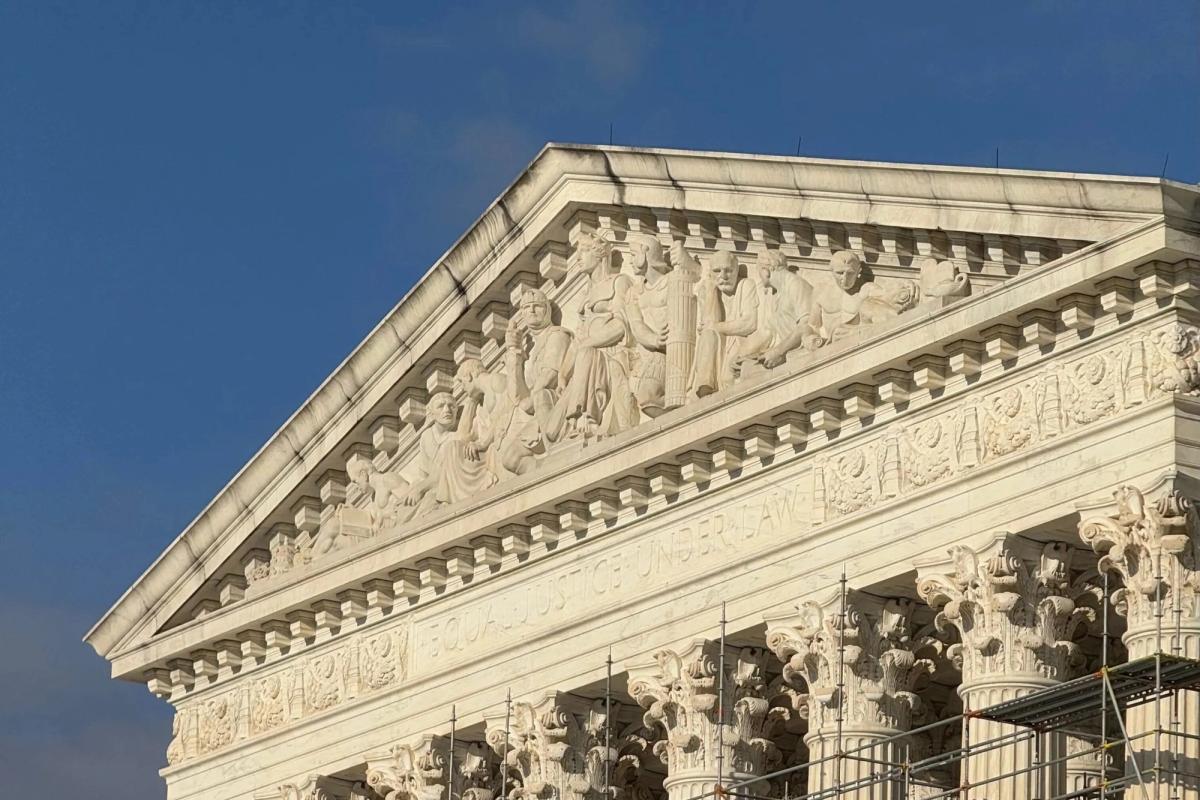
It’s a Thursday in June, and seasoned Supreme Court watchers likely know what that means: We’re expecting opinions this morning. Our opinion day live blog begins at 9:30 a.m. EDT.
At the Court
After the possible announcement of opinions this morning, the justices will meet in a private conference to discuss cases and vote on petitions for review. Orders from that conference are expected on Monday at 9:30 a.m. EDT.

Morning Reads
House Republicans advance constitutional amendment to prevent US Supreme Court expansion
Nate Raymond, Reuters (paywalled)
On Wednesday, a Republican-led House panel "advanced a proposed amendment to the U.S. Constitution that would permanently limit the number of justices on the U.S. Supreme Court to nine, citing the potential for Democrats to someday 'pack the court' if they regain control of Congress," according to Reuters. "The U.S. House Judiciary Committee voted 15-8 along party lines to move forward the proposed constitutional amendment despite long odds that it would ever be finalized.” To pass, the amendment would need the support of two-thirds of the House and Senate, "and 38 states would then need to vote to ratify it."
Trump Begins Rebuilding His Tariff Wall, Citing Forced Labor
Alicia Diaz and Jennifer A Dlouhy, Bloomberg (paywalled)
Late on Tuesday, the Trump administration made its “biggest move” yet toward rebuilding the system of tariffs that was “struck down by the Supreme Court” earlier this year, according to Bloomberg. “Following an investigation into how trade partners handle goods allegedly produced by forced labor, a 10% tariff rate would apply to imports from Canada, Mexico, the European Union, Taiwan and the UK, among other places,” the Office of the U.S. Trade Representative announced. “Products from other major economies, including China, India, Japan, South Korea, Brazil and Switzerland, would be subject to a 12.5% levy.” Bloomberg noted that the “recommended duties are a result of probes launched under a separate legal authority known as Section 301 of the Trade Act of 1974.”
Trump Administration Fights Court Order to Refund Some Tariffs
Tony Romm and Ana Swanson, The New York Times (paywalled)
In an emergency appeal filed late Tuesday night, the Trump administration asked the U.S. Court of Appeals for the Federal Circuit to block an order from the Court of International Trade that would require U.S. Customs and Border Protection Commissioner Rodney S. Scott to offer testimony on the tariff refund process next week, according to The New York Times. Also on Tuesday, the administration filed “a separate notice that it intended to challenge” the trade court’s “order that requires the government to refund the full $166 billion collected from illegal tariffs.” The government has said it will not automatically process refund requests from “businesses whose tariff bills were already paid and finalized” when the Supreme Court issued its ruling and will, instead, wait on those importers to file their own lawsuits seeking the refunds.
Attitudes toward same-sex marriage and transgender issues are shifting, Gallup poll shows
Geoff Mulvihill and Amelia Thomson-DeVeaux, Associated Press
A new Gallup poll shows that “[a]cceptance of same-sex marriage and relationships in the U.S. has flattened after more than two decades of steadily increasing support, with an ongoing decline among Republicans,” according to the Associated Press. The survey, fielded in May, found that around “65% of U.S. adults believe same-sex marriage should be legal, down slightly from 71% in 2022 and 2023.” The AP noted that “[l]awmakers in at least 11 states introduced legislation for their current or most recent sessions calling on a ban on same-sex marriage. ... Most didn’t pick up momentum. But the Tennessee House passed a measure to allow private citizens and organizations not to recognize the unions; Idaho’s House passed a resolution calling on the Supreme Court to undo” its 2015 decision legalizing same-sex marriage nationwide.
This ‘necessary and proper’ ban could almost drive someone to drink
Jarrett Dieterle, The Washington Post
For The Washington Post’s Red Tape newsletter, Jarrett Dieterle explored two recent federal circuit court decisions on the ban on “making moonshine, applejack and other spirits” at home, which “teed up a likely Supreme Court fight over the ban that could shape the boundaries of government power.” The ban in question “stems from a 19th-century push to tax alcohol and tobacco” and prohibits “the distillation of consumable spirits from ‘any still, boiler, or other vessel ... in any dwelling house.’” In the two ongoing federal lawsuits over the 1868 law, the government “claims that the ban is justified as a ‘necessary and proper’ exercise of the government’s taxing power” and also “asserts that the ban is permissible under the Constitution’s commerce clause, which empowers Congress to regulate economic activity ‘among the several states.’” Dieterle contends that these arguments show the government is “drunk on power.”
The Proposed Trump NDA Is Following John Roberts’s Bad Example
Madiba K. Dennie, Talking Points Memo
In a column for Talking Points Memo, Madiba K. Dennie highlighted the Office of Personnel Management’s “draft of a sweeping nondisclosure agreement that the administration hopes to impose on millions of federal workers.” Specifically, Dennie pointed out one of the Trump administration’s justifications for the potential NDA – that the “Supreme Court has a gag rule, too.” Chief Justice John Roberts’ use of NDAs with court employees came to light in a February story from The New York Times. Dennie contended that confidentiality agreements are “inherently in tension with democracy’s demand for transparency.”
On Site
Relist Watch

A random assortment of relists: prolonged detention, confessions of error, small juries, and new rules on habeas
In his Relist Watch column, John Elwood offered an overview of four newly relisted petitions, which cover such topics as the government’s authority to detain certain noncitizens without bond hearings as they await removal proceedings and whether a jury of six satisfies the Sixth Amendment’s guarantee of a jury trial.
Contributor Corner

The two Roberts courts
In his Empirical SCOTUS column, Adam Feldman examined the current makeup of the court and how discussions pitting the six Republican-appointed justices against the three Democratic-appointed ones can distract from “serious disagreement inside the conservative majority.” According to Feldman’s analysis, there are “recurring internal divisions among the court’s conservatives over how far to move, how broadly to write, and how much authority courts should exercise in technically complex disputes.”
SCOTUS Outside Opinions

When and why did complying with the Voting Rights Act become unconstitutional?
In Louisiana v. Callais, the Supreme Court made it more difficult for plaintiffs to prevail on a claim that a map violates Section 2 of the Voting Rights Act, which prohibits racial discrimination in voting. But did it also adopt a new rule for when an electoral map violates the 14th Amendment as a racial gerrymander? Issa Kohler-Hausmann and Kevin Z. Yang wrestled with that question.
Podcasts
Amarica’s Constitution
Rosen on Liberty; Gorsuch on Gorsuch - with Jeffrey Rosen and Justice Neil Gorsuch
Akhil Amar and Andy Lipka interview Jeffrey Rosen, president emeritus of the National Constitution Center and GW law professor, about the mission of his new podcast and his special passion for history, the Constitution, and the American idea. They then introduce the first episode of that podcast, The Blessings of Liberty, featuring a conversation between Rosen and Justice Neil Gorsuch.
A Closer Look
C.S. v. McCrumb
In February 2022, Robert Kerr Elementary School in Durand, Michigan, took part in the “Great Kindness Challenge,” which it marked with kindness-themed activities and dress-up days, including “Hat Day,” on which students could wear a hat of their choosing throughout the school day. C.S., who was then in third grade at Kerr, chose to wear “a black baseball cap featuring a white star, a white image of an AR-style rifle, and the phrase ‘come and take it,’” according to her petition for review, which invites the Supreme Court to revisit under what circumstances public school officials can limit students’ First Amendment rights.
After noticing the gun on C.S.’s hat, the school’s behavioral specialist notified the principal, who determined that the hat violated Kerr’s dress code. School officials contacted C.S.’s parents to ask if they would drop off a different hat. When her parents declined, officials asked C.S. to remove the hat and put it in her locker.
Approximately three months later, C.S.’s family brought a Section 1983 claim against school officials, contending, among other things, that their Hat Day decision violated the First Amendment. Before a federal district court, the officials defended their choice by emphasizing not just the school’s dress code, which prohibits wearing “offensive” clothing, including clothes with violent themes, but also their desire to avoid disruption, particularly among students who had transferred to Kerr after a November 2021 school shooting in a nearby town.
In March 2024, the district court granted school officials’ motion for summary judgment, holding that school administrators did not violate C.S.’s free speech rights by having her remove the hat because removal was “reasonably necessary to avoid disruptions of the teaching and learning process in light of the age of the students and the context of recent experiences.”
Last year, the U.S. Court of Appeals for the 6th Circuit affirmed that decision, emphasizing the limits on student speech articulated by the Supreme Court in 1969’s Tinker v. Des Moines Independent Community School District, which centered on middle and high school students who wore black armbands to school to protest the Vietnam War. Tinker, according to the 6th Circuit, “protects the First Amendment rights of teachers and students in public school as long as their speech does not threaten to substantially disrupt or interfere with school activities.” When confronted with C.S.’s hat, the court concluded, “school officials made a reasonable forecast of substantial disruption to the school’s educational environment.”
In her petition for review at the Supreme Court, C.S. contends that the 6th Circuit’s decision “exposes large and growing cracks in Tinker.” In that 1969 case, C.S. continues, the Supreme Court held “that avoiding ‘discomfort and unpleasantness’ are insufficient grounds for restricting” student speech, and yet “the Sixth Circuit now has recognized such an exception, covering speech that school officials speculate could cause hurt feelings or emotional harm.”
The appellate court’s emphasis on how C.S.’s hat might make her classmates feel is especially problematic, according to C.S., given that school officials did not offer the November 2021 school shooting as an explanation of their decision until after the lawsuit was filed. “The Sixth Circuit has approved the squelching of First Amendment protected rights based on nothing but sheer speculation about the effect C.S.’s hat conceivably could have on other students—assumptions school officials did not voice until months later, and which conveniently dovetail with their personal dislike of guns.”
Initially, school officials waived their right to respond to the petition, but the court requested a response in early March. In that brief, filed last month, the officials counter that C.S. is not asking the court to clarify its holding in Tinker, but instead to “rewrite” it by “requir[ing] school officials to disclose all justifications for restricting student speech at some unknown point pre-lawsuit.” They further argue that the case is an “exceptionally poor vehicle” for addressing students’ free speech rights, in part because of the “unusual” circumstances, which include the nearby school shooting just months before Hat Day.
C.S. v. McCrumb is scheduled to be considered by the justices for the first time at their conference on Thursday.
SCOTUS Quote
MR. CLEMENT: “Well, a couple of things, Justice Sotomayor. I went back to the Tropiano case because it is sort of the progenitor of this whole line of Second Circuit cases, and I noticed two things. One, I noticed it was written by a district court sitting by designation. So I mean, I – I don't mean anything by that other than this is not Marbury. Second, I would say that the second thing I noticed is that the debt –”
JUSTICE SOTOMAYOR: “Oh, I think when I sat as a district court judge, I would have been insulted by that.”
(Laughter.)
MR. CLEMENT: “Well, it's not – it's a good thing you're no longer sitting in that capacity, Your Honor.”
JUSTICE SOTOMAYOR: “Okay. It[] really is, for you.”
— Sekhar v. United States (2013)