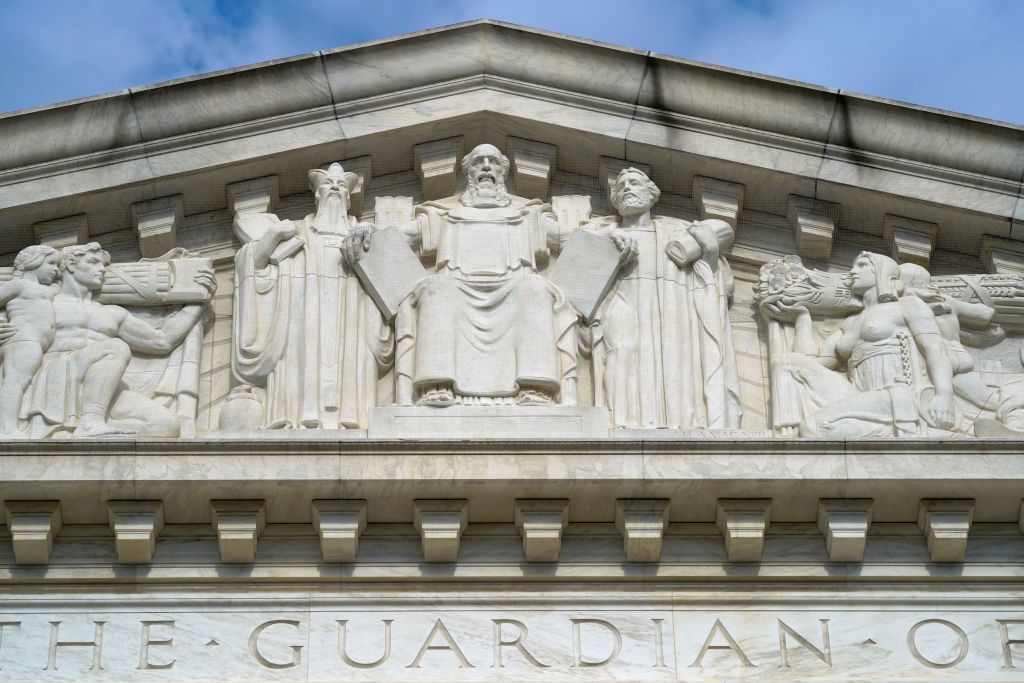
The Supreme Court on Tuesday ruled that Idaho and West Virginia did not discriminate against two transgender athletes who had sued to be allowed to participate in sports alongside other girls and women.
The decision is limited to those two states, though it’s likely to impact similar laws that exist in 25 other states — and experts say the next question is whether future legal cases will force states to ban trans athletes from playing on teams that align with their gender identity.
In Little v. Hecox and West Virginia v. B.P.J the court was tasked with deciding whether the state bans on trans athletes violate Title IX or the equal protection clause of the Constitution.
“The question before the Court is: Under Title IX and the Equal Protection Clause of the Fourteenth Amendment, may schools maintain women’s and girls’ sports for biological females? In other words, may schools determine eligibility for women’s and girls’ sports based on biological sex? The answer is yes,” Justice Brett Kavanaugh wrote for the majority.
The other conservative justices — Chief Justice John Roberts and Justices Samuel Alito, Clarence Thomas, Neil Gorsuch and Amy Coney Barrett — filed concurring opinions. Liberal Justices Sonia Sotomayor, Elena Kagan and Ketanji Brown Jackson filed opinions that agreed with the majority decision that state laws barring trans athletes from competing in line with their gender identity do not violate Title IX, the landmark federal statute prohibiting sex-based discrimination in school sports. But they argued that the majority erred in holding that such laws are not in conflict with the Constitution’s equal protection clause and that Pepper-Jackson should have been able to argue that in lower courts.
“Unjustified sex-based discrimination inflicts ‘injury … to personal dignity’ regardless of the number of individuals affected,” Sotomayor wrote Tuesday, referring to the majority’s view that transgender student-athletes account for only a small portion of the population.

The court’s ruling comes as President Donald Trump’s administration argues Title IX already prohibits transgender athletes from competing on teams that match their gender identity. An executive order to bar transgender athletes from girls’ and women’s sports signed last winter states that doing otherwise denies cisgender female student-athletes equal opportunity to participate in competitive sports, and the Education and Justice Departments have launched dozens of investigations into schools with inclusive policies since the start of Trump’s second administration. The federal government has threatened to pull millions in federal funding from states and schools that permit transgender athletes to participate in female sports.
“The Trump administration is trying to force them to discriminate against transgender students, and saying federal law requires that discrimination. We think that’s dead wrong, and the Supreme Court absolutely did not endorse that argument,” Joshua Block, senior counsel for the ACLU’s LGBTQ & HIV Project, told reporters after Tuesday’s ruling. “In fact, it said that this is a question up to the states.”
Conservatives have long argued that transgender women should be banned from women’s sports because their hormone levels make them faster and stronger, giving them an unfair advantage and making them a safety threat to cisgender women.
Both runner Lindsay Hecox or high school shot-putter Becky Pepper-Jackson represented unique challenges to those stereotypes. Hecox didn’t make her track team at University of Iowa and was participating in club sports when she was barred from playing. Pepper-Jackson was competing with other girls, but transitioned before ever hitting puberty, meaning she was not necessarily hormonally different from other girls in her grade.
Kavanaugh concluded the majority opinion by emphasizing that the student-athletes involved in the West Virginia and Idaho cases, as in most similar disputes across the country, are teenagers or young adults.
“Those student athletes want to play sports. Their desire to compete warrants respect,” he wrote. “No student-athlete on either side of the issue, whether a biological female or transgender, deserves to be ostracized or vilified.”
LGBTQ+ advocacy groups criticized the court’s ruling.
Kelley Robinson, president of the Human Rights Campaign, called the ruling “heartbreaking” for trans student athletes.
“When politicians convince the public that any girl could be ‘the wrong kind of girl,’ they invite harassment, intimidation, invasive questioning, or even an inspection of their body by a total stranger,” Robinson said in a statement.
Jaymes Black, chief executive of the Trevor Project, also condemned the ruling. “These rulings only serve to send a message to transgender and nonbinary young people that says, ‘you don’t belong.’ But these young people do belong, And they deserve the same opportunities as their peers, including participating in school sports.”
While the issue of trans participation in sports has grown increasingly contentious nationwide since 2020, advocates insist that trans athletes make up just a fraction of overall competitors. In 2024, NCAA President Charlie Baker said that trans athletes accounted for “less than 10” of half a million college athletes in the country.
Scientific research on trans participation in sports is limited, but studies so far have not shown any overall physical advantage for trans women over their cisgender peers after medical transition. Still, trans advocates have argued that fixating on physical differences denies transgender women their humanity and defaults to cisgender viewpoints. Sports are not fair for many reasons, including class, geography and natural body strength, they add.