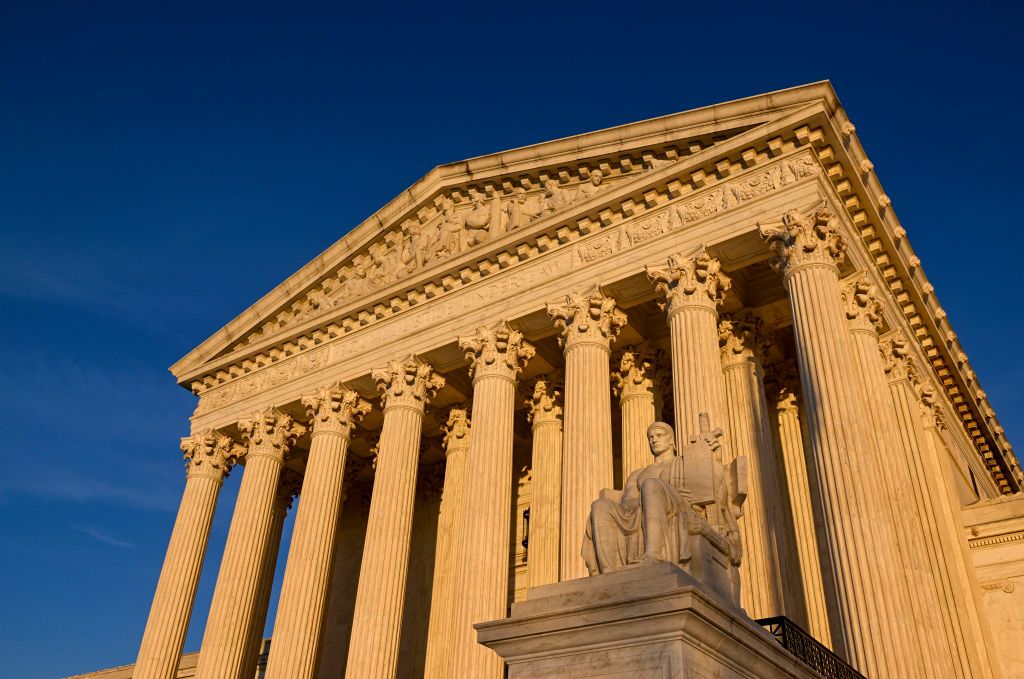
It’s June 1. The official start of hurricane season in the Atlantic, Statehood Day for both Kentucky and Tennessee, and Oscar the Grouch Day. It’s also the beginning of what is likely to be the final month before the justices’ summer recess – or, to put it another way, a 30-day sprint during which the court will issue the final 26 opinions in cases that were argued during the 2025-26 term.
As in other years, these are likely to include some of the highest-profile cases of the term – and indeed, some of the biggest cases of the past few years. The court has already handed President Donald Trump a significant defeat on one of his major policy issues, his effort to impose sweeping tariffs on goods imported into the United States, and (at least after the oral argument) it seemed poised to do so again on another one of the president’s top priorities, ending the guarantee of citizenship to almost everyone born in the United States. But the term is nonetheless shaping up as one in which the president may prove successful on several fronts.
The Supreme Court issued its decision in the tariffs case, Learning Resources v. Trump, on Feb. 20. In a press conference not long after the ruling, Trump criticized the six justices who joined the majority, saying that they should be “absolutely ashamed.” He singled out Justices Neil Gorsuch and Amy Coney Barrett, whom he appointed to the court during his first term, calling them “an embarrassment to their families, to one another.”
Six weeks later, Trump became the first sitting president to attend an oral argument at the court, when he came to hear his solicitor general, D. John Sauer, defend the constitutionality of Trump’s executive order seeking to end birthright citizenship for immigrants who are in the country illegally or temporarily in Trump v. Barbara. In a post on social media last month, Trump stressed what he regards as the high stakes in the case, writing that “[a] negative ruling on Birthright Citizenship, on top of the recent Supreme Court tariff catastrophe, is not Economically sustainable for the United States of America.” But after the oral argument on April 1, at least five – and perhaps as many as seven – justices appeared likely to strike down Trump’s order. Trump himself appeared to acknowledge the prospect that he could lose the birthright citizenship case in remarks last month, saying that the court will “probably rule against me because they seem to like doing that.”
Trump’s effort to fire Lisa Cook, a member of the Federal Reserve’s Board of Governors, seems likely to fail as well. Under federal law, the president can only remove members of the Fed “for cause.” Trump contended that he had good reason to fire Cook, contending that she had committed mortgage fraud before she joined the Fed in 2022.
Cook, who vigorously disputes Trump’s mortgage fraud allegations, went to federal court to try to block her firing, and the lower courts required the Trump administration to allow Cook to stay on the job while her challenge continued. The Trump administration then went to the Supreme Court, which also refused to intervene, leaving Cook at the Fed for now. After nearly two hours of oral argument in Trump v. Cook in January, the justices seemed sympathetic to Cook.
On the other hand, Trump’s firing of Rebecca Slaughter, who until last year served as a member of the Federal Trade Commission, appears likely to stand. The laws governing the FTC bar the president from removing FTC commissioners except in cases of “inefficiency, neglect of duty, or malfeasance in office” – none of which Trump cited when he fired Slaughter in an email last year. Instead, he indicated that allowing her to remain in office would be “inconsistent with [the] Administration’s priorities.”
When Slaughter challenged her firing, a federal trial court directed the administration to reinstate her, and a federal appeals court turned down the government’s request to pause that ruling. The Trump administration then went to the Supreme Court, which granted its request to intervene, clearing the way for the government to remove Slaughter from office while the litigation continues and – because the likelihood that the government would ultimately succeed is one factor that the justices would have considered – signaling sympathy for the Trump administration. Oral argument in Trump v. Slaughter was heard in December.
Trump is also likely to prevail in a challenge to the federal government’s policy of systematically turning back asylum seekers before they can reach the U.S.-Mexico border. When the justices heard oral argument in Mullin v. Al Otro Lado in March, a majority of them appeared to agree with the Trump administration that the policy does not violate a federal law that allows immigrants to apply for asylum when they “arriv[e] in the United States.”
It was less clear, after the oral arguments on April 29 in Mullin v. Doe, whether the Trump administration will succeed in its efforts to strip Haitian and Syrian nationals of protection that they currently enjoy under a federal program that allows foreign citizens to remain in the United States when the federal government believes that it is not safe for them to go home. Last year the Supreme Court twice paused rulings by lower courts that barred the Trump administration from ending designations under the same program, known as the Temporary Protected Status program, for Venezuela.
The court has already issued its rulings in two major cases that did not directly involve the federal government. In Chiles v. Salazar, the court ruled that a Colorado law banning “conversion therapy” – treatment intended to change a client’s sexual orientation or gender identity – for young people discriminates against a licensed counselor based on the views that she expresses in her talk therapy. And in Louisiana v. Callais, the court struck down Louisiana’s congressional map, which the state had created with two majority-Black districts in response to a lower court’s ruling that an earlier map violated the Voting Rights Act, and made it much more difficult for challengers to prevail on a claim that a map dilutes the power of minority voters.
The court is also expected to issue two major decisions on elections and campaigns. Watson v. Republican National Committee concerns a challenge to a Mississippi law that allows mail-in ballots to be counted as long as they are postmarked by, and received within five days of, Election Day. At oral argument, a majority of the justices appeared ready to uphold a lower court’s ruling that federal law requires all ballots to be received by Election Day. And in National Republican Senatorial Campaign Committee v. Federal Election Commission, several justices were sympathetic to the argument, made by the challengers, that a federal law that limits the amount of money that political parties can spend in coordination with a candidate for office violates the First Amendment.
Just under a year ago, the Supreme Court – by a vote of 6-3 – upheld Tennessee’s ban on certain forms of medical treatment for transgender minors. A few weeks later, the justices agreed to weigh in on the legality of two state bans – in Idaho and West Virginia – on the participation by transgender women and girls on women’s and girls’ sports teams. In January, the court heard oral arguments in those cases, Little v. Hecox and West Virginia v. B.P.J., and appeared poised to uphold those laws as well.
Finally, the justices will once again weigh in on the scope of the Second Amendment’s right to bear arms. In Wolford v. Lopez, the court is considering – and a solid majority of the court appeared skeptical of – a Hawaii law that bars licensed gun owners from bringing their guns onto private property unless they have explicit permission from the property owner to do so. The federal government supported the Maui gun owners challenging the Hawaii law. But it seemed unlikely to fare as well in United States v. Hemani, a challenge by a Texas man to a federal law that makes it a crime for users of illegal drugs to have a gun.
Decisions in all of these cases are expected by the end of June or (at the very latest) early July.