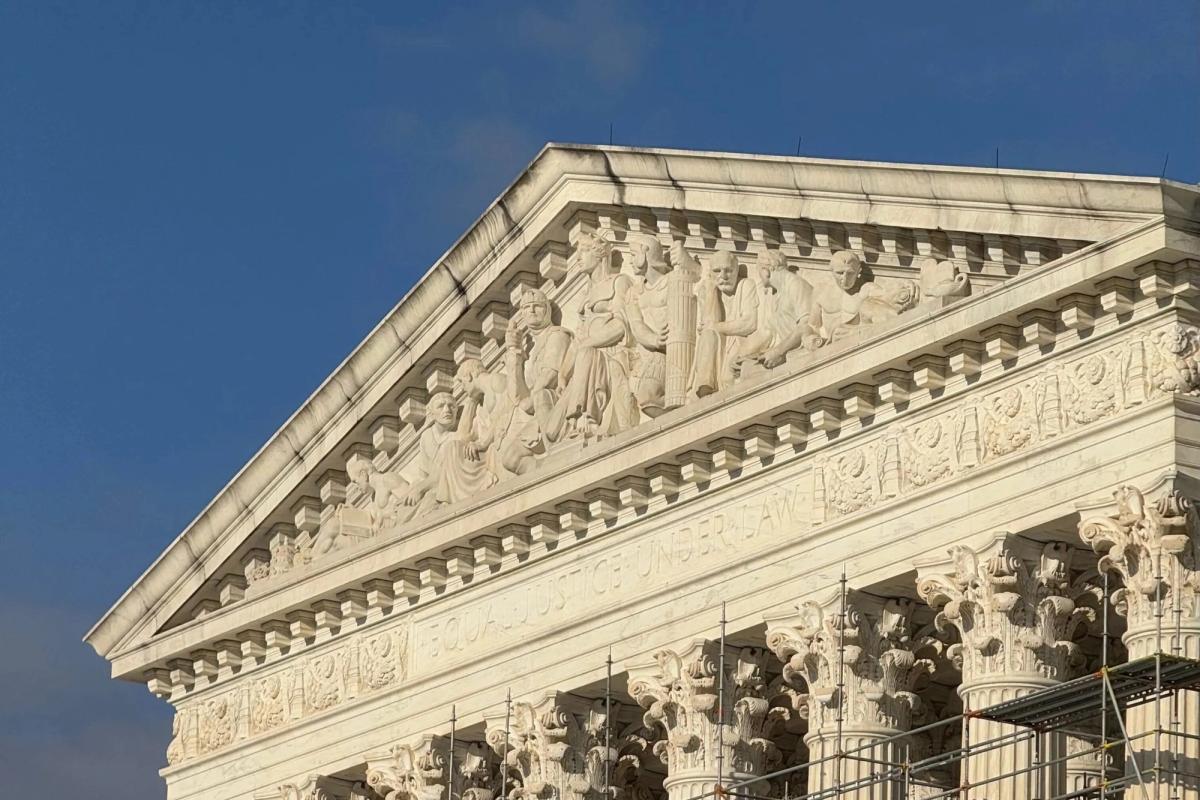
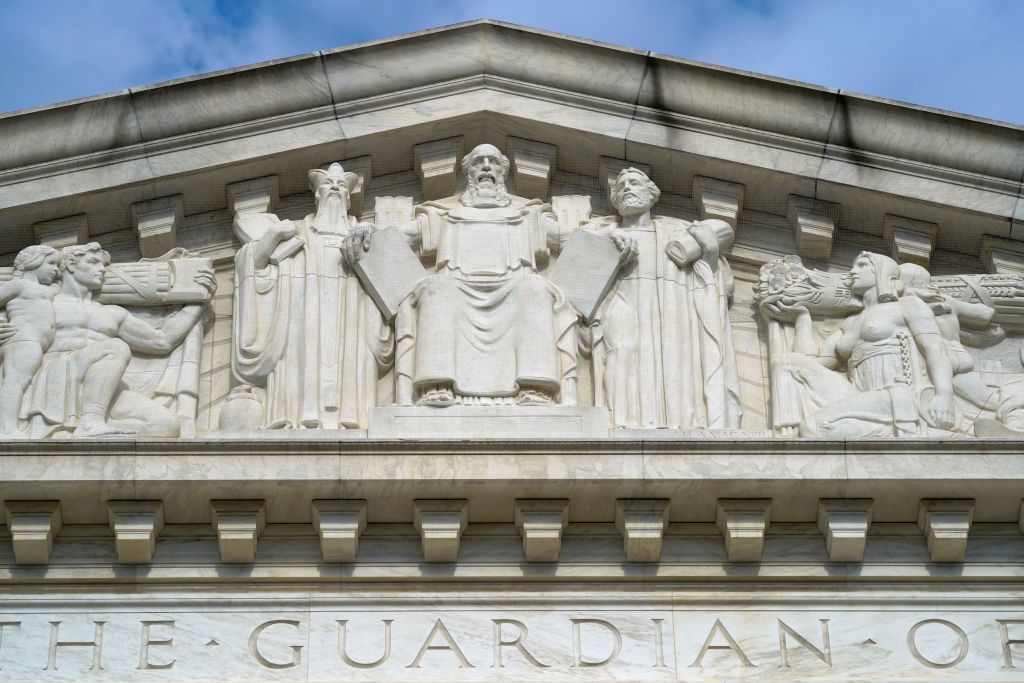
Scholar Robert Dahl, writing back in 1957, once remarked that “Americans are not quite willing to accept the fact that [the Supreme Court] is a political institution and not quite capable of denying it; so that frequently we take both positions at once.”
Generally, the justices have refrained from explicitly commenting on politics. That custom, however, is more a matter of practice and institutional norms than a hard-and-fast rule, and over more than two centuries, justices have at times set it aside while sitting on the bench.
As the current court continues to generate criticism from both sides of the aisle, it seemed relevant to take a deep dive into the (somewhat) rare occasions when justices have openly – and often controversially – done so.
Politics from the bench
In the court’s earliest years, the judicial and political roles were hard to separate – in ways that might shock those who currently accuse the court of partisanship. Besides often being heavily invested in political causes (e.g., campaigning on behalf of elected officials or seeking elected office themselves), the early justices often used addresses to grand juries while circuit riding as occasions for commentary beyond the strictly legal. At that time, such bodies were not simply assembled to decide whether to indict individuals. Instead, the responsible circuit justice would address the grand jurors at the start of each court term, “laying out their duty and the manner in which it was to be performed,” and “lectur[ing] on the role of government, on the implications of the new Constitutional system, and on the jury’s role and responsibility within that system.” Many of these charges were later printed in newspapers and reached a wider audience. In this way, the justices acted as “republican schoolmasters” who saw their role as to “instill a sense of civic virtue in the populace.”
The first chief justice, John Jay, did just that while riding circuit. In May 1790, Jay addressed several grand juries on the (then) “Eastern circuit,” openly contemplating political ideas discussed in the Federalist Papers, such as if men are capable of self-government. Jay was also political in a more explicit sense – he advised President George Washington in both politics and law, and while on the court, negotiated the “Jay Treaty” between the United States and Britain – which helped avert war between the two countries.
But perhaps no early justice tested the limits as far as Justice Samuel Chase. A Federalist who had campaigned for President John Adams in 1800, Chase delivered an 1803 charge to a Baltimore grand jury that criticized Republicans and the Jefferson-aligned Congress for repealing the Judiciary Act of 1801. This repeal, which, among other things, removed 16 circuit judges (most appointed by Adams), meant, according to him, that “the independence of the national judiciary” would be shaken to its foundation. Following this, Chase assailed a new Maryland provision broadening the vote to include individuals without property, saying that it would turn the U.S. into “a mobocracy.”
These overtly political remarks led in part to Chase’s impeachment by the House (specifically, the articles called out his activities as “tending to prostitute the high judicial character with which he was invested, to the low purpose of an electioneering partizan”) and President Thomas Jefferson himself encouraged Chase’s impeachment in a letter to a House member, referencing “the extraordinary charge of Chace [sic] to the grand jury at Baltimore” and asking “ought this seditious & official attack on the principles of our constitution, and on the proceedings of a state, [] go unpunished?”
The Senate ultimately acquitted Chase in 1805, and no justice has been impeached since.
Then there was Chief Justice John Marshall, who – even while serving as chief justice – remained heavily involved in Federalist politics. Perhaps most remarkably, Marshall held two offices simultaneously after being sworn in as chief, as he continued acting as secretary of state for the final month of the Adams administration. Legal scholars today have noted the conflict of this “double duty,” which was not limited to Marshall (Jay and Chief Justice Oliver Ellsworth served in similar roles). In fact, the case that made Marshall’s legacy, Marbury v. Madison, arose directly from commissions he had failed to deliver in his capacity as secretary of state.
Marshall’s off-bench advocacy didn’t end with the Adams administration, however. After his ruling in 1819’s McCulloch v. Maryland that recognized Congress’ ability to create the Second Bank of the United States pursuant to the necessary and proper clause of the Constitution drew criticism from certain corners, Marshall published a series of nine essays in the Alexandria Gazette under the pen name “A Friend of the Constitution” defending his own opinion. Legal scholars have also debated if Marshall’s conduct there was appropriate.
Mid-19th century
In 1829, President Andrew Jackson nominated John McLean for the Supreme Court, who took his seat the day after. During his time as a justice, McLean had a goal in mind other than serving on the court: to become president. Indeed, as Adams once remarked, McLean “thinks of nothing but the Presidency by day and dreams of nothing else by night.”
In 1848, McLean was talked about as a candidate for the anti-slavery Free Soil Party, but he demurred after Martin Van Buren took the lead for the nomination. Nevertheless, in a withdrawal letter that ran in several newspapers, McLean endorsed the party’s defining position of keeping slavery out of the land the United States had won from Mexico. This was not unusual for McLean, who was more than willing to take on the nation’s most difficult issues: He also voiced his strong objections to the annexation of Texas and to the war with Mexico (as, famously, did Abraham Lincoln). This was not met without opposition, as Mississippi Sen. Henry Foote complained that “the conduct of McLean, as a political letter-writer, is unworthy of the bench, discreditable to the country, and wholly indefensible.” Others accused him of “electioneering from the bench” given antislavery remarks contained within some of his court opinions.
Justice Levi Woodbury, who was on the court with McLean, made a presidential run of his own to serve as the nominee for the Democratic Party. Woodbury was reportedly known as a “loyal Jackson man … [who] saw [his] judicial and political positions as interchangeable.” The year before the 1848 Democratic convention, he held for a unanimous court in Jones v. Van Zandt that (1) the Fugitive Slave Act was valid under the Constitution as an exercise of congressional power and (2) that slavery’s protections were baked into the Constitution’s original compromises. The decision “gave him southern support,” though not enough to secure him a victory over Sen. Lewis Cass, who then went on to lose to Zachary Taylor.
The most widely read jurist in America
Near the start of the 20th century, Justice David J. Brewer treated the lecture hall as his second vocation. Justice Oliver Wendell Holmes Jr., who professed personal fondness for Brewer, frequently poked fun at his “itch for public speaking.” Nevertheless, by one historian’s account, all that speaking made Brewer “probably the most widely read jurist in the United States at the turn of the twentieth century.”
And Brewer did not shy away from politics at the podium. His most insistent cause was peace; he spoke against the country’s drift toward empire abroad, against military buildups, and against war in general. He also took aim at the Progressive movement and at President Theodore Roosevelt in particular, criticizing Roosevelt’s imperialism (specifically, the Monroe Doctrine) and accusing him of playing “hide and seek” with the idea of running for a third term as president. Brewer also said New York Governor Charles Evans Hughes (who would eventually take his place on the court) – was a better politician than Roosevelt. The justice’s constant readiness to speak his mind in public reportedly unsettled some of his colleagues, including Holmes.
Which brings us to Hughes. Hughes, who had served as governor of New York, was initially nominated to the court in 1910 by President William Howard Taft, “in part to remove a likely challenger from the 1912 presidential election.” This didn’t quite work: Six years after his Senate confirmation, Hughes ran for president again, becoming the only sitting justice to be nominated for the presidency by a major party. He resigned from the court after being nominated and subsequently lost to Woodrow Wilson. In 1930, after serving as secretary of state, Hughes was picked as chief justice by President Herbert Hoover to fill the seat vacated by Taft and was swiftly confirmed. From there, perhaps his most notable political maneuver was to successfully speak out against President Franklin Roosevelt’s court packing plan, leading the president to grudgingly remark that Hughes was the best politician in the nation.
A first for radio
In 1937, there was no shortage of drama in politics or on the court. Hugo Black, a New Deal Democrat from Alabama who as a senator had been a vocal supporter of Roosevelt’s plan to enlarge the institution, was confirmed that August by a vote of 63 to 16. Soon after, Pittsburgh Post-Gazette reporter Ray Sprigle won a Pulitzer Prize for exposing Black’s membership in the Ku Klux Klan in the 1920s, and editorial boards and politicians demanded that he step down.
Black publicly responded on October 1, 1937, with an 11-minute address made available across the U.S. via radio — by the Hugo Black archive’s account, the first such broadcast any justice had ever made. He admitted the charge (“I did join the Klan”) but maintained that he had resigned years earlier, kept no ties to the group, and held no racial or religious prejudice. The Post-Gazette put the audience at roughly 50 million, second, it said, only to the radio audience for King Edward VIII’s abdication in 1936. The address did its work: Polling showed Americans who wanted Black to resign dropped from 59 to 44 percent. Black took his seat on October 4, 1937, and proved to one of the court’s most ardent defenders of civil rights for Black Americans.
A justice takes on the bicentennial
In 1987, with the country gearing up to celebrate the Constitution’s 200th anniversary under a commission led by the recently retired Chief Justice Warren Burger, Justice Thurgood Marshall declined to join in. Speaking on May 6 to a lawyers’ group in Hawaii, Marshall remarked that the Framers’ judgment did not strike him as especially wise and described the document they wrote as “defective from the start“ – being, in his view, a charter that had protected slavery, shut women out of the vote, and that took a civil war and a series of amendments to set right.
The Maui speech drew front-page coverage (The Washington Post headline read “MARSHALL BLASTS CELEBRATION OF CONSTITUTION BICENTENNIAL”) and a conservative backlash, with one legal group going so far as to call for his resignation on the theory that Marshalls’ words “reflect[ed] a deep-seated bitterness and dislike that impair his capacity.” Others criticized Marhsall for misreading the Founding and defended the Constitution’s Framers, which was responded to at length in many a law review article. To be fair, the response was not all critical, and some received the speech well. For his part, Marshall did not address the critics and reprinted his address in several law journals.
Calling a candidate a ‘faker’
A more recent moment of a justice entering the political fray occurred when Justice Ruth Bader Ginsburg – in a string of interviews with The Associated Press, The New York Times, and CNN – went after the Republican presidential nominee, Donald Trump, in July of 2016, calling him “a faker,” pressed the point that he had not released his tax returns, said she could not picture the country with him as president, and quipped that her late husband would have judged it time to decamp for New Zealand. As NPR’s Nina Totenberg reported, no modern justice she knew of had ever “publicly criticize[d] a presidential candidate.”
The New York Times editorial board told Ginsburg to give up the political commentary, while Sen. Mitch McConnell called the comments inappropriate and Chuck Grassley said she should stay out of it. Trump did not remain silent, tweeting that her “mind is shot” and demanding that she resign. Ginsburg put out a statement describing her remarks as “ill-advised” and conceded that judges ought not to comment on candidates for office.
Arguing about whether the court is political
More recently, several justices have weighed in publicly on the question of whether the court is political – a subject that is arguably, in and of itself, political. In 2018, Trump dismissed an adverse ruling which held the administration could not deny asylum to individuals who crossed the border illegally as the work of an “Obama judge.” Chief Justice John Roberts pushed back, saying that “we do not have Obama judges or Trump judges.” Trump replied in a tweet: “Sorry Chief Justice John Roberts, but you do indeed have ‘Obama judges,’ and they have a much different point of view than the people who are charged with the safety of our country.” (As many media outlets, including SCOTUSblog, have reported, this has been far from Trump’s only criticisms about the Supreme Court and the justices – especially following its tariffs decision).
In 2021, speaking at a center named for McConnell, Justice Amy Coney Barrett insisted that the justices are not “a bunch of partisan hacks.” The same year, Justice Stephen Breyer published a book and embarked on a public tour arguing that the court is not a political body and warning against proposals to add seats to it. And in 2022, after the court overturned Roe v. Wade in Dobbs v. Jackson Women’s Health Organization, Justice Elena Kagan said more than once that judges put their legitimacy at risk when they come across as “political or partisan.”
Last term, as well as this one, brought some additional reflections on politics from the justices. In July, Justice Ketanji Brown Jackson said that the state of American democracy is what keeps her up at night and that she is “not afraid to use [her] voice.” She called some of the court’s recent decisions an “existential threat to the rule of law” and warned that these risk making the court appear political. And in April 2026, in an address at the University of Texas that raised some eyebrows, Justice Clarence Thomas linked “progressivism” to Stalin, Hitler, Mussolini, and Mao, and said that the audience should find “the same level of courage that the signers of the Declaration had … It may mean speaking up in class tomorrow when everyone around you expects you to live by lies. It may mean confronting today’s fashionable bigotries such as anti-semitism … It may mean running for your school board when you see that they are teaching your children to hate your values and our country.”
The court and politics, still
Critics of the current court, from those troubled by Thomas’ remarks on progressivism to those skeptical of Jackson’s statement about existential threats to the rule of law, at times speak as though the current justices publicly wade into politics in a way that previous courts never approached. History very much suggests otherwise.
As noted at this article’s start, Robert Dahl wrote in 1957 that Americans are “not quite willing to accept” the court as a political institution and “not quite capable of denying it.” If anything, the preceding two centuries show that certain justices, at certain times, felt much the same way.