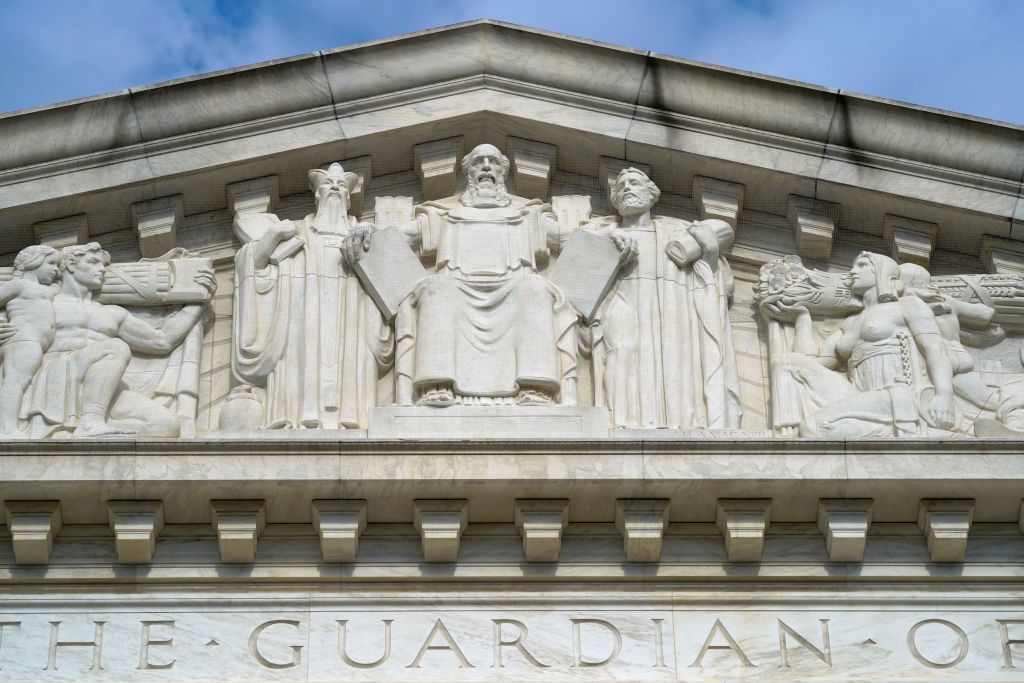
The final four

The court has indicated that today will be the final opinion announcement day of the term. We will be live blogging beginning at 9:30 a.m. EDT. The court has four cases left to decide: Trump v. Barbara (birthright citizenship); West Virginia v. B.P.J. and Little v.


The final four

The court has indicated that today will be the final opinion announcement day of the term. We will be live blogging beginning at 9:30 a.m. EDT.

The court has four cases left to decide: Trump v. Barbara (birthright citizenship); West Virginia v. B.P.J. and Little v. Hecox (transgender athletes); and National Republican Senatorial Committee v. Federal Election Commission (Campaign Finance). For a refresher on these cases, see the Closer Look section below.
On a (somewhat) separate note, do you know an exceptional lawyer looking for something different? We're hiring to help build a new editorial product serving appellate lawyers, corporate counsel, and commercial litigators. If you have a federal clerkship and significant appellate or commercial litigation experience, send a brief note explaining why you're interested, along with your resume, to scotusblog@thedispatch.com.

At the Court

On Monday, the court released its opinions in four cases: Trump v. Slaughter, Trump v. Cook, Watson v. Republican National Committee, and Chatrie v. United States.

  • In Slaughter, the court, by a vote of 6-3, held that the Federal Trade Commission’s for-cause removal provision violates the separation of powers enshrined in the Constitution. Chief Justice John Roberts wrote the majority opinion, and Justice Sonia Sotomayor wrote a dissenting opinion, which was joined by Justices Elena Kagan and Ketanji Brown Jackson.
  • In Cook, the court denied the Trump administration’s request to be allowed to remove Federal Reserve System Governor Lisa Cook from office while her challenge to her firing continues. Roberts wrote the majority opinion, and Justices Clarence Thomas, Samuel Alito, and Amy Coney Barrett wrote dissenting opinions. Alito’s dissent was joined by Justice Neil Gorsuch.
  • In Watson, the court held, by a vote of 5-4, that the federal Election-Day statutes do not require mail-in ballots to be received by Election Day in order to be counted. Barrett wrote the majority opinion, and Alito wrote a dissenting opinion, joined in full by Thomas and Gorsuch and in part by Justice Brett Kavanaugh.
  • In Chatrie, the court held that police officers conducted a Fourth Amendment search when they acquired Okello Chatrie’s location data from Google because an individual has a reasonable expectation of privacy in his cellphone location information. Kagan wrote the majority opinion, Gorsuch wrote an opinion concurring in the judgment, and Alito and Barrett wrote dissenting opinions.

Earlier on Monday, the court added six cases to its oral argument docket for the 2026-27 term and denied review in President Donald Trump’s appeal of a $5 million judgment against him in a case brought by E. Jean Carroll. For more on Monday’s order list, see the Morning Reads and On Site sections below.

Late Monday morning, Thomas denied Roy Moore’s request to block a ruling by the U.S. Court of Appeals for the 11th Circuit from going into effect. Moore had contended the lower court’s ruling needed to be put on hold to ensure he would be able to recover the $8.2 million that a jury awarded him if he ultimately prevails in the case.

Also on Monday, eight of the nine justices released their financial disclosures for 2025. (Alito was granted an extension, so his will come later this year.) Find Amy’s coverage in the On Site section.

Morning Reads

As Nerves Fray at Supreme Court, Some Pine for an Old Colleague With a Soft Touch

James Romoser, The Wall Street Journal (paywalled)

As tensions appear to rise at the Supreme Court, “several current justices have privately expressed that they miss [the] presence” of retired Justice Stephen Breyer, “both as a friend and for his ability to lower the temperature,” according to The Wall Street Journal, which cited “people close to the court.” During his 28 years as an associate justice, Breyer “could be counted on to help keep the peace,” in part by “lightening the mood” using “anecdotes about modern architecture and knock-knock jokes he learned from his grandchildren.” “[S]ome within and around the court saw him as the court’s glue, bringing levity in his interactions with his colleagues and avoiding hard-edge commentary in his opinions. His embrace of collegiality helped contribute to a sense that the court was a functional, collaborative institution, even when it was divided over tough cases.”

Supreme Court won’t revive Alan Dershowitz’s $300 million suit against CNN

Lindsay Whitehurst, Associated Press

The court on Monday refused “to revive a $300 million defamation lawsuit filed against CNN over its coverage of a prominent attorney’s remarks made while defending President Donald Trump during his 2020 impeachment,” according to the Associated Press. “Alan Dershowitz said the news network aired only a portion of the comment made during his defense of the president, distorting his meaning to make him look like he’d ‘lost his mind.’” “In his appeal, Dershowitz had urged the court to reconsider New York Times Co. v. Sullivan,” a “landmark First Amendment case that made it harder for public figures to win libel lawsuits.” Justice Clarence Thomas dissented from the denial, in an opinion joined by Justice Neil Gorsuch.

Supreme Court rejects legal battle over New York's COVID-19 vaccine mandate for healthcare workers

Melissa Quinn, CBS News

On Monday, the court denied a petition for review “involving New York’s now-repealed mandate for healthcare workers to receive the COVID-19 vaccine during the pandemic,” according to CBS News. “The dispute arose after the New York Department of Health issued an emergency rule in 2021 that required all licensed healthcare workers to be fully vaccinated against COVID-19. ... A group of employees at New York healthcare facilities sought religious exemptions from the vaccine mandate,” then sued when their requests were denied and they were then fired. “The workers, who are unnamed in court papers, argued that their employers’ refusal to grant exemptions violated Title VII of the Civil Rights Act, which prohibits workplace discrimination because of religion.” “A federal district court tossed out the case, and an appeals court upheld that decision.”

On Site

Opinion Analysis

Supreme Court allows Trump to fire FTC commissioner and overturns major restraint on presidential power

Supreme Court allows Trump to fire FTC commissioner and overturns major restraint on presidential power

The Supreme Court on Monday gave President Donald Trump sweeping new authority over approximately two dozen multi-member agencies. By a vote of 6-3, the justices struck down the for-cause removal provision protecting FTC commissioners and overruled its 91-year-old decision in Humphrey’s Executor v. United States.

Opinion Analysis

Court prevents Trump from firing Fed governor

Court prevents Trump from firing Fed governor

On Monday, the court ruled in favor of Lisa Cook, a member of the Federal Reserve’s Board of Governors whom Trump had attempted to fire. By a vote of 5-4, the court held that Cook can continue to remain in her job while her challenge to Trump’s efforts to fire her moves forward.

Opinion Analysis

Justices uphold state law allowing for late-arriving mail-in ballots

Justices uphold state law allowing for late-arriving mail-in ballots

Just over four months before the 2026 midterm elections, the court on Monday upheld a Mississippi law that allows mail-in ballots to be counted as long as they are postmarked by, and received within five days of, Election Day.

Opinion Analysis

Court rules that law enforcement’s use of “geofence warrant” was a “search”

Court rules that law enforcement’s use of “geofence warrant” was a “search”

On Monday, the court ruled that when law enforcement officials used a “geofence warrant” – a warrant that instructed Google to provide location data for cellphone users who were near a particular place during a specific time period – to obtain evidence used to convict a Virginia man of a 2019 bank robbery, they conducted a “search” for purposes of the Fourth Amendment.

Court News

Court agrees to hear six new cases, including dispute over proof of citizenship to vote

Court agrees to hear six new cases, including dispute over proof of citizenship to vote

The court on Monday added six new cases to its argument docket for the 2026-27 term. The announcements came as part of a list of orders from the justices’ private conference on June 25, which was the final regularly scheduled conference before the justices’ summer recess. The justices met again on Monday and are expected to release orders from that conference sometime this week.

Court News

Supreme Court will not consider $5 million verdict against Trump

Supreme Court will not consider $5 million verdict against Trump

The court will not hear an appeal by President Donald Trump seeking review of the $5 million jury verdict entered against him in the sexual abuse and defamation case filed by journalist E. Jean Carroll. His petition for review was conferenced by the justices for the first time on June 25 after being scheduled for a February conference and then rescheduled more than a dozen times.

Court News

Justices’ financial disclosures reveal Bad Bunny concert tickets, plenty of travel in 2025

Justices’ financial disclosures reveal Bad Bunny concert tickets, plenty of travel in 2025

Justice Sonia Sotomayor received concert tickets valued at more than $4,000 from the record company that represents the Puerto Rican superstar Bad Bunny, while Justice Ketanji Brown Jackson received a painting for her chambers valued at $2,500. Those gifts, along with other details about the justices’ book deals, travel, and teaching gigs, were made public in the justices’ annual financial disclosures, which were released on Monday.

View from the Court

250th birthday minutes on the bench

250th birthday minutes on the bench

In his View from the Court column, Mark Walsh explained what it was like in the courtroom on Monday as the court released its decisions on mail-in ballots, the president’s removal powers, and geofence warrants. He highlighted the justices’ use of brief historical lessons in their recent opinion summaries.

A Closer Look

The Final Four Cases

As noted above, the court has indicated that today will be the final opinion announcement day for the current term. There are four cases yet to be decided, including Trump v. Barbara, on President Donald Trump’s executive order seeking to end birthright citizenship.

Here’s a brief refresher on these final four cases.

Trump v. Barbara

In Barbara, the court is considering a challenge to Trump’s birthright citizenship order, which he signed on Jan. 20, 2025, and which said that, beginning in 30 days, babies born in the U.S. would not be automatically entitled to citizenship if their parents are in the country either illegally or temporarily. The court is weighing whether the order violates the citizenship clause of the 14th Amendment and/or a federal immigration law that codifies that clause.

Trump’s order has never gone into effect, as challenges to it were filed almost immediately, and every lower court that has weighed in so far has ruled that it is unconstitutional. Last term, the court addressed one aspect of the dispute in Trump v. CASA, holding that district courts did not have the power to issue universal injunctions putting the order on hold nationwide. However, the court left open the possibility of similar preliminary injunctions in class-action lawsuits, which explains why the order has remained on hold.

By taking up Barbara, the court agreed to squarely address the order itself. The Trump administration contends that the executive order simply “restores the original meaning” of the citizenship clause, while the challengers counter that the administration “is asking for nothing less than a remaking of our Nation’s constitutional foundations.” At oral argument on April 1, the court appeared likely to side with the challengers and prevent the order from going into effect.

West Virginia v. B.P.J. and Little v. Hecox
In B.P.J. and Hecox, the court is considering laws in West Virginia and Idaho that prohibit transgender athletes from competing on women’s and girls’ school sports teams. The cases are closely related, but they were not consolidated for argument, likely because the lower court ruling in Hecox centered on the 14th Amendment’s equal protection clause, while the lower court ruling in B.P.J. centered on Title IX, a federal civil rights law that bars sex discrimination in educational programs and activities that receive federal funding.

During oral arguments on Jan. 13, the states – which claim they are not discriminating against transgender athletes and are, instead, seeking to preserve fairness and safety in sports – appeared likely to prevail. The lingering question was how narrow the court’s ruling would be.

National Republican Senatorial Committee v. Federal Election Commission

In NRSC v. FEC, the court is revisiting the thorny issue of campaign finance restrictions. The case, like 2001’s FEC v. Colorado Republican Federal Campaign Committee before it, addresses limits on the amount of money that political parties can spend in coordination with a candidate for office. The court has been asked to strike down those limits and potentially overrule that 2001 decision.

The challengers, including the National Republican Senatorial Committee and the National Republican Congressional Committee, assert that the limits on coordinated spending violate the First Amendment. The Trump administration supports their position, so the court appointed Roman Martinez, a former clerk to Chief Justice John Roberts and then-Judge Brett Kavanaugh, to offer an opposing view. Martinez contends that the NRSC and NRCC did not have a right to sue or the right to avail themselves of the expedited review that the challengers sought.

At oral argument on Dec. 9, it was unclear how the court would rule, in part because Justice Neil Gorsuch did not ask any questions, and Justice Amy Coney Barrett asked only one.

SCOTUS Quotes

“To ‘discharg[e] the duties of his trust,’ the President must have the assistance of officers he can trust. Although it is up to the Senate to decide whether to confirm those with whom the President would prefer to work, neither Congress nor the courts may saddle him with those with whom he cannot work. Subordinates who exercise the President’s power are subject to removal by him. Then, and only then, can they remain accountable to the President, and the President to the people.”

— Chief Justice John Roberts in Trump v. Slaughter  (2026)

“The [majority’s] result is a President who emerges with far greater power than ever before. It is a power, however, that neither the People, nor Congress, nor the Constitution bestowed upon him. In granting the President this unbridled authority, the Court upends its precedent, misconstrues our history, and sheds any pretense of judicial modesty.”

— Justice Sonia Sotomayor, dissenting in Slaughter

Need Support?

Find verified resources for reproductive healthcare, support services, and advocacy organizations.

Find Resources