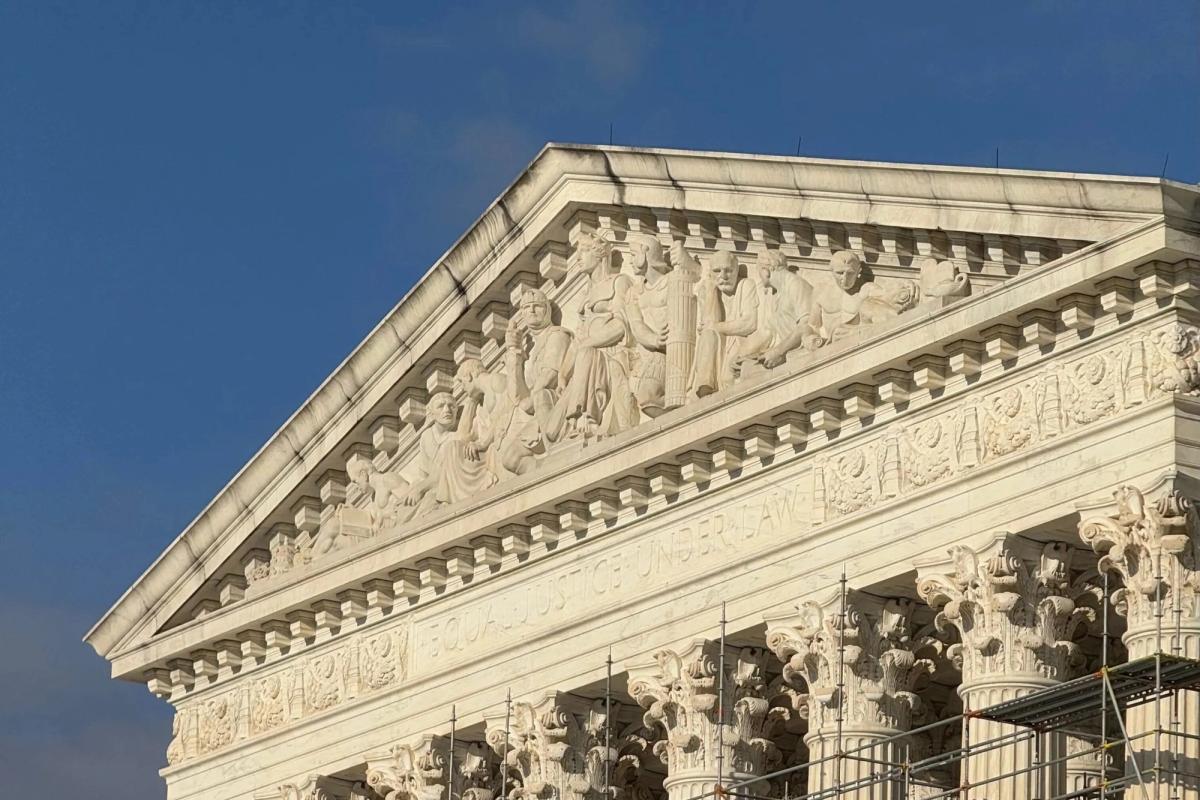
It’s going to be another busy day at the Supreme Court, and it’s expected to start with opinion announcements.
At the Court
On Tuesday, the justices heard argument in two cases: Keathley v. Buddy Ayers Construction, on the rules pardoning omissions by bankrupt debtors; and Noem v. Al Otro Lado, on the rights of asylum seekers at the U.S.-Mexico border. For more on the Al Otro Lado argument, see the On Site section below.
After the possible announcement of opinions this morning, the justices will hear argument in Flowers Foods v. Brock, on whether “last-mile” drivers – drivers who deliver from a regional warehouse to a store – are exempt from the arbitration requirements of the Federal Arbitration Act.
Next Wednesday, April 1, we will be live blogging as the Supreme Court hears argument in Trump v. Barbara, the birthright citizenship case. To learn more about the case, join our LinkedIn Live event with Briefly tomorrow at noon EDT.
Morning Reads
Some state officials say shifting mail ballot deadline will complicate plans for November elections
Nicholas Riccardi and Julie Carr Smyth, Associated Press
As the Supreme Court heard argument on Monday on whether mail-in ballots need to arrive by Election Day to be counted, the Associated Press spoke with election officials across the country about what a decision mandating they arrive on that day would mean for the 14 states “that allow regular mail ballots sent by Election Day but arrive some period of days afterward to be counted.” “The biggest challenge,” according to an official in Illinois, “would be informing voters that they faced a tighter deadline,” but there would be concerns about updating election materials and budgetary challenges, as well. “Most election offices have already printed flyers, signs and even ballot envelopes with the current election deadlines for use in November. They would have to scramble to reprint that material, usually done months or years in advance to save money.”
Stephen Miller Asks Why Texas Pays to Teach Undocumented Children
Lauren McGaughy, The New York Times
President Donald Trump’s immigration adviser, Stephen Miller, “raised the idea of ending public education funding for undocumented children in a closed-door meeting with Texas lawmakers in Washington last week, a move that would challenge a decades-old U.S. Supreme Court precedent,” according to The New York Times. Specifically, passing a law that would fund “public education only for children who are citizens” or lawful immigrants “would break with the Supreme Court precedent set in Plyler v. Doe, a 1982 decision that determined that states must pay for the elementary school education of all students regardless of immigration status.”
Judge refuses to drop lawsuit over Musk role as Trump adviser
Miranda Nazzaro, The Hill
As the Supreme Court considers a petition for review from the federal government aimed at blocking “a wide-ranging and intrusive discovery order against the U.S. DOGE Service,” a separate lawsuit over Elon Musk’s work with DOGE is moving forward. “US District Judge Tanya Chutkan issued a memo Monday tossing out a dismissal request from the federal government, stating the claims that Musk and other DOGE leaders unlawfully assumed an expansive role in the federal government can play out in court,” according to The Hill.
Judge scraps another school admissions policies lawsuit
Naaz Modan, K-12 Dive
In December 2024, approximately 18 months after it released its decision ending affirmative action programs in college admissions, the Supreme Court declined to weigh in on a similar dispute involving elite public high schools in Boston that considered students’ zip codes during the admissions process. The group of parents, students, and alumni challenging the policy said it discriminated against white and Asian students. Now, a second lawsuit over updates to the Boston schools’ admissions policies, which also alleges race-based discrimination, is drawing closer to the Supreme Court, according to K-12 Dive, which noted that the case is part of a broader battle over whether policies focused on zip codes or socioeconomic status violate the Supreme Court’s affirmative action decision.
Will Birthright-Citizenship Case Be Decided on Statutory Grounds?
Ed Whelan, National Review
In a post for the National Review’s Bench Memos blog, Ed Whelan reflected on the possibility that the court will strike down Trump’s executive order limiting access to birthright citizenship on statutory grounds, using the statute “that states that ‘a person born in the United States, and subject to the jurisdiction thereof, is a ‘citizen[] of the United States at birth,’” rather than on constitutional grounds, using the 14th Amendment. “As the Chief has put it, ‘If it is not necessary to decide more, it is necessary not to decide more,’” Whelan wrote. “My guess is that the Chief will be part of a supermajority of the Court that rules that the EO violates” the statute “and that declines to address the constitutional question.”
On Site
Court appears likely to side with Trump administration on rights of asylum seekers
The Supreme Court on Tuesday appeared likely to uphold the federal government’s policy of systematically turning back asylum seekers before they can reach the U.S. border with Mexico. During roughly 80 minutes of oral argument, a majority of justices seemed to agree with the Trump administration that the policy does not violate a federal law allowing noncitizens to apply for asylum when they “arrive[] in the United States.”
Temporary Protected Status and the Supreme Court: an explainer
The Supreme Court announced last week that it will hear argument in late April on the Trump administration’s effort to remove protected immigration status from Syrian and Haitian nationals. Here’s a brief overview of the Temporary Protected Status program, what’s at stake in these disputes, and what the court has said in the past year about the administration’s authority to revoke protected status.
Justice Scalia’s uncertain legacy
In his Controlling Opinions column, Richard Re reflected on Justice Antonin Scalia’s complicated legal legacy. “On the surface,” Re wrote, “Scalia’s legacy has never been more distinguished. … Yet the surface celebration masks a deeper ambivalence and even repudiation.”
Podcasts
You Can’t Preach Jesus Here | Interview: Judge Rebecca Taibleson
Judge Rebecca Taibleson of the U.S. Court of Appeals for the 7th Circuit joined Sarah Isgur and David French for a conversation about her path to the federal bench. But first, Sarah and David discussed the Supreme Court’s unanimous decision on free speech zones, the viral Afroman jury verdict, and the Pentagon Press policy ruling.
Security Concerns and the Court
Late last month, Justice Clarence Thomas changed a planned in-person appearance at a legal conference at American University to a remote one following a security threat. Although details of the threat were not made public, student groups had taken to social media before the event to question Thomas’ appearance, and a group of individuals protested outside the venue with “No Kings” placards and one-page excerpts of Anita Hill’s testimony from Thomas’ confirmation hearing.
“I apologize for having to change things, but I wanted to make sure I didn’t endanger anyone by my mere presence,” Thomas said to conference attendees from the Capitol Hill office of Sen. Mike Lee. “At the same time, I encourage you not to follow the example of the things that have happened that prevent us from being together.”
Thomas’ comments put a spotlight on security concerns surrounding the justices, concerns that have been in the news regularly since a leaked draft of the Supreme Court’s opinion in Dobbs v. Jackson Women’s Health Organization sparked nationwide protests in May 2022. The draft showed the court overturning Roe v. Wade, which it ultimately did in June 2022.
As Kelsey noted in her recent piece on investigations into the Dobbs leak, the leak led to protests outside multiple justices’ homes, including the Alexandria, Virginia, home of Justice Samuel Alito, who authored the Dobbs draft opinion (and final opinion). There was also an assassination attempt on Justice Brett Kavanaugh. (The individual arrested near Kavanaugh’s home was sentenced in October to over eight years in prison following a guilty plea.) Amid this unrest, additional security was deployed to protect the justices, and barricades were erected around the court.
On May 11, 2022, nine days after the unauthorized leak, then-Attorney General Merrick Garland “announced he had ordered the U.S. Marshals Service to assist in providing round-the-clock security to justices,” as Politico reported at the time. Garland and other Justice Department officials met with Supreme Court officials roughly a week later to “discuss the security needs of Justices and the Court since the unauthorized release of a draft Court opinion” and “discussed ongoing efforts to enhance coordination, intelligence sharing, and technical support as it relates to judicial security,” according to a Justice Department press release.
In June 2022, Congress passed the Supreme Court Parity Act to address rising security concerns. Per the ABA, the law “extends Supreme Court police protection to ‘any member of the immediate family of the Chief Justice, any Associate Justice, or any officer of the Supreme Court if the Marshal determines such protection is necessary,’ thereby providing protection similar to that already afforded high ranking officials in the executive and legislative branches.” Prior to passage of the 2022 law, the justices themselves (but not their families) had federal security protection under the U.S. Code.
But expanded security for the justices and their families means higher security costs, which explains why Supreme Court security funding has played a role in Congress’ ongoing budget debates. In addition to considering requests to provide additional funding to the Supreme Court Police Department, Congress considered a request for more security funding from other members of the judiciary.
Even before Thomas’ recent comments on safety, these funding debates felt urgent. Per federal data from the U.S. Marshals Service, threats to judges increased by 40% between 2022 and 2025.
SCOTUS Quote
MR. CLEMENT: “And postmarks have their own problems. I mean, the main mailbox, post box in – post office, rather, in Chicago stays open 24/7. So, when all the other polls close in Illinois or every other state at 8 p.m. … the post office is still open until midnight.
Now I’m not here to say that there could ever be voting fraud in Chicago.”
The post SCOTUStoday for Wednesday, March 25 appeared first on SCOTUSblog.