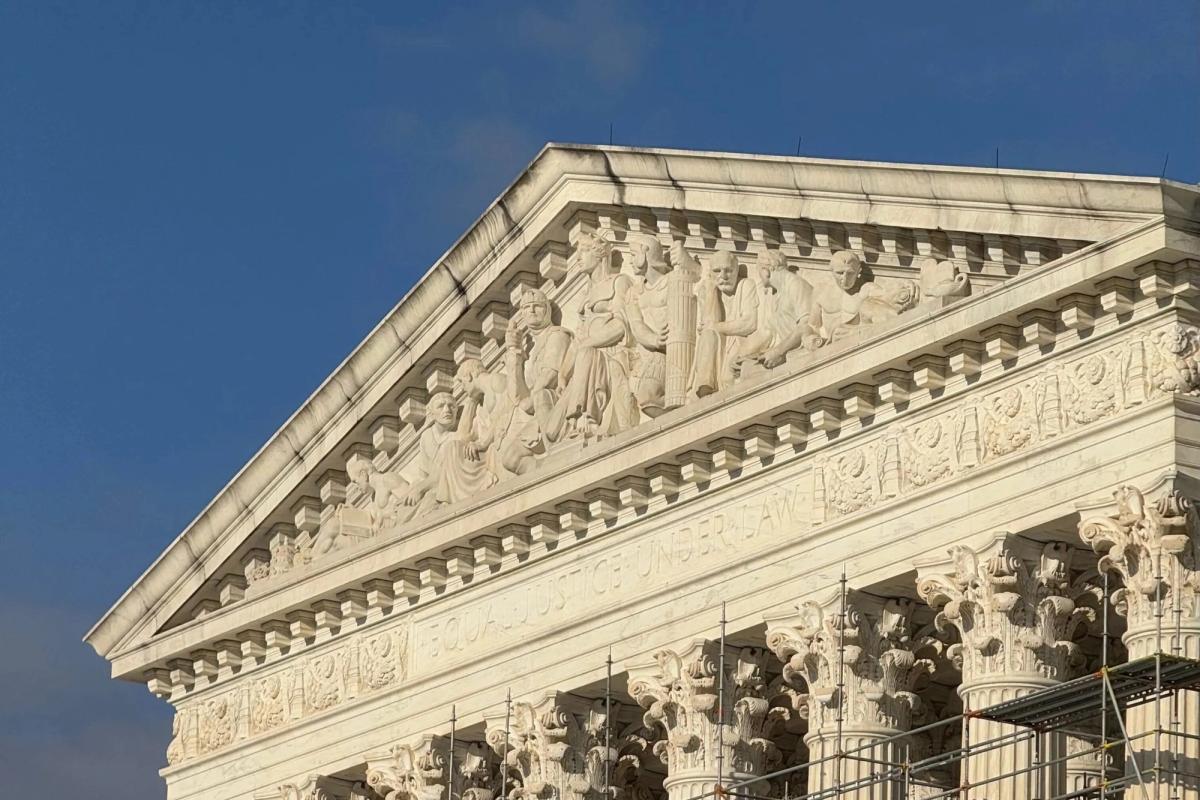
The Supreme Court’s April 29 ruling curtailing a key provision of the Voting Rights Act cleared the way for last-minute redistricting pushes in states such as Louisiana and Tennessee. As a result, it fueled new, more urgent calls for Congress to take action to ban mid-decade map drawing and partisan gerrymandering and to bring an end to the battle over redistricting.
These pleas for congressional action serve as a reminder that the Supreme Court doesn’t necessarily have the final say on an issue. Congress can avoid the potential consequences or limit the impact of an unpopular ruling by updating the statute the decision addressed or passing a new law. Research into statutory responses to Supreme Court decisions shows that such congressional undertakings were once common, although the practice has fallen off considerably since about 1998.
And, of course, Congress can also propose a constitutional amendment in response to a ruling. However, the proposal won’t become part of the Constitution until it’s approved by at least two-thirds of the House and Senate and ratified by at least 38 states.
But being able to do something is not the same thing as doing it, and Congress has faced a torrent of criticism claiming that it isn’t doing much of anything these days. In 2025, Congress “hit new lows for productivity,” casting just 362 votes, “the second-lowest count in the last quarter century,” according to The New York Times. And the 118th Congress, which served from Jan. 3, 2023, to Jan. 3, 2025, enacted just 274 laws, “the fewest since the Civil War,” per a Wall Street Journal analysis.
In this era of inaction, it’s unlikely that Congress will respond to Louisiana v. Callais or any other of this term’s rulings. But Congress responded to the Supreme Court’s decisions in the past, including after major cases on race and religion. Here are three of the most important examples of Congress “overruling” the court.
The 13th and 14th Amendments
In 1857, the Supreme Court decided Dred Scott v. Sandford, and its ruling is often described as the worst in Supreme Court history. The court held that Dred Scott, an enslaved man who spent time in free territory, was not free; that African Americans, whether enslaved or free, were not and could not be citizens; and that the Missouri Compromise, which addressed where Americans could own slaves, was unconstitutional.
The decision came as the country was wrestling with the future of slavery, and, indeed, the Civil War began just four years later. While the war was still ongoing, Congress passed the 13th Amendment, which outlawed slavery in the United States. It was ratified by December 1865, about eight months after Confederate General Robert E. Lee admitted defeat.
The next year, Congress passed the 14th Amendment, which guarantees citizenship to “[a]ll persons born or naturalized in the United States, and subject to the jurisdiction thereof.” It also bars states from “depriv[ing] any person of life, liberty, or property, without due process of law” or denying “equal protection of the laws” to any person. It took just over two years for three-fourths of states to ratify this amendment, according to the National Archives, and it became part of the Constitution in July 1868.
Together, the 13th and 14th Amendments overturned Dred Scott by ending slavery and requiring equal treatment of African Americans. However, as the National Archives points out, it took many additional lawsuits, pieces of legislation, and executive branch actions for these Americans to actually enjoy the protections outlined in the 14th Amendment.
The Religious Freedom Restoration Act
As noted above, Congress doesn’t always have to amend the Constitution to minimize the impact of a ruling. In some cases, it can undo or circumvent a Supreme Court decision with a new statute, as it did in 1993 with the Religious Freedom Restoration Act.
RFRA was Congress’ response to the court’s 1990 ruling in Employment Division v. Smith, a case that centered on two men, Alfred Smith and Galen Black, who had ingested peyote during a Native American Church ceremony. As a result of using the drug, the men were fired from their jobs at a private drug rehabilitation organization. Then, they were denied unemployment benefits from the Employment Division of Oregon’s Department of Human Resources, because applicants who had been fired for work-related misconduct were ineligible for such benefits.
Smith and Black sued the Employment Division, contending that the First Amendment barred the state from treating their religious practice as misconduct. They won before the Oregon Court of Appeals and Oregon Supreme Court, but the U.S. Supreme Court ultimately held, in an opinion by Justice Antonin Scalia, that Oregon had not violated the First Amendment by enforcing its controlled substances law, which prohibited peyote possession and use.
In the ruling, the court abandoned the compelling interest test it had previously used in free exercise cases, which required the government to show that the law that had interfered with a religious practice served a compelling purpose and that this purpose could not be achieved through some other, less restrictive means. Smith meant that, moving forward, the free exercise clause would offer no protection from “a neutral, generally applicable law,” meaning a law that applies to everyone and does not target a specific faith group.
Critics of the Smith decision claimed that it would force people of faith to navigate unintended consequences of what in the eyes of a judge would be neutral, generally applicable policies. After Smith, these religious individuals would no longer be able to win exemptions to such laws through First Amendment challenges, and would, instead, need to rely on legislators to respond to their concerns.
The outcry from religious organizations was so intense that Congress quickly took action. By the summer of 1990, Congress was already considering legislation that would restore the compelling interest test in free-exercise cases. RFRA ultimately passed with near-unanimous support three years later, after being slowed down by a debate over whether it should include a carveout preventing religious freedom challenges to abortion restrictions, as I previously reported for the Deseret News.
The text of RFRA includes a brief discussion of its purpose – and criticism of the Smith ruling. That decision, lawmakers wrote, “virtually eliminated the requirement that the government justify burdens on religious exercise imposed by laws neutral toward religion,” even though “laws ‘neutral’ toward religion may burden religious exercise as surely as laws intended to interfere with religious exercise.” Under RFRA, people of faith regained the ability to challenge any law that burdened their religious practice; at which point the government is required to show that offering a religious exemption to the challenged policy would undermine its purpose.
However, the story of RFRA is also a story about how sometimes Congress doesn’t get the last word. In 1997, the Supreme Court in City of Boerne v. Flores held that RFRA did not apply to state actions, meaning that Congress ultimately only succeeded in “overruling” Smith as applied to federal laws.
Lilly Ledbetter Fair Pay Act
A more recent example of congressional action in response to a controversial ruling unfolded just under two decades ago, after the Supreme Court in 2007 considered a sex discrimination lawsuit over unequal pay for men and women doing the same work. The case, Ledbetter v. Goodyear Tire & Rubber Co., featured Lilly Ledbetter, who spent 19 years working for Goodyear Tire and learned near the end of her time there that she was being paid less than men in her same position.
After retiring in 1998, Ledbetter sued the company for violating Title VII of the Civil Rights Act of 1964, which outlaws discrimination in the workplace on the basis of sex. A jury awarded Ledbetter more than $3 million, but, as Anastasia Boden noted in a column this month for SCOTUSblog, “an appellate court overturned that ruling after finding her claims to have been brought too late.”
In its 2007 ruling, the Supreme Court affirmed the U.S. Court of Appeals for the 11th Circuit, agreeing that Ledbetter had not filed her claim in time. The clock, according to Justice Samuel Alito, who wrote the majority opinion, did not reset every time Ledbetter received a paycheck. It had started when the salary decision was made.
Justice Ruth Bader Ginsburg wrote a dissenting opinion, which was joined by three other justices. In it, she contended that the court had “overlook[ed] common characteristics of pay discrimination.” Such discrimination is not immediately evident, Ginsburg explained, because “[p]ay disparities often occur, as they did in Ledbetter’s case, in small increments.” She further argued that the ruling was “totally at odds with the robust protection against workplace discrimination Congress intended Title VII to secure.” Ginsburg concluded by calling on Congress to take action. “[T]he ball is in Congress’ court,” she wrote. “[T]he Legislature may act to correct this Court’s parsimonious reading of Title VII.”
Ledbetter ran with this idea and met with congressional leaders to urge them to take action. Less than two years after the court released its decision in May 2007, Congress in January 2009 passed the Lilly Ledbetter Fair Pay Act, which amended Title VII, as well as related statutes, to clarify that the time limit for challenging unequal pay and other unlawful practices resets “each time compensation is paid.” Ledbetter told the Birmingham News as she prepared to go to the signing ceremony that she was “thrilled” the law passed.
The court and Congress
These days, high-profile rulings sometimes prompt lawmakers to introduce related legislation, but these measures often seem more like messaging bills, rather than serious proposals. For example, after recent decisions on abortion rights and presidential immunity from prosecution, Democrats pushed legislation that would undo the consequences of those decisions. But these were not bipartisan measures, and they stood little chance of making it through the deeply divided legislative branch.
Unless lawmakers embrace opportunities for compromise – and Congress wakes up from its current slumber – the court is unlikely to face such a direct response from Congress again anytime soon.