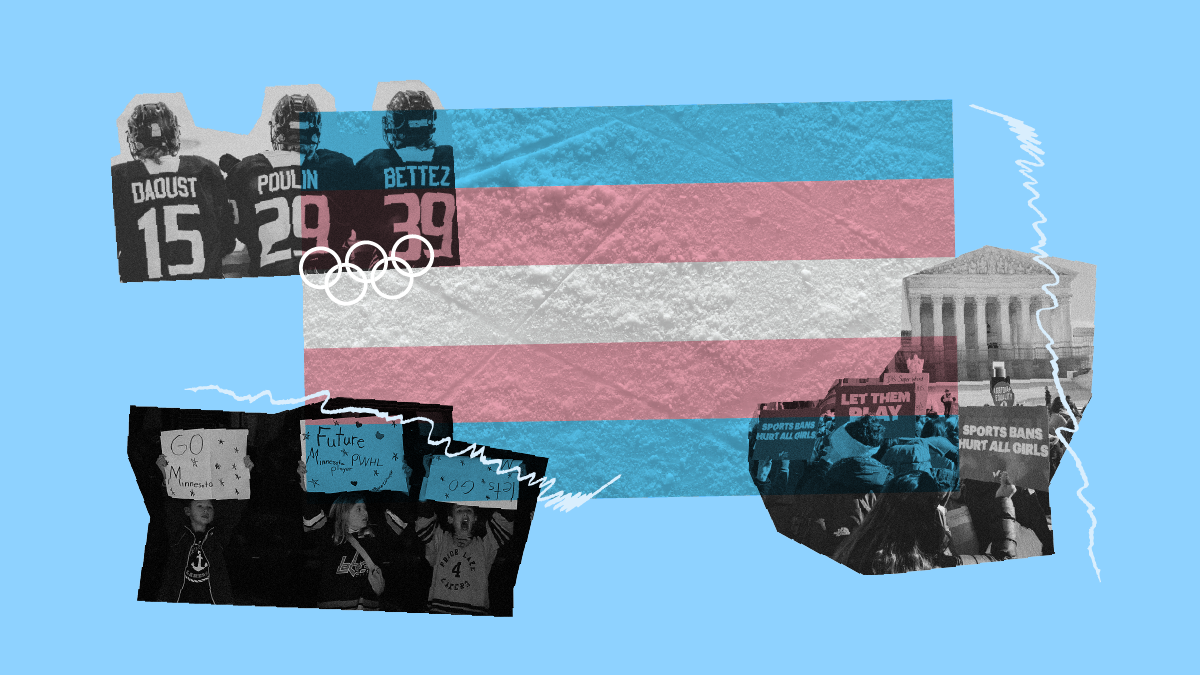
Ice hockey is in the air. Over the last few months, Heated Rivalry captivated millions of viewers. The Professional Women’s Hockey League continues to grow and break records at every turn. And with the 2026 Winter Olympics underway, the world’s best players—including the first Black woman to play for the U.S. Olympic hockey team—are taking center ice. As a hockey fan, I’m living my best life. But as a transgender hockey player, the Trump administration has turned the sport I love into a political battleground.
It all started with President Trump’s lawless and transphobic executive order demanding that sporting organizations exclude transgender girls and women from participation in girls’ and women’s sports. Then last summer, the United States Olympic and Paralympic Committee (USOPC) caved to Trump’s executive order and issued a policy banning transgender women from Olympic and Paralympic participation. The USOPC also directed the national sports governing bodies it oversees to revise their own policies to align with the anti-trans order. USA Hockey—the national governing body for ice hockey programs across the country—followed suit, issuing a policy that bans transgender women and girls from women’s and girls’ programs. And the consequences of Trump’s order don’t stop there: anti-trans extremists in Congress are working to codify the USOPC’s ban into law, depriving USOPC of the authority to change its rules in the future and permanently banning transgender athletes from participation. This effort may soon be voted on by the full U.S. House of Representatives.
USA Hockey governs a vast network of amateur and recreational ice hockey programs across the country for both adults and youth, with youth players making up nearly 70% of its membership. That means that this anti-trans policy will primarily harm kids and recreation-level athletes—people who just want to play, learn, and have fun.
And this attempt to target and exclude transgender athletes actually harms cisgender people too: USA Hockey also banned people who take testosterone from women’s and girls’ programs—a rule that not only affects many transgender and nonbinary athletes like myself, but also cisgender women who take testosterone as part of routine medical care, such as treatment for managing symptoms associated with menopause.
Yes, you read that correctly: the nearly 100,000 women and girls playing in women’s and girls’ hockey programs—alongside countless women and girls, both cisgender and transgender, playing in other USOPC-sanctioned sports—will now be subjected to intrusive scrutiny of their bodies. In addition to inappropriate inquiries into private medical decisions, women and girl athletes who don’t conform to rigid gender stereotypes, or who are stronger, taller, or faster, will now be especially vulnerable to invasive investigation and testing to “prove” their gender. All because Trump and his allies want to attack trans people and sideline us from public life.
This cruel policy hurts me and many of my teammates. Women’s sports spaces have long served as safe, inclusive, and welcoming communities for people with marginalized identities, including transgender and gender expansive people. While Heated Rivalry may be fictional, it highlights the very real challenges many LGBTQIA+ athletes face. In hockey, women’s leagues often provide a refuge from the homophobia, misogyny, and transphobia that still dominate many cisgender male-centered programs.
When organizations like the USOPC and USA Hockey cave to political pressure from the Trump administration—and anti-trans legislators turn that pressure into law—the harm extends far beyond transgender athletes who simply want to play the sports they love.
Arbitrary and categorical bans on transgender, nonbinary, and intersex people’s participation in sports don’t create more opportunities for girls and women. They also don’t address the real gender inequities in sports. In reality, all these policies accomplish is inviting gender policing, medical surveillance, and harassment of anyone who does not fit someone else’s rigid and archaic understanding of femininity. There are countless examples of this intrusive gender policing playing out against professional cisgender women athletes, particularly Black and brown women, ranging from Serena Williams to Brittney Griner to boxers Lin Yu-Ting and Imane Khelif. And we’ve seen relentless attacks on transgender student athletes at the state level, which blatantly undermine and violate Title IX protections that sought to protect marginalized students who had historically been left out of school sports.
Across the country, professional-level players, recreational players, and leagues—including those governed by USA Hockey—have spoken out against these discriminatory policies, making one thing clear: we did not ask for this.
Policies that police athletes’ gender are the real threat to women’s sports—not trans people. As I watch the Olympics this year, I’ll be thinking of the trans athletes who couldn’t be there to represent their country, the trans kids being told they can’t play with their friends on their school teams, and my fellow trans hockey players—because everyone deserves the opportunity to play, compete, and belong.
The post From the Local Hockey Rink to the Olympic Stage: How the Trump Administration’s Attacks on Trans Athletes Harm Us All appeared first on National Women's Law Center.