Justice Scalia’s uncertain legacy

Controlling Opinions is a recurring series by Richard Re that explores the interaction of law, ideology, and discretion at the Supreme Court. On the surface, Justice Antonin Scalia’s legacy has […] The post Justice Scalia’s uncertain legacy appeared first on SCOTUSblog .
Justice Scalia’s uncertain legacy

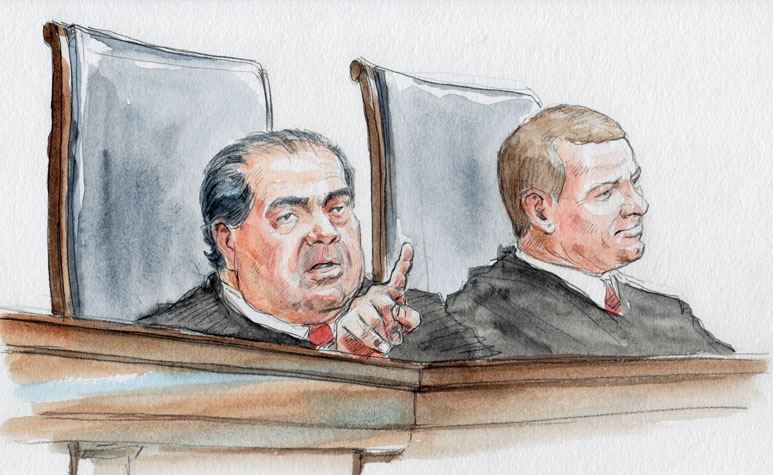
Controlling Opinions is a recurring series by Richard Re that explores the interaction of law, ideology, and discretion at the Supreme Court.

On the surface, Justice Antonin Scalia’s legacy has never been more distinguished. He is regularly invoked by all sitting justices, as well as by advocates before the Supreme Court. Legal culture remains transformed by the legal movement he helped spearhead, as evidenced by the prevalence of textualism and originalism. And his most celebrated dissent, from Morrison v. Olson, is on the verge of being vindicated in Trump v. Slaughter, which may give the president the power to fire the heads of certain independent agencies. Many of Scalia’s followers and admirers justifiably celebrate his memory and influence.

Yet the surface celebration masks a deeper ambivalence and even repudiation. For some of Scalia’s signature positions have been outright rejected by the justices who carry his banner. Take the demise of Chevron deference in Loper Bright v. Raimondo. As the majority there admitted, Scalia was “an early champion of Chevron.” Yet every conservative justice repudiated Chevron. Or consider Employment Division v. Smith, a major ruling cabining religious exemptions under the free exercise clause. Smith has come in for sharp criticism from Justice Samuel Alito and been whittled away by cases like Mahmoud v. Taylor.

And most recently, in Mirabelli v. Bonta, the conservative justices enforced a substantive due process right relating to parents’ knowledge and control of their children’s sex identification while at public schools. Scalia, by contrast, had deemed parents’ unenumerated rights unenforceable in federal court and generally repudiated substantive due process as illegitimate. In Obergefell v. Hodges, for instance, he asserted that substantive due process “stands for nothing whatever, except those freedoms and entitlements that this Court really likes.” That last statement remains largely true, but now it is his followers who are making it so.

Scalia’s core methodological commitments, moreover, are less settled than sometimes appears. One reason why Scalia is invoked so often is that liberal justices have been citing his restraint-oriented views. Loper Bright again offers an example, as do many cases bearing on textualism, such as West Virginia v. EPA, in which the court curbed certain emissions regulations implemented by the Environmental Protection Agency. Ironically, the liberal justices, particularly Justice Elena Kagan, have sometimes hewed closest to Scalia’s favored methods in such cases.

In a tribute to the late justice, the great advocate Paul Clement recalled Scalia asking him “when I thought ‘the bad old days’ — when the Supreme Court routinely looked beyond the text of statutes — had ended?” Clement, who had himself clerked for the justice, responded, “The bad old days ended when you got on the court, Mr. Justice Scalia.” That anecdote says a lot about what old-fashioned textualism was about. Once Scalia was no longer on the court, however, a version of “the bad old days” came back. In recent years, the justices do “routinely” look “beyond the text of the statutes,” particularly when applying the major questions doctrine. Figuring out what that atextual principle means, and whether it applies, is regularly the central issue in cases on statutory interpretation.

Just look at the recent tariff case, Learning Resources v. Trump. That ruling featured not just debate over the major questions doctrine but also dozens of references to “common sense” or “commonsense,” even though the case featured a 6–3 lineup and seven sharply divergent opinions. Many of these uses of “common sense” did not reflect the plain meaning of statutory terms but instead represented controversial intuitions about the proper operation of government – a mode of argument that resembles the anti-textualist ruling in Church of the Holy Trinity v. United States, which also featured citations to “common sense.” In Learning Resources, some references to common sense arose in Justice Neil Gorsuch’s concurrence, which forcefully criticized Justice Amy Coney Barrett’s reliance on assertedly commonsensical interpretation. Yet even Gorsuch joined the chief justice’s opinion, which invoked “common sense” twice. Remarkably, every justice in Learning Resources authored or joined a “common sense” opinion.

Originalism, too, is not quite turning out as expected. As Clement put it in his tribute, Scalia “advocated a focus on the original public meaning of the constitutional text.” Yet major rulings have not relied on the public meaning originalism that Scalia famously supported. Instead, some cases, like Dobbs v. Jackson Women’s Health or United States v. Rahimi, have developed one of Scalia’s more peripheral interpretive approaches, which is now labeled “history and tradition.” Under that looser method, the justices have focused on post-enactment events as well as on judicially constructed “principles” that lie outside of any written enactments.

Other big decisions, like Mahmoud or United States v. Skrmetti, have rested on decidedly non-Scalian case law. And still other rulings, like Trump v. United States or Bost v. Illinois State Board of Elections, have rested on policy judgments or on what the majority thought was “fair.” Consistent with that trend, many conservatives are turning away from originalism and toward theories that render moral judgment central to the judicial role. For example, liberal theorist Ronald Dworkin, who was among Scalia’s most incisive critics, has become an inspiration for some noted legal conservatives, such as Adrian Vermeule.

Even some of Scalia’s vindications are tempered by retrenchment. While Slaughter is set to redeem the general theory of Scalia’s Morrison dissent, for instance, Trump v. Cook is expected to move in the opposite direction. Cook involves the president’s attempt to terminate Federal Board Governor Lisa Cook for cause, based on alleged mortgage fraud. One might have thought, based on Scalia’s approach in Morrison, that the leaders of administrative agencies could be fired at will. As Scalia wrote in that case, the Article II vesting clause “does not mean some of the executive power” is vested in the president, “but all of the executive power”; thus, the president must have the power to fire, or otherwise control, all personnel who wield executive power. In the last year, however, the justices have signaled that the Fed is different. It seems that not all executive power was vested in the president after all, the Morrison dissent notwithstanding.

Indeed, conservatives sometimes honor Scalia even as they qualify his views. At the Cook oral argument, for example, Justice Brett Kavanaugh invoked Scalia’s Morrison dissent in a way that limited its applicability. Kavanaugh’s remark started off by noting an amicus brief that “cites Justice Scalia’s dissent in Morrison, which is always a good place to look for wisdom.” Having thus tipped his hat to that canonical dissent, Kavanaugh pointed out “the concern that you’re putting all these resources” toward finding misconduct with the idea of “let’s find something, anything, about” an official to justify firing her. Cook’s attorney, the very same Paul Clement who had clerked for Scalia, seized on Kavanaugh’s suggestion, noting that “Justice Scalia creat[ed] this beautiful picture of some independent counsel with nothing to do but to find a crime on somebody.” In Morrison, however, Scalia had viewed the risk of such rogue prosecution as a reason for presidential control over federal prosecutors. By contrast, Kavanaugh and Clement used that part of Scalia’s reasoning to raise concerns about presidential control and to support independence for the Federal Reserve. Both the bench and the bar are sometimes prepared to honor Scalia’s views in the breach.

***

While Scalia was famous for staking out stark positions, his legacy was always both complex and evolving. Early in his career, he was more pluralist about the law’s sources and open about making methodological choices. For instance, he cast stare decisis as a policy-based “exception” to originalism, and he acknowledged that the text of Article III, including its “Cases” and “Controversies” language, did not actually support the doctrine of standing.

Over time, he grew more woodenly formalist, consistent with the intellectual trends he helped establish. For example, he retracted the “faint-hearted” originalism that he advertised early in his tenure. Yet even in District of Columbia v. Heller, which was perhaps his greatest methodological success, Scalia tempered originalism with pragmatism, as his opinion for the court included a series of conclusory reassurances that preemptively limited the scope of Second Amendment rights. At the time, those reassurances seemed necessary to secure Justice Anthony Kennedy’s vote. Today, that apparent concession to non-originalist judging has become a cornerstone of Second Amendment doctrine.

Toward the end of his storied career, the forces of legal realignment began to work on Scalia. In other words, the constraining views that made sense when he was a visionary dissenter did not have the same appeal once he and other strong conservatives had grown accustomed to commanding the judicial power. Scalia started to scale back on his career-long support for deference to agencies, including by casting doubt on Auer deference, or the principle that courts should defer to an agency’s interpretation of its own regulations, even though that doctrine is named for an opinion he had authored. He also began to find ways for the free exercise clause to support greater accommodations for religious belief in cases like Hosanna-Tabor v. EEOC, which protected religious groups’ internal operations. And, in cases like Utility Air Regulatory Group v. EPA, he worked to build out the reasoning that would later become the major questions doctrine. Perhaps, given more time, Scalia would have reversed himself on some of his core commitments, yielding a self-contradictory jurisprudence.

Scalia’s successors sometimes acknowledge his pivots and cast them in a favorable light. In Loper Bright, Gorsuch suggested it was a sign of Scalia’s open-mindedness that, during the twilight of his career, he began to back away from his long-held support for Chevron deference. As Gorsuch put it, “the Justice began to express doubts over the very project that he had worked to build.” So “[i]f Chevron’s ascent is a testament to the Justice’s ingenuity,” Gorsuch reasoned, “its demise is an even greater tribute to his humility.” Gorsuch is surely correct that judges should be open to reconsidering their beliefs in light of new evidence or argument. But both Scalia’s earlier views and his later, nascent ones tracked the interests of conservative political interests at those respective times. If Scalia had actually thrown overboard his decades of support for Chevron deference, that result would have diminished his legacy by striking at its core: a demand for intellectual integrity, independent of party politics. A better basis for praising Scalia is that he was slow to adopt the latest interpretive fashions.

In hindsight, then, it may be doubly fateful that Scalia passed away when he did. Not only did that timing create an opportunity for political mobilization around conservatism, leading to President Donald Trump’s first election and a supermajority conservative court, but it also prevented Scalia from pivoting any further in light of changing political trends. As a result, his jurisprudence today stands on a stronger, more coherent footing.

In another sense, however, Scalia’s legacy has suffered a misfortune. Imagine for a moment that Hillary Clinton had won the presidency in 2016 and, as a result, the Supreme Court had become decidedly liberal for the next generation. In that alternate universe, conservatives would still be able to point to Scalia as a visionary. Untested by success, Scalia’s views on textualism, originalism, agency deference, religious exemptions, executive unitarianism, and all the rest would remain pristine. Admirers might continue to extol his unrealized project. In fact, however, Scalia’s own disciples are the ones who are quietly altering, ignoring, or repudiating many of his views. And if even the persons most committed to the justice cannot quite bring themselves to adhere to his foundational ideas, then one must wonder about the ideas themselves.

The post Justice Scalia’s uncertain legacy appeared first on SCOTUSblog.

Need Support?

Find verified resources for reproductive healthcare, support services, and advocacy organizations.

Find Resources