Good morning, and welcome to what’s expected to be April’s first opinion day. We will be live blogging beginning at 9:30 a.m. EDT.
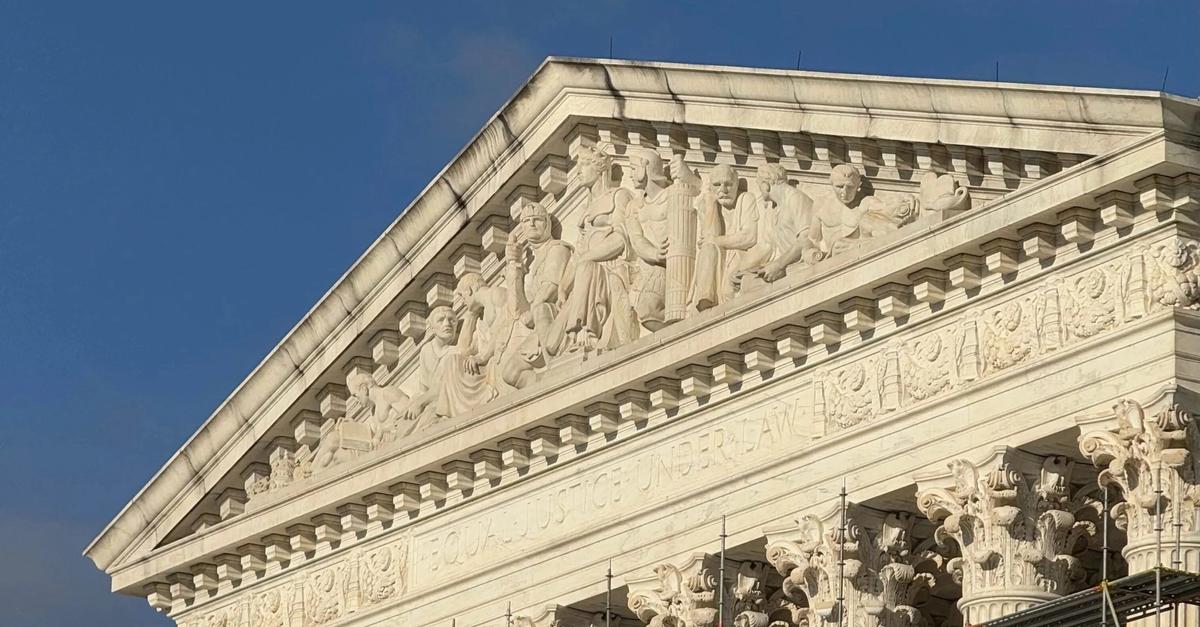
At the Court
After the possible announcement of opinions this morning, the justices will meet in a private conference to discuss cases and vote on petitions for review. Orders from that conference are expected on Monday at 9:30 a.m. EDT.
Also on Monday, the court will hear oral argument in two cases: Sripetch v. SEC, on whether the Securities and Exchange Commission can use disgorgement to force a wrongdoer to turn over its profits to the government without showing directly that the wrongdoer’s activities harmed its customers; and T.M. v. University of Maryland Medical System Corp., on whether the Rooker-Feldman doctrine, which limits lower federal courts’ authority to review state-court judgments, applies when such judgments remain subject to further review in state courts.
Morning Reads
Supreme Court Justice Clarence Thomas blasts progressivism as threat to America
Devin Dwyer, ABC News
Justice Clarence Thomas spoke on Wednesday at a University of Texas Austin Law School event tied to America’s founding 250 years ago. During his remarks, Thomas criticized the political philosophy of progressivism, presenting it as an existential threat, according to ABC News. “Progressivism seeks to replace the basic premises of the Declaration of Independence and hence our form of government,” he said. “Thomas said Washington has been overrun by elected and appointed officials who lack commitment to ‘righteous cause, to traditional morality, to national defense, to free enterprise, to religious piety or to the original meaning of the Constitution.’”
Sniping by justices underscores tension over Supreme Court’s ‘shadow docket’
John Fritze, CNN
Highlighting viral comments from Justices Sonia Sotomayor and Ketanji Brown Jackson about one or more of their conservative colleagues and requests for emergency relief from the Trump administration, CNN noted that the “Supreme Court’s emergency docket has resurfaced as a flashpoint within the federal judiciary” even as the court’s attention shifts from that docket to its merits docket. “The revived criticism of the process has landed as the Supreme Court is heading into its most intense period, with justices working behind the scenes to draft opinions in the most significant merits cases ahead of summer recess. … At the same time, the emergency docket itself has lightened considerably this year as challenges to many of Trump’s most controversial early domestic policies have either run their course or already reached the high court.”
Cruz says Trump ‘spoke to me seriously’ about Supreme Court vacancies
Ashleigh Fields, The Hill
During a Wall Street Journal Opinion Live interview on Wednesday, Sen. Ted Cruz, a Republican from Texas, “said President Trump spoke to him ‘seriously’ about filling a hypothetical Supreme Court vacancy in his first term,” according to The Hill. “[T]he president spoke to me seriously about all three vacancies, and three times I said no, because I don’t want to be out of the arena of the political battle,” Cruz said. He added, “I don’t want to be a judge. A principled federal judge stays out of policy fights and stays out of political fights. If I were a judge, I would do that. I don’t want to do that. I want to be right in the middle of political and policy fights.”
Most Tariff Refunds Facing Denial If Importers Don’t Opt In
Erik Larson, Bloomberg
In a Tuesday filing with the Court of International Trade, Customs and Border Protection explained that “[t]he vast majority of importers who paid $166 billion in tariffs that were overturned by the US Supreme Court risk not getting refunds because they haven’t signed up for electronic payment,” according to Bloomberg. “Only about 20% of the roughly 300,000 firms eligible to receive electronic refunds have signed up for the process. … The agency has previously said it will reject non-electronic refund requests.” Greg Husisian, a partner at Foley & Lardner representing companies seeking refunds, told Bloomberg that smaller companies “may not even know” about the refund process.
I Almost Never Predict Supreme Court Outcomes. Trump Will Lose This Case.
Linda Greenhouse, The New York Times
In a column for The New York Times, Linda Greenhouse reflected on the Supreme Court’s decision to hear argument later this month on the Trump administration’s effort to remove protected immigration status from hundreds of thousands of Haitian and Syrian immigrants. Although, as she explained, she rarely predicts how the court will rule, Greenhouse feels confident that the court will side with the Haitians and Syrians. Why? “My prediction here rests on one word: procedure,” she wrote. “The records in both the Haitian and Syrian cases reveal a brazen violation of procedural requirements on the part of” the Department of Homeland Security, Greenhouse contended, noting that the Supreme Court has emphasized “procedural irregularity” in past rulings against Trump.
On Site
Why does the government keep showing up at the Supreme Court uninvited?
Although the federal government frequently files “friend of the court” briefs in the Supreme Court, it has been – at least until recently – unusual for it to do so at its own initiative when a petition for review is still pending. What led to the surge in “uninvited” briefs?
What cases might the court grant next?
In his Empirical SCOTUS column, Adam Feldman analyzed the petitions for review being tracked on SCOTUSblog’s petitions page, exploring which ones carry the strongest likelihood of being granted.
The (non-)partisan puzzle in the conversion therapy case
In a column for SCOTUSblog, Craig Konnoth revisited the court’s 8-1 ruling in Chiles v. Salazar, holding that Colorado’s law prohibiting licensed counselors from seeking to change the sexual orientation or gender identity of minors was subject to strict First Amendment scrutiny. Specifically, Konnoth reflected on the significance of Justices Sonia Sotomayor and Elena Kagan’s decision to join the majority.
Podcasts
There Is No Historic Defeat for Civil Rights
Sarah Isgur takes a break from her whirlwind book tour to deliver the legal goods with David French. They discuss a Washington Post piece on civil rights data during the Trump era, Chiles v. Salazar, and free speech and AI liability in child porn.
Chief Justice Earl Warren
The 14th chief justice of the United States, Earl Warren, is most well-known for his landmark rulings: Brown v. Board of Education, Miranda v. Arizona, Loving v. Virginia, New York Times Co. v. Sullivan, and Tinker v. Des Moines, among many others. In President Harry Truman’s view, “[t]he Warren record as Chief Justice has stamped him in the annals of history as the man who read and interpreted the Constitution in relation to its ultimate intent. He sensed the call of the times – and he rose to the call.” (SCOTUSblog readers back in 2021 apparently felt similarly, crowning Warren “the greatest justice in history” in a bracketed tournament.)
Born in Los Angeles in 1891 to a Norwegian immigrant railroad worker, Warren grew up in Bakersfield, California. Even before high school, the future chief justice listened to criminal cases at the local courthouse. His father was temporarily blacklisted following the Pullman Strike, and Warren also worked for the railroad company; these experiences, he noted in his memoirs, contributed to his “progressive political and legal attitudes.” After earning his law degree from UC Berkeley in 1914, Warren spent virtually his entire career in public office, first as Alameda County’s district attorney – where in 13 years he apparently never had a conviction overturned by a higher court – then as California’s attorney general and, starting in 1942, its governor.
Warren’s record as attorney general is marred by his advocacy of the forced internment of over 100,000 persons of Japanese descent during World War II (with more than two-thirds of these individuals being native-born U.S. citizens). In his memoirs, Warren said that he had “since deeply regretted the removal order and my own testimony advocating it, because it was not in keeping with our American concept of freedom and the rights of citizens.”
Despite this, Warren was elected governor for three consecutive terms, and in 1948, joined Thomas Dewey on the Republican presidential ticket as its vice-presidential nominee (but only after turning down Dewey twice). That turned out to be the only time Warren lost in an election.
Warren’s path to the chief justiceship came partly through circumstance. When Chief Justice Fred Vinson died suddenly in September 1953, President Dwight D. Eisenhower, honoring a promise to Warren that he would make him his first appointment to the Supreme Court (Warren had campaigned for Eisenhower in the general election despite initially running as a potential candidate), appointed Warren interim chief justice. On March 1, 1954, Warren’s appointment was confirmed by the Senate.
From the get-go, Warren was able to forge relative solidarity on the court (something that his predecessor had continually failed at) by pragmatically appealing to the different justices. In his very first term, Warren authored the unanimous opinion in Brown v. Board of Education, declaring racially segregated public schools inherently unequal under the 14th Amendment and overturning the “separate but equal” doctrine that had prevailed since Plessy v. Ferguson in 1896. The decision affected 21 states and the District of Columbia, though many of the Southern states continued to resist the court’s ruling. Following Brown, Warren faced calls for impeachment for the remainder of his term in office.
Warren also participated in, or wrote, several rulings which significantly altered the legal and political landscape. In 1964’s Reynolds v. Sims, Warren established the “one person, one vote” principle, holding that representation in state legislatures must be apportioned equally on the basis of population – a ruling Warren said was his most important contribution to American law.
Warren’s tenure reshaped several other areas of law. Miranda v. Arizona required police to advise suspects of their rights before questioning – a ruling shaped in part by Warren’s “close association” with August Vollmer, the Berkeley chief of police and an early advocate for interrogation reform. Loving v. Virginia struck down bans on interracial marriage, and Gideon v. Wainwright guaranteed the right to counsel to all criminal defendants. And on First Amendment grounds, the Warren Court produced New York Times Co. v. Sullivan and Brandenburg v. Ohio – which, respectively, held that a public official can only recover damages in a civil defamation suit if the statement was made with “actual malice,” and determined that a state cannot prohibit speech unless the advocacy is “directed at inciting or producing imminent lawless action” and is “likely to produce such action.”
Then there is the matter of the Warren Commission. In 1963, President Lyndon Johnson asked Warren to chair the commission investigating President John F. Kennedy’s assassination. Warren initially declined, citing constitutional concerns about separation of powers, the court’s heavy docket, and the potential for future litigation to require his recusal – before ultimately accepting after Johnson pressed him further. The end result satisfied few people, and many believe that Warren’s instinct for secrecy undermined a more robust public defense against conspiracy theories.
After 16 years on the court, Warren retired from it in June 1969, succeeded by Warren Burger, and died from heart problems in July 1974, at the age of 83, at Georgetown University Hospital in D.C. He is buried at Arlington National Cemetery and was posthumously awarded the Presidential Medal of Freedom in 1981. Although no fan of the Warren Court, even President Richard Nixon said on the night of Warren’s death that “America has lost one of her finest public servants.”
SCOTUS Quote
JUSTICE SCALIA: “Is there – is there a difference between the function of the sign and the content of the sign?”
MR. SAVRIN: “Yes, Your Honor.”
JUSTICE SCALIA: “I frankly can’t grasp that. What is it?”
MR. SAVRIN: “Well, it depends on how –“
JUSTICE SCALIA: “Doesn’t its function depend upon its content?”
MR. SAVRIN: “In a literal sense, yes.”
JUSTICE SCALIA: “Oh, I see. What sense are we talking here?”
(Laughter.)
JUSTICE SCALIA: “Poetic?”
MR. SAVRIN: “Well, both –”
— Reed v. Town of Gilbert (2015)
The post Opinion(s) on the way appeared first on SCOTUSblog.