SCOTUStoday for Friday, April 10

On April 10, 1869, Congress passed legislation increasing the number of Supreme Court justices from seven to nine, where it’s remained since. The post SCOTUStoday for Friday, April 10 appeared first on SCOTUSblog .

SCOTUStoday for Friday, April 10

On April 10, 1869, Congress passed legislation increasing the number of Supreme Court justices from seven to nine, where it’s remained since.
At the Court

The Supreme Court on Thursday denied Sam Ronan’s request to block Ohio election officials from removing him from the state’s Republican primary election ballot. Read Amy’s analysis to learn more about the dispute.

The court will next hear arguments on Monday, April 20, the first day of its April sitting.

Morning Reads

Trump May Use Emergency Law for Iran Tariffs Despite Court Ruling, Adviser Says

Hadriana Lowenkron and Greg Stohr, Bloomberg

National Economic Council Director Kevin Hassett said Thursday that “President Donald Trump has the authority to enact new Iran-related duties under an emergency law,” the International Emergency Economic Powers Act, that “the Supreme Court previously ruled could not be used to impose tariffs,” according to Bloomberg. “This is clearly within the president’s tariff power,” Hassett said. “If we’re in a state of conflict, then you know, the IEEPA policy is exactly designed for that. And so countries really should be careful.” Bloomberg noted that the court’s tariffs ruling said “IEEPA ‘does not authorize the president to impose tariffs,’” and did not “carv[e] out an exception for military conflicts.”

Judge halts Trump administration move to end protections for Ethiopians

Zach Schonfeld, The Hill

U.S. District Judge Brian Murphy “blocked the Trump administration from ending temporary deportation protections for thousands of Ethiopians, ruling on Wednesday that it likely disregarded the rules Congress set up for” the Temporary Protected Status program, according to The Hill. Specifically, Murphy held that “the DHS failed to consult with the proper agencies” before ending Ethiopians’ participation in TPS, describing its decision as “pretextual.” Later this month, the court will hear argument in two related cases – “challenges to ending protections for Haiti and Syria.”

Supreme Court remade by Trump ushers in historic defeats for civil rights

Justin Jouvenal, The Washington Post

A new analysis of 270 Supreme Court decisions handed down “between 2020 and 2024 — the first five terms of the six-justice conservative majority” — shows that, over that period, the court became “the first since at least the 1950s to reject civil rights claims in a majority of cases involving women and minorities,” according to The Washington Post. “The analysis shows that in addition to civil rights, the court powered by Trump’s picks — Justices Neil M. Gorsuch, Brett M. Kavanaugh and Amy Coney Barrett — has pushed to the right of any modern court on religious rights and voting issues.”

Supreme Court Secrecy Includes Reasons for Recusal

Adam Liptak, The New York Times

In the latest edition of his newsletter for The New York Times, Adam Liptak highlighted a recent study on “the justices’ decisions about whether to disqualify themselves from cases in which they may have a conflict of interest.” The study from Harvard law professor Richard Lazarus, who is a close friend of Chief Justice John Roberts, emphasized the lack of information about recusals and suggested policies that could assure court watchers that the ethics “guidelines are not mere lip service.” “One was the creation of a formal ethics office at the court that the justices could consult. The other, the focus of this item, was a little sunlight. In the absence of unusual circumstances, he wrote, justices should ‘release formal written statements explaining their reasons for recusing or not recusing.’”

Winning For Workers Before A Conservative Court: Jennifer Bennett

David Lat, Original Jurisdiction

For his Substack, Original Jurisdiction, David Lat spoke with Jennifer Bennett of Gupta Wessler, who “has argued five cases before the high court, and of the four that have been decided, she won all of them—with unanimous decisions each time.” They discussed how she prepares for oral argument before the Supreme Court and moments that stand out from her five appearances before the justices. “[T]he first time I was ever in the Supreme Court was my first Supreme Court argument,” Bennett recalled. “And you walk into the Court, and the bench is incredibly close to your face. And I just remember thinking, ‘If they hate you, they could spit at you!’”

On Site

Contributor Corner

Conversion therapy and professional speech

In his Courtly Observations column, Erwin Chemerinsky reflected on the court’s decision in Chiles v. Salazar, in which it “essentially declar[ed] unconstitutional the Colorado law prohibiting talk therapy to attempt to change a minor’s sexual orientation or gender identity.” The ruling “continues a pattern of inconsistent decisions concerning the ability of the government to regulate speech by professionals,” Chemerinsky wrote.

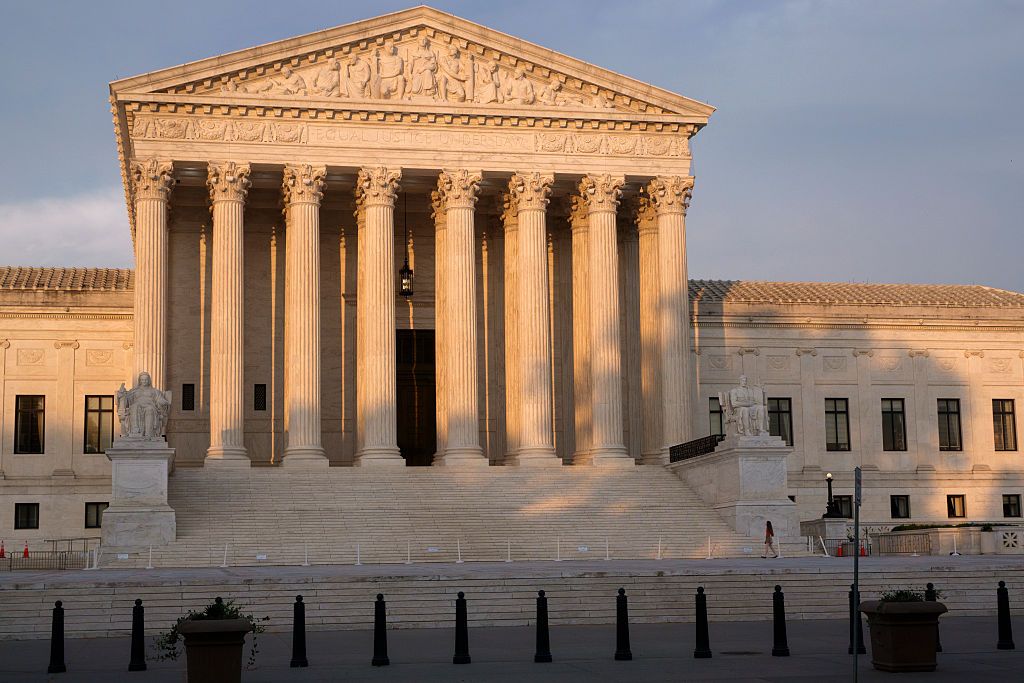
The statue, Authority of Law, by American sculptor James Earle Fraser outside the Supreme Court of the United States. The High Court building was built during the Great Depression and completed in 1935. Architect Cass Gilbert's design is based on a Greco-Roman temple.
Contributor Corner

Legislative history lives on – in secret

In her Clear Statements column, Abbe R. Gluck examined the court’s current approach to statutory interpretation, pushing back against claims that textualism has displaced the use of congressional intent. “Rumors of the textualist triumph over legislative history have been greatly exaggerated,” Gluck wrote. “Whether the justices want to admit it or not, the court today is paying attention to legislative history and what it reveals about statutory purposes.”

supremecourt

Podcasts

Advisory Opinions

Trump’s ‘War Crimes’

Sarah Isgur and David French discuss President Donald Trump’s rhetoric over Iran, what constitutes a war crime, and what happens if a military officer fails to obey an order or regulation.

SCOTUS Quote

“When you go see an argument, you’ve been on the opposite side, you know that this court is an extremely well-prepared court, that the justices have read the briefs, that the justices know the case. And I think our conversation in conference reflects that. It’s substantive. It’s a conversation that only people who have really done the reading and done the thinking could have. And again, I think if you were a fly on the wall, you would be pretty proud of the institution.”

Justice Elena Kagan  (2019)

The post SCOTUStoday for Friday, April 10 appeared first on SCOTUSblog.

Need Support?

Find verified resources for reproductive healthcare, support services, and advocacy organizations.

Find Resources