MONTGOMERY, ALABAMA — More than 30 years apart, two women separately set forth on long drives south to Alabama. Their backgrounds were different, their mission the same: to join an existential fight for the soul of American democracy.
Viola Gregg Liuzzo, a White 39-year-old married mother of five from Detroit, went first. In 1965, she was appalled by images from Bloody Sunday, when state troopers tear-gassed and brutalized voting rights activists who were attempting to cross the Edmund Pettus Bridge on a march from Selma to Montgomery. When Dr. Martin Luther King Jr. and John Lewis asked Americans to come to Selma to join them for their third try in March, Liuzzo answered the call.
Jocelyn Benson, a 19-year-old inspired by Liuzzo’s story, made the same journey in 1997. Right out of college, she worked as a volunteer researcher and undercover investigator at the Southern Poverty Law Center (SPLC), the nonprofit legal and advocacy organization that researches white supremacists and far-right hate groups.
Benson’s time in Alabama helped set her on course to effect change by running for political office. After being elected to two terms as Michigan’s secretary of state, the state’s chief election official, she’s now the Democratic front-runner for the open governor’s race, set to be among the most competitive and consequential in the nation.
“I left this experience thinking my contribution to the work would be making sure I was a public servant,” Benson recalled in an interview outside the Civil Rights Memorial at the SPLC’s headquarters in Montgomery, where she got her start nearly 30 years ago.
“That’s all I’ve ever wanted to be, alongside being someone who would have the courage of those who were on the foot of the Edmund Pettus Bridge,” she added.
Anthony Liuzzo Jr., Viola’s son, remembers her as a “strong, ferocious woman” strongly committed to social justice and to her community. She couldn’t attend the 1963 March on Washington, but she heeded King’s call for Americans to drive with their headlights on to show solidarity and painted: “My lights are on in support of Dr. King and his march on Washington” on her car with shoe polish, he recalled. She also opened up their family’s home to people experiencing homelessness and addiction and offered them clean clothes, meals and tried to get them to attend Alcoholics Anonymous meetings.
“Inevitably, a lot of them would rip us off. But she didn’t care,” he said. “She said, ‘If I can get one, give them help, and it makes a difference in their life, then I’ll have succeeded.’”
On March 25, 1965, Liuzzo walked into Montgomery as part of the historic, successful four-day march for voting rights from Selma that ended at the Alabama state capitol, where Dr. King addressed the then-25,000-person crowd.

After the march ended, she offered to shuttle marchers and volunteers back to Selma in the 1963 Oldsmobile she had driven 14 hours from Detroit. She and a fellow volunteer, a young Black man named Leroy Moton, were stopped at a red light driving on Route 80 in Lowndes County when four Ku Klux Klan members in another car spotted them. They proceeded to chase Liuzzo, eventually overtaking her car and fatally shooting her.
Moton pretended to be unconscious and later testified against the men, three of whom were convicted of federal conspiracy to intimidate African Americans and were sentenced to prison.
Liuzzo holds a unique place in history as a White woman who was killed during the Civil Rights Movement.
After Benson first learned of Liuzzo’s story as a student studying political science at Wellesley College in the late 1990s, she traveled to Montgomery during the spring break of her junior year to visit the SPLC and the Civil Rights Memorial.
She graduated early, then borrowed her grandparents’ 1985 Buick and drove to Montgomery, she writes in her 2025 memoir “A Purposeful Warrior.” There, she waited tables at an Italian restaurant to pay her bills during her unpaid internship at the SPLC.

Benson researched neo-Nazi and far-right hate groups, including posing as a freelance journalist to uncover and expose the plans of white supremacist leaders and groups. In her first undercover assignment, she went to South Carolina to meet with and write a report on neo-Nazi leader Davis Wolfgang Hawke. The work could be scary, but she felt grounded in history.
Benson views it as her life’s mission to carry on the work that Liuzzo would have continued had she lived and gone back to Detroit.

“I wanted to learn from everyone who was actively trying to answer this question of, ‘What is the unfinished work of the Civil Rights Movement today?’” Benson said. “And that was 30 years after Selma when I was here. So now here we are, over 60 years later, still trying to pick up that baton and say, ‘How can I honor all the lives that were lost in this work by continuing the work they would have done had they lived?’”
After two years at the SPLC, Benson continued her studies as a Marshall Scholar at Oxford University and earned her law degree from Harvard Law School. A law clerkship for 6th U.S. Circuit Court of Appeals Judge Damon Keith, a prominent Black jurist and ardent defender of civil rights, brought her to Detroit. Benson began teaching law at Wayne State University Law School at 27 and was appointed as the law school’s dean at 36, making her the youngest woman to serve as dean of an accredited law school in the history of the United States.
She worked to elevate Liuzzo’s legacy at Wayne State, where Liuzzo had been a part-time nursing student. Anthony Liuzzo Jr., who was 10 when his mother died, met Benson for the first time in 2015, when the school awarded Liuzzo an honorary doctor of laws degree and dedicated a memorial tree and plaque in her honor.
“I know she had worked with the Southern Poverty Law Center, but I had never met her,” Anthony Liuzzo Jr. said in an interview. “And I mean, right from the start, I thought, ‘Wow, she’s a firecracker.’ Very smart, intelligent, and just cared about people. You could tell that.”
And every year, Benson returns to Montgomery and Selma for the Selma Jubilee weekend marking the anniversary of Bloody Sunday.
The 19th joined Benson and a group of seven elected officials from Michigan as they visited historic landmarks in Montgomery, marched across the Edmund Pettus Bridge in Selma and paid their respects at a memorial to Liuzzo on the highway where she was killed.
This year, the trip was particularly resonant for Benson as she takes on her biggest political challenge yet.
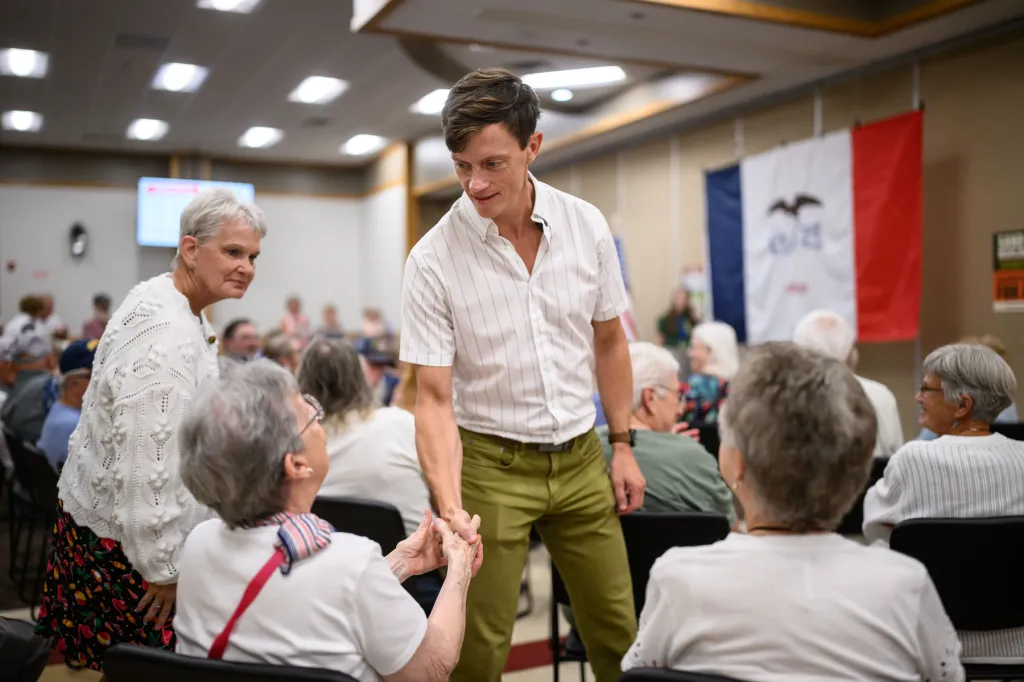
“I do think this will be the most watched governor’s race in the nation because of the stakes of play,” Benson said. “But I’m ready for that spotlight as well, because I’ve been under that spotlight as secretary of state.”
Prior to the 2020 election, secretaries of state were largely under-the-radar figures whose work administering elections attracted little public scrutiny. But all that changed soon after Benson was first elected in 2018.
She found herself facing down violence and threats when she defended the integrity of the 2020 election against President Donald Trump’s false claims of election fraud and attempts to overturn his election loss in Michigan and other key battleground states. Months of attacks from Trump and his supporters culminated in angry, armed protesters showing up at her home, where she was inside with her young son, in December 2020.
“I had this moment where I was like, ‘Oh, this is part of that work, too.’ You have to be prepared to have the moral courage to not run when it gets particularly scary, when your life is threatened,” Benson recalled. “And that, and being here, in many ways, prepared me to walk through the fire, especially in the Trump era.”

She would later be honored with a John F. Kennedy Profile in Courage award, and in 2023, was awarded the Presidential Citizens Medal by then-President Joe Biden. Many Democrats and civil rights advocates see strong parallels between the world the Civil Rights Movement fought against and life under the second Trump administration.
The Voting Rights Act of 1965, the crowning achievement of those who marched from Selma to Montgomery, is increasingly under threat. Ahead of the 2026 midterms, the Trump administration has taken extraordinary steps to cast doubt on election results. Protests over the administration’s aggressive immigration enforcement and mass deportations, and the killing of two U.S. citizens by federal immigration officials in Minneapolis, have dominated the news.
“It’s really sad to me and to my whole family that we see everything that my mother fought and died for being stripped away, and not even a little at a time,” Anthony Liuzzo Jr. said. “By just leaps and bounds, they’re just stripping everything away.”
Benson planned this year’s trip to Alabama with Democratic state Rep. Morgan Foreman, who grew up steeped in the history of the Civil Rights Movement from her older family members, some of whom had lived in the South at the time.
“Every single thing is at stake in Michigan. And I might sound dramatic when I say this, but the soul of our nation is at stake in Michigan right now,” said Foreman, who has endorsed Benson. “We know that the Trump administration, MAGA, they’re putting a lot of energy into Michigan right now to make it more purple, to try to turn it red, and we just cannot let that happen.”
Trump narrowly carried Michigan by 1.4 percentage points in the 2024 presidential election, as Democratic Sen. Elissa Slotkin won a close Senate race by fewer than 20,000 votes. Michigan will again be at the center of the political universe yet again in 2026, with an open U.S. Senate seat, three top statewide executive offices, multiple competitive U.S. House seats and both chambers of the divided state legislature all up for grabs.
“In poker, there’s a part of the game when all chips are pushed in, and everything’s on the line,” said Marcus Muhammad, the mayor of Benton Harbor and the president of the Black Mayors of Michigan, which recently endorsed Benson. “I think that’s the political landscape and picture that we’re looking at in 2026.”

Benson is the front-runner for the Democratic nomination: her main opponent is Genesee County Sheriff Chris Swanson after Lt. Gov. Garlin Gilchrist dropped out of the governor’s race and opted to run to replace her as secretary of state. A crowded field of Republican candidates, including Rep. John James, state Sen. Aric Nesbitt and former state Attorney General Mike Cox are running in the GOP primary, set for August 4th.
While their primary has meant that her potential general election opponents have not aimed much fire at her yet, Republicans in the state and nationally have continued to scrutinize Benson’s handling of elections. Michigan is one of several states that successfully rebuffed the Trump administration’s requests to turn over sensitive voter data and last year, some Republicans asked the Trump administration to take over Michigan’s 2026 elections because Benson is running for governor while secretary of state.
Benson, who was also on the ballot statewide in 2022, said her team has a “firewall” in place to avoid any potential conflicts of interest and she has full confidence in the state’s local election officials. “I will not be the face of election administrators in Michigan this cycle,” she said.
In a twist that could throw a wrench into the race, former Detroit Mayor Mike Duggan, who left the Democratic Party after the 2024 election, is running as an independent candidate. Though Duggan has been vocally criticizing the Democratic Party in his campaign, his bid threatens to siphon votes from the Democratic nominee. On the campaign trail, Duggan has slammed Democrats over the state’s sliding education performance and lawmakers’ legislative priorities in Lansing as Democrats, including state party chair Curtis Hertel, have excoriated his bid as a “self-serving ego trip on a road to nowhere.”
Black voters are critical to the electorate in Michigan, especially in Detroit and its surrounding suburban counties. A drop in support for Democrats among some voters of color, especially young Black men and Latinos, contributed to former Vice President Kamala Harris’ 2024 loss to Trump in Michigan and other key battleground states.

Foreman said she was “very moved” by Benson’s affinity for the history of the South.
“I’m just really appreciative of her time and her love for this country and her love for the movement, because the movement never stopped. It’s changed. It looks different, but it hasn’t stopped at all,” Foreman added.
As governor of Michigan, Benson would again be in a position to push back on any Trump-led efforts to interfere with and subvert the 2028 presidential election. Being a prominent swing-state governor would also give her a larger platform to restore and reshape the Democratic Party’s brand in the lead-up to the 2028 presidential contest.
“To me, this work is not just the unfinished work of the Civil Rights Movement,” she said. “It’s the required work of state leaders right now to see the dysfunction in the broken system that is recklessly leading our nation and offer an alternative vision for what government can be, an entity that actually improves your life, that shows up when you need it, and then gets out of the way when you don’t.”
Benson and seven elected officials from Michigan were among the hundreds of Democratic elected officials and civil rights activists who descended on Selma for the anniversary of the Bloody Sunday march. But there was one stop they needed to make first.
Route 80 cuts through the rolling green hills and rural farmlands between Selma and Montgomery. On the eastbound side of the highway, next to a Methodist chapel, is a memorial: a headstone on a small brick patio that reads: “In memory of our sister Viola Liuzzo, who gave her life in the struggle for the right to vote.”

When Benson was elected as secretary of state, which oversees motor vehicle services in Michigan, she reissued the vintage navy blue and gold plate with the tagline “Water-Winter Wonderland,” like the one that was on Liuzzo’s car.
Benson’s office produced a special commemorative edition with Liuzzo’s plate number, which she gave to her family. “I thought she hit a home run with that,” Anthony Liuzzo Jr. said. “It was such an honor to have that done.” Benson brought another plate with her to Alabama for her and the group of lawmakers to sign and leave at Liuzzo’s memorial, a physical token of her impact.
Anthony Liuzzo Jr. said his mother’s legacy lives on through the lives she’s shaped, Benson’s and those of the many Americans who have reached out to him over the years.
“I get emails and I get things through Facebook messages, saying, ‘Just wanted to let you know how your mother changed my life. I didn’t know about her, but after I found out, it just changed my life,’” he said. “And no matter what they do, they can’t kill what she was and what she lived and died for.”