Birthright citizenship promotes inclusivity. The Supreme Court could revoke that promise.

More than 3 million babies born in the United States each year receive the right to citizenship. There is no application. No test. No government interview. Citizenship is documented by a line on their birth certificates — reflecting a promise written into the Constitution more than 150 years ago.


Birthright citizenship promotes inclusivity. The Supreme Court could revoke that promise.

More than 3 million babies born in the United States each year receive the right to citizenship. There is no application. No test. No government interview. Citizenship is documented by a line on their birth certificates — reflecting a promise written into the Constitution more than 150 years ago.
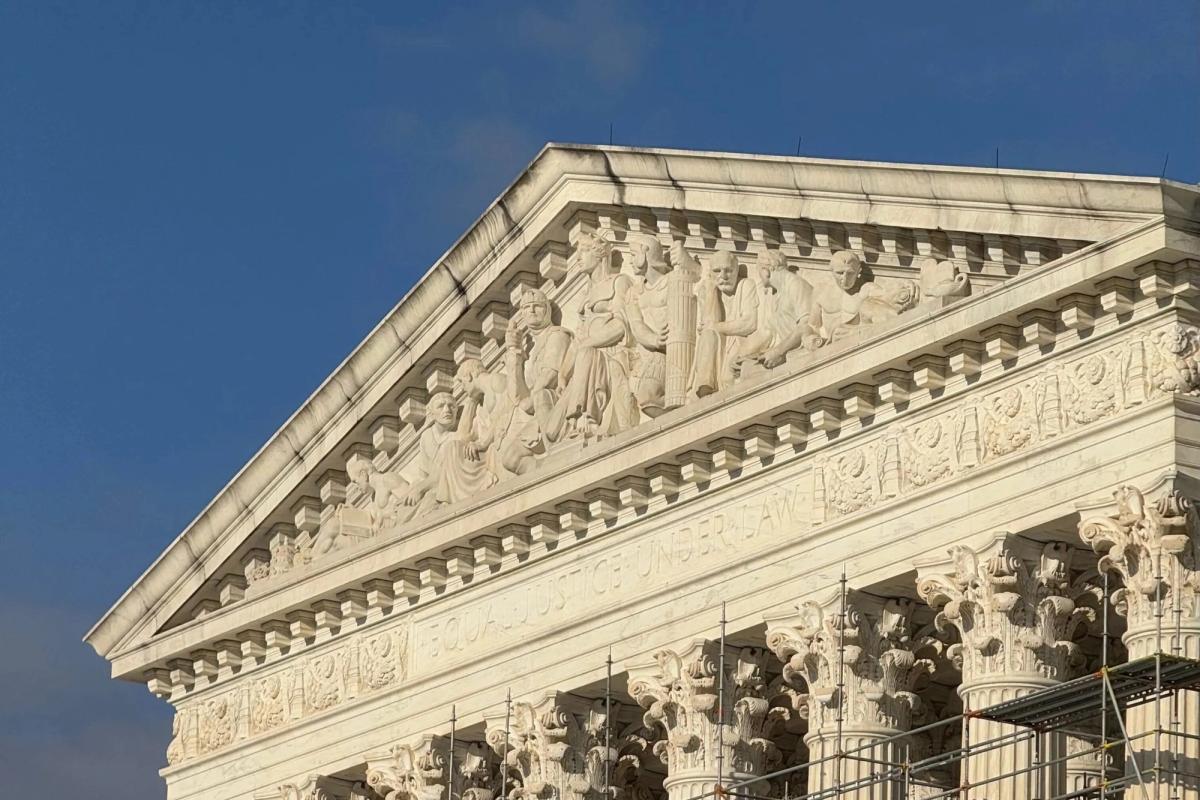
On April 1, the U.S. Supreme Court will hear arguments in Trump v. Barbara, a case that could dramatically reshape that longstanding principle. The decision will determine the constitutionality of President Donald Trump’s executive order to restrict the 14th Amendment’s guarantee to birthright citizenship.

But this consequential case goes beyond deciding who gets to be an American. Upholding the executive order could usher in a new population of children who would be vulnerable to immigration enforcement measures. Pregnant women who have sued to challenge the order describe living in fear that their child will be “stateless.”

The drafters of the 14th Amendment, which was ratified in 1868, aimed to create a clear standard of belonging that would apply to people born on U.S. soil, historians and legal experts told The 19th. For years, however, efforts to define (and redefine) citizenship and belonging in the country have persisted, determining who the government has the power to detain, deport or push out. 

On the day Trump returned to office, he signed an executive order reinterpreting the 14th Amendment. It would deny birthright citizenship to children born to a mother living in the country without authorization and a father who is not a U.S. citizen or permanent resident, as well as children born to a mother who has temporary legal status — including a visa —  and a father who is not a U.S. citizen or permanent resident.

The order does not address transgender parents or parents from other queer identities. It does, however, define “mother” as a “female biological progenitor” and “father” as a “male biological progenitor.” In effect, the change would move from determining citizenship based on birthplace to a system anchored by parental immigration status.

Shifting the interpretation of birthright citizenship threatens to significantly expand the number of people living in the country without authorization for generations. An estimated 2.7 million additional people would be unauthorized by 2045, and 5.4 million additional people by 2075, according to projections published by the Migration Policy Institute and Pennsylvania State University.

This “ever-expanding group of outsiders,” as researcher Juliet Stumpf wrote in a paper 20 years ago, not only allows the government to withhold the privileges of citizenship, like the right to vote, but it also gives the state “the power to punish, and the power to express moral condemnation.” 

It’s a reality that is already playing out in the current political climate. 

Trump has repeatedly stated that ICE, under his administration, will detain and deport “the worst of the worst,” though data indicate that a majority of the people arrested by immigration officials do not have a criminal conviction.

Stumpf is the Edmund O. Belsheim Professor of Law chair at Lewis & Clark Law School, whose research focuses on the intersections of criminal and immigration law. In her work, she analyzes a concept called “membership theory,” where a society decides which groups of people belong and receive privileges while excluding others who fall outside. Since the country’s founding, its criminal legal system, including jails, prisons and other forms of confinement, have been used to segregate and control populations of noncitizens and people of color.

The drafters of The 14th Amendment and the Black Americans leading the charge to adopt birthright citizenship understood this dynamic in the years before the Civil War. Free Black Americans, considered noncitizens by many authorities, were forced to navigate a patchwork of different laws. A free Black person could be considered a citizen of New York or Massachusetts, but might be picked up and jailed if they crossed state lines into South Carolina or another southern state, said Kate Masur, a professor of history at Northwestern University.

Free Black Americans understood from experience that the denial of their American citizenship was a denial of their membership in society, and that it pushed them to the margins, Masur said. The 14th Amendment was designed to ensure their inclusion and to lay the groundwork for a multiracial nation.

During debates over the 14th Amendment, lawmakers specifically discussed whether birthright citizenship would include the children of Chinese immigrants. Supporters of the amendment affirmed that those children would be included, Masur said.

“The challenges of immigration and trying to create a multicultural nation were very much on the radar of the people who were pushing for this amendment,” she said. “They said, ‘Yes, we are trying to do something that’s universalizing, even to the extent that it would make citizens of the children of the immigrants who many Americans most feared at this time.’”

But even after the 14th Amendment became the law of the land, efforts remained to limit who could claim the membership and benefits of U.S. citizenship. One of the most notable examples of this came in the 1890s, when Wong Kim Ark, a man born in San Francisco to Chinese parents, sued the government after being denied reentry into the United States following a visit to China to see his family. That case resulted in a landmark Supreme Court decision affirming that Ark had acquired citizenship by being born on U.S. soil, a fact that did not change with his international travel.

But efforts to tie birthright citizenship to parental status persisted. Between 1921 and 1944, the U.S. government orchestrated mass removals of an estimated 1 million men, women and children of Mexican ethnicity. As the country reeled from its most devastating economic crisis, the federal government treated Mexican-born and Mexican-American people as scapegoats who needed to be pushed out to free up jobs.

“There was no change to naturalization immigration laws. Instead, the mass removals were categorized as repatriation, implying a voluntary process of relocation and removal that women and children, who were U.S. citizens, were following their Mexican husbands or fathers out of the country when they were removed,” said Marla A. Ramírez, assistant professor of history and Chicanx & Latinx Studies at the University of Wisconsin-Madison.

In some cases, this repatriation process involved government agents knocking on doors and encouraging people of Mexican descent to self-deport Other times, immigration officials raided parks and public spaces, arrested families and loaded them onto trains and trucks headed for Mexico. For women, these policies were informed by a legal doctrine called coverture, which in effect erased a woman’s individual legal identity once she married, Ramírez said.

In a public Facebook post, one woman shared the story of her grandmother, who was born in Mexico City in 1899, became a U.S. citizen in 1922 and witnessed how repatriation targeted both citizens and noncitizens of Mexican descent. 

“The repatriations frightened my grandmother,” she wrote. “She started using an old time fade cream to lighten her skin. She wore light face makeup, light gloves and light hosiery. She wore hats and used umbrellas so she wouldn’t tan. She learned English at the same time she learned Spanish, French and German so she didn’t have an accent. Still she didn’t speak Spanish outside of the house. She always only wore 100 percent American fashion and styles. She made sure everyone called her Mrs. Mary Cummins and never Maria Rivera. I also think it’s the reason she married a super white guy with white blue eyes.” 

This point in history is not a direct mirror of the U.S. political climate in 2026, when the nation’s highest court will now consider whether to limit birthright citizenship. But clear parallels exist: the government reinterpreting law, pointing to economic anxieties to push for deportations and self-deportations, ensnaring whole families in the process. 

Immigrant parents and pregnant people have reported altering their day-to-day lives by avoiding seeking out medical care, staying confined to their homes and concealing aspects of their cultural identity because of fear of immigration enforcement. “It comes from a long history of attempts to reduce the protections of birthright citizenship. And it is important because those reductions often target people of minority backgrounds in terms of race, ethnicity or class, and usually can target women,” Ramírez said.

The Supreme Court justices will evaluate the case after the April 1 oral arguments and rule by the end of the court’s term in late June or early July. It’s impossible to determine the decision in advance. Many legal experts contend that birthright citizenship is settled law, strengthened by years of prior court rulings, including the Ark case. But in some high-profile cases, the court’s conservative majority has recently overruled long-standing legal precedent, such as overturning federal abortion protections and sharply limiting the consideration of race in college admissions.

Since Trump took office during his second term, more than 600,000 people have been deported, according to figures from the Department of Homeland Security. In January, 73,000 people were being held in ICE detention, a record high in the agency’s 23-year history. Among those arrested and detained over the last 14 months are individuals with legal status, asylum seekers and U.S. citizens.

Being in the United States without authorization is not a crime, Stumpf said, but since the 1990s, the U.S. government has constructed a system of rhetoric with terms like “illegal alien,” and punitive measures like prolonged detention that have criminalized the existence of undocumented people.

Now, the addition of more than $70 billion last year to expand immigration enforcement operations adds a heightened level of policing and surveillance that affects both undocumented people and those suspected of being undocumented because of their language or skin color, Stumpf said.

These are the stakes of the decision before the Supreme Court, experts said.

“There’s kind of two levels to it,” Stumpf said. “What are these kids going to be actually subject to? And then, how is society going to perceive their membership in our country?”

Need Support?

Find verified resources for reproductive healthcare, support services, and advocacy organizations.

Find Resources