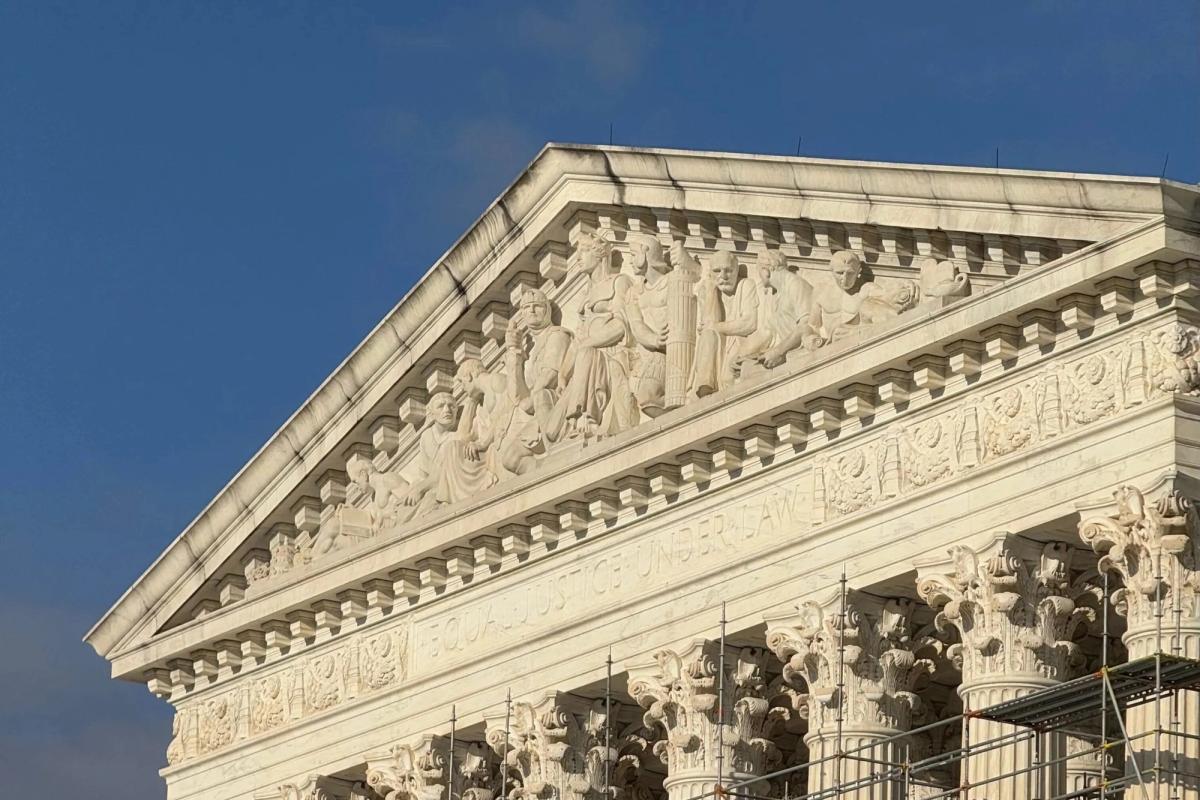
Justice Jackson criticizes the court

Plus, in the latest edition of Ask Amy, Amy explores how common it is for a justice to have argued a case before the Supreme Court before becoming a justice.

Justice Jackson criticizes the court

We realized Ask Amy was making our Friday newsletters rather long, so we’ll now run this on Wednesdays in place of a Closer Look.

And please join us today at noon EDT on LinkedIn Live for Amy’s discussion with Briefly’s Adam Stofsky about this term’s highest-profile cases. Register here.

At the Court

On Tuesday, the court denied a request for a stay of execution from Tony Carruthers, who was sentenced to death in Tennessee after being found guilty of three murders. Carruthers is scheduled to be executed on Thursday.

The court has indicated that it may release opinions on Thursday at 10 a.m. EDT. We will be live blogging that morning beginning at 9:30.

After the possible announcement of opinions, the justices will meet in a private conference to discuss cases and vote on petitions for review. Orders from tomorrow’s conference are expected on Tuesday at 9:30 a.m. EDT.

Morning Reads

Justice Jackson criticizes Supreme Court’s handling of major voting case

Justin Jouvenal, The Washington Post

During an appearance at a gathering of lawyers on Monday in Washington, D.C., “Justice Ketanji Brown Jackson criticized the high court ... saying its decision to expedite a ruling in a major voting rights case this month made it appear political,” according to The Washington Post. “Jackson said the court’s reputation rests on appearing neutral in political disputes but speeding up the release of its [Louisiana v. Callais] ruling made it appear as if it were favoring one side,” because the “shortened timeline paved the way for Republicans in Louisiana” to redistrict ahead of this year’s elections.

Justices Hint at Strains as Supreme Court Comes Under Scrutiny

Ann E. Marimow and Aishvarya Kavi, The New York Times (paywalled)

The New York Times highlighted Jackson’s Monday remarks in its story about how she and other justices who have offered public remarks in recent weeks appear to be “intensely aware of a public debate about their relationships with each other and the court’s own legitimacy.” While several justices, including Chief Justice John Roberts, have pushed back against criticism of the court during their appearances, emphasizing that justices are not political actors and that they know how “to get along despite substantive disagreements,” Jackson, the Times noted, “has been most willing to criticize the court, increasingly alone.”

NAACP calls for boycott of Southern college sports programs over voting rights

Matt Brown, Associated Press

The Supreme Court’s Callais ruling set off a redistricting push across the country. That push, in turn, has prompted the NAACP to “call[] on Black athletes and fans to boycott the athletic programs of public universities in states that are taking steps that the nation’s oldest civil rights group says are restricting Black voting rights,” according to the Associated Press. “The NAACP’s campaign calls out Alabama, Florida, Georgia, Louisiana, Mississippi, Texas and South Carolina as states to boycott, arguing that the athletic programs of those states’ major universities are especially reliant on Black athletic talent and should protect Black political interests.”

Packing the Supreme Court is no longer a fringe idea

Ian Millhiser, Vox (paywalled)

“Court-packing, or adding seats to a court in order to change its ideological or partisan makeup, was considered an exceedingly radical idea as recently as a decade ago,” according to Vox. But it is quickly amassing supporters – and not just Democrats. “In February, Utah Republicans packed their state supreme court after that court backed a challenge to the state’s GOP-friendly congressional maps.” Vox noted that, at the federal level, court-packing would be easier to pursue than other proposed reforms, because “Congress could add seats to the Supreme Court with ordinary legislation, while more moderate proposals, such as term limits for the justices, would almost certainly require a constitutional amendment.”

Ranking the Worst Supreme Court Decisions of All Time

Damon Root, Reason

After noticing that Monday marked 130 years since the court released its “notorious decision in Plessy v. Ferguson,” in which it “enshrined the notorious pro-Jim Crow doctrine of ‘separate but equal,’” Damon Root set out to compile a “list of the worst SCOTUS decisions ever made.” He proposed Dred Scott v. Sandford, “which said that black Americans ‘are not included, and were not intended to be included, under the word “citizens” in the Constitution,’” and Korematsu v. United States, “which upheld President Franklin D. Roosevelt’s wartime internment of innocent Japanese-American citizens,” and invited his readers to “weigh in with your own votes.”

On Site

Contributor Corner

A docket in the shadow of bigger problems

A docket in the shadow of bigger problems

In his Major Questions column, Adam White reflected on comments Justice Ketanji Brown Jackson made recently about how the Supreme Court responds to emergency petitions arising from the executive branch’s orders and actions. Jackson called on the court to focus more on the relative harms than on the legal issues involved. White contended that such an approach “risks prioritizing the interests of those who go to court to block new government policies, not those countless non-litigants who stand to benefit from a given government policy.”

Contributor Corner

Rethinking a Supreme Court principle used to undermine the Voting Rights Act

Rethinking a Supreme Court principle used to undermine the Voting Rights Act

In his Courtly Observations column, Erwin Chemerinsky revisited the Purcell principle – the principle that federal courts should not alter the conduct of elections soon before they are to occur. Conservative justices, according to Chemerinsky, have frequently invoked this principle over the past two decades, and yet they “paid no attention to it whatsoever” in Louisiana v. Callais, “a ruling that will dramatically change the conduct of elections that are ongoing.”

Podcasts

Advisory Opinions

Let’s Sue the Government

Sarah Isgur and David French discuss the IRS lawsuit brought by President Donald Trump, the Supreme Court’s mifepristone decision, and a unanimous ruling from the justices that no one except Sarah cares about.

Ask Amy

After the “A Closer Look” section of our May 8 newsletter indicated that Chief Justice John Roberts "argued 39 cases before the Supreme Court, winning 25 of them," we got this question: Is it typical that Justices argue cases before the Supreme Court before being appointed as a Justice?

In short, not necessarily. In addition to Roberts, three other current justices – Samuel Alito, Elena Kagan, and Brett Kavanaugh – argued cases at the court before joining it.

Alito argued 12 cases, winning 10. Perhaps most memorably, he stepped up to argue one with just two days’ notice after a death in the family of the lawyer who had been slated to argue.

While serving as the U.S. solicitor general during the Obama administration, Kagan argued six cases before she was elevated to the Supreme Court. Her first argument in any court was the landmark Citizens United v. Federal Election Commission, in which the justices struck down restrictions on independent campaign contributions by corporations.

Kavanaugh argued one case, in 1998: Swidler & Berlin v. United States, in which he (on behalf of Ken Starr and the Office of Independent Counsel in the Whitewater investigation) asked the court to hold that an attorney can be required to turn over notes he took during an interview with a client after the client's death. By a vote of 6-3, the court rejected that argument, ruling that the attorney can refuse to turn over those notes.

Some other justices in the past few decades have also argued before the court. Justice Ruth Bader Ginsburg argued six times, in cases involving gender discrimination law, between 1972 and 1978.

And Justice Thurgood Marshall argued before the court 32 times, winning 29 of those cases, including the 1954 landmark decision in Brown v. Board of Education, striking down the principle of “separate but equal” facilities in education.

But the justice with the most arguments before the court was Justice Robert Jackson, who argued there a whopping 44 times, winning 38 of those. Jackson was also the last justice who did not have a law degree. He did not go to college at all; after completing one year at Albany Law School, he served as an apprentice with a practicing lawyer before being admitted to the New York bar at the age of 21.

SCOTUS Quote

JUSTICE SCALIA: “What was that? What was that basic protective gear that everybody –”

JUSTICE GINSBURG: “Hard hats, ear plugs or ear muffs, and boots.”

MR. FREDERICK: “Thank you, Justice Ginsburg.”

CHIEF JUSTICE ROBERTS: “What was it?”

(Laughter.)

CHIEF JUSTICE ROBERTS: “Let's see if you remember what she said. What was it?”

(Laughter.)

MR. FREDERICK: “Hard hats, ear plugs, hair nets, beard nets, and basic smocks.”

CHIEF JUSTICE ROBERTS: “And – but the –”

JUSTICE GINSBURG: “And boots.”

MR. FREDERICK: “And boots. Sorry. I forgot boots.”

CHIEF JUSTICE ROBERTS: “You left boots out.”

Tyson Foods, Inc. v. Bouaphakeo (2015)

Need Support?

Find verified resources for reproductive healthcare, support services, and advocacy organizations.

Find Resources