“It would be consistent with my public image if I told you that I spent the summer catching flies so we could pull the wings off the flies,” Justice Samuel Alito told an audience at the 5th Circuit Judicial Conference, a gathering of judges and lawyers, last Tuesday morning in Houston. The remark came in response to a question from law professor (and former Texas solicitor general) Aaron Nielson about Alito’s pastimes as a child growing up in New Jersey. Alito made clear that he was only joking about the flies, but in a wide-ranging conversation that lasted roughly 75 minutes Alito showed his sense of humor, expressed dissatisfaction with life in the public eye and in Washington, D.C., and offered a glimpse into the inner workings of his chambers and the Supreme Court.

Nielson, who worked as a law clerk for Alito during the 2014-15 term, recalled Alito’s “legendary” springer spaniel Zeus. Alito described Zeus as an example of the “effect of Washington, D.C., on the psychology of living beings.” He explained that when his family lived in New Jersey, Zeus served as a therapy dog and was generally “sane.” But then Alito joined the court and the family moved to Washington, Alito said, where there is “something in the atmosphere of the Beltway that affects the brain,” causing Zeus to develop mental health issues. Zeus, Alito said, could no longer be left alone, requiring the Alitos to spend “more money on dogsitters than we had ever spent on babysitters.”
Alito also explained how he had come to serve as the “circuit justice” – which means that he fields emergency requests from the circuit – for the 5th Circuit, which includes Texas, Louisiana, and Mississippi. After the 2016 death of Justice Antonin Scalia, who had previously served in that role, Alito joked, Chief Justice John Roberts called him into his chambers and said, “I think what the 5th Circuit needs is another Italian American born in Trenton, New Jersey.”
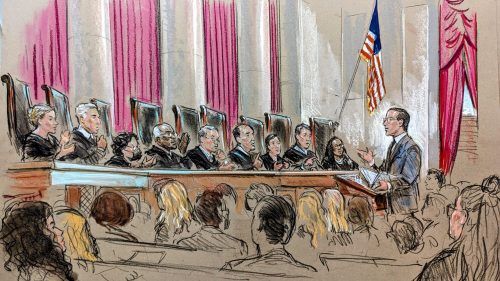
Other parts of Alito’s conversation with Nielson were more substantive. He spent quite a bit of time discussing how he and the court do their work. Alito acknowledged that oral arguments have become “entirely different” from when he started at the court in 2006. With the shift in format since the justices’ return to the courtroom after holding oral arguments over the telephone during COVID-19, he said, arguments “can go on and on and on and on … past the point where they are contributing to the decision-making process.” He suggested that there is “too much speechifying” and “too little asking real questions” during those oral arguments.
Alito recounted how he once decided that, as an experiment, he would not ask any questions at all. He reported that he found the experience “unbelievably boring,” and he contended that oral arguments are “valuable” even if their role is ultimately “limited” in helping the justices to decide the case. He explained that by the time oral arguments arrive, he has already read the briefs, received memos on the case from his law clerks, and discussed the case with them. “Inevitably,” he concluded, he will have “a tentative idea” how the case should be decided even before arguments.
When it comes time to write an opinion, Alito said, his process for doing so is “nothing very radical.” One of his law clerks first produces an outline for the draft, discusses that outline with Alito, and then drafts the opinion. He then “sits down at my word processor and edit[s]” it thoroughly. Separate writings – concurring or dissenting opinions – are “more personal,” Alito said, and he is therefore “more likely to do a draft” himself, rather than delegate the first draft to a law clerk.
Because his law clerks draft opinions, Alito told the audience, the hardest part of hiring clerks for him is finding good writers. Educational institutions, he said, don’t do a good job of teaching students how to write. Alito recalled how, when he was a boy, his own father went over his school essays line by line, calling it a “very labor-intensive process.”
More broadly, talking about the court’s emergency docket, Alito confirmed that although initial requests for relief go to the circuit justice, that justice will refer the question to the full court if it “involves anything that we think will involve any disagreement” among the nine justices.
Alito was also asked how being a federal judge has changed since he was sworn in as a judge on the U.S. Court of Appeals for the 3rd Circuit in 1990. Alito lamented that all federal judges now face a much “harder job.” He called “the security problems that have developed” “very alarming,” particularly since the May 2022 leak of his draft opinion in Dobbs v. Jackson Women’s Health Organization, in which the court struck down the constitutional right to an abortion.
Nielson asked Alito about collegiality at the court. In particular, the two discussed the 2007 case Hein v. Freedom From Religion Foundation, in which Alito – joined by Roberts and Justice Anthony Kennedy – wrote for a plurality of the court in rejecting a claim that taxpayers had a right to challenge a White House “Faith-Based and Community Initiatives” program. Scalia agreed with the result that the court reached but was sharply critical of Alito’s opinion, writing that it was “entirely consistent with our previous cases addressing taxpayer standing to raise Establishment Clause challenges to government expenditures. Unfortunately,” Scalia said, “the consistency lies in the creation of utterly meaningless distinctions which separate the case at hand from the precedents that have come out differently, but which cannot possibly be (in any sane world) the reason it comes out differently.”
Alito downplayed Scalia’s barbs, noting that at one point (although not until after the decision in Hein) the court had included justices from four of the five boroughs in New York City: Justice Elena Kagan was from Manhattan; Justice Ruth Bader Ginsburg was from Brooklyn; Justice Sonia Sotomayor was from the Bronx; and Scalia was from Queens. Throw in Alito, from New Jersey, he said, and the justices simply related to each other differently – suggesting that it was easy at the time to brush off negative comments in opinions because they all shared a common background and understanding.
Alito notably did not discuss collegiality on the current court, one day after he wrote a concurring opinion in the court’s order granting a request to immediately finalize its opinion in Louisiana v. Callais, in which a majority of the justices (in a decision by Alito) struck down that state’s congressional map. In his brief concurring opinion, Alito dismissed a suggestion by Justice Ketanji Brown Jackson that the court should allow the normal 32-day waiting period to expire to avoid the appearance of partisanship as “baseless and insulting.”
Alito said that although he had not used artificial intelligence, he was “interested in” and “apprehensive” about “what AI is going to mean for our society.”
Finally, Alito gave the audience a preview of his new book, describing it as a collection of his speeches. One, he said, is about originalism and the difference between being an originalist judge and an originalist scholar. “What we’re doing is practical work,” he told the audience; judges are not scholars. The book’s scheduled release date – Oct. 6, 2026 – led to some speculation that Alito plans to retire before then, to allow him to promote the book without the constraints of the court’s schedule. Jan Crawford of CBS News, however, has reported that Alito does not intend to retire, and Nielson did not inquire about whether Alito plans to remain on the bench.