Happy publication day to SCOTUSblog’s own Sarah Isgur. Her new book Last Branch Standing offers “[a] myth-busting glimpse into the inner workings of the Supreme Court.”
At the Court
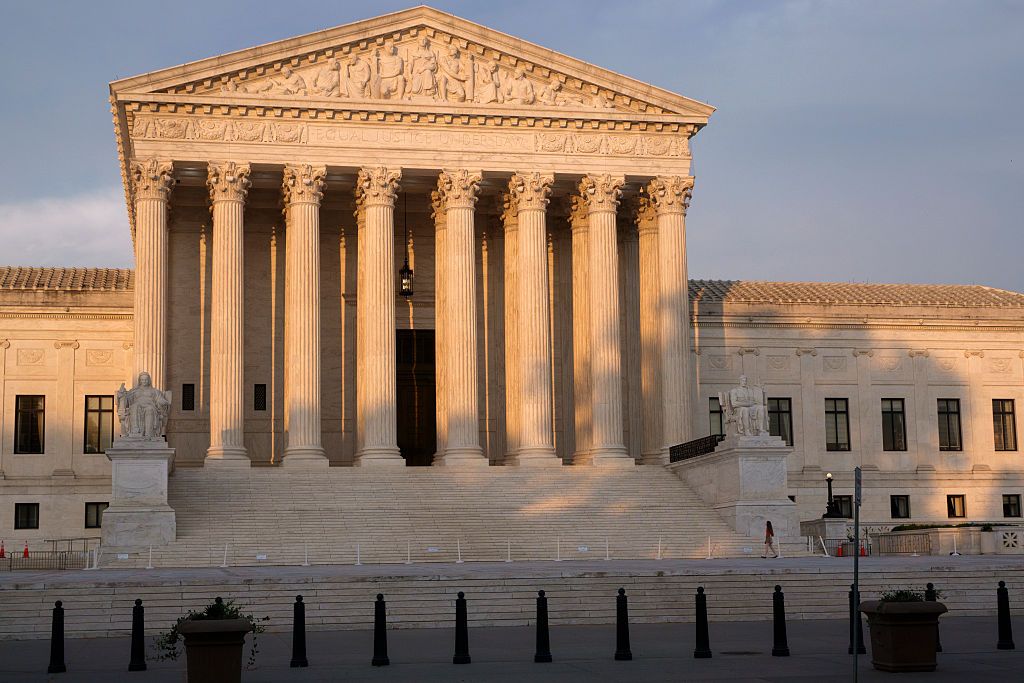
The court will next hear arguments on Monday, the first day of its April sitting.
The court has not yet indicated when it will next announce opinions.
Morning Reads
Alaska man to plead guilty to threatening six US Supreme Court justices
Nate Raymond, Reuters
Additional details are emerging about a plea deal reached between an Alaska man and the prosecutors who charged him with making “threats against a judge and knowingly possess[ing] a handgun despite a prior felony conviction.” Panos Anastasiou, 77, will “plead guilty to threatening to assault and murder six U.S. Supreme Court justices in hundreds of messages he sent through the court’s website” between March 2023 and the fall of 2024, according to Reuters. “Prosecutors recommended probation with home confinement for Anastasiou,” who will appear in a federal court in Anchorage on Thursday “for a change of plea hearing.”
Tariff Refund Tool Will Go Live on April 20, US Customs Says
Laura Curtis, Bloomberg
In a Friday statement, U.S. Customs and Border Protection revealed that “[i]mporters seeking tariff refunds will be able to begin filing their requests on April 20,” which will kick off “what could become the largest repayment by the US government in its history,” according to Bloomberg. CBP created the new system for seeking tariff refunds in response to “the February ruling by the US Supreme Court that threw out duties that President Donald Trump had imposed using emergency powers.” The Court of International Trade has “ordered the federal government to refund as much as $170 billion, plus interest, paid by roughly 330,000 importers.”
Can medical malpractice lawsuits protect LGBTQ youth from conversion therapy? This California lawmaker thinks so
Kristen Hwang, CalMatters
Following the Supreme Court’s ruling last month in favor of a talk therapist who challenged Colorado’s ban on conversion therapy, “California lawmakers are advancing a new strategy to discourage efforts to change a person’s sexual orientation or gender identity,” according to CalMatters. “A bill introduced by Sen. Scott Wiener, a Democrat from San Francisco, would increase the time period during which someone could file a malpractice suit against a mental health professional for trying to change their sexual orientation or gender and harming them in the process. Depending on the age of the person who files the claim, the bill would increase the statute of limitations from three years to 22 years or within five years of discovering the harm.” Shannon Minter, legal director for the National Center for LGBTQ Rights, said that, “[b]ecause almost all medical organizations have disavowed conversion therapy, attempting it would still be considered malpractice even if” states roll back their bans in response to the Supreme Court ruling. “Opponents of the measure say it’s a clear effort to circumvent the Supreme Court’s decision, which will likely prevent states like California from enforcing conversion therapy bans.”
Texas’ GOP attorney general candidates want to challenge decades-old Supreme Court rulings
Eleanor Klibanoff, The Texas Tribune
U.S. Rep. Chip Roy and state Sen. Mayes Middleton, the Republican candidates for Texas attorney general, have both campaigned on the promise of taking on “decades-old Supreme Court precedent” on education, religious freedom, gay marriage, and federal authority over the states, according to The Texas Tribune. “We could sit here all night talking about cases that Texas ought to be challenging,” said Roy during a recent campaign forum. “We have to be vigilant in challenges at every single turn.” The Texas Tribune noted that these campaign messages are part of a nationwide transformation of state attorney general offices, which were once “bureaucratic backwaters” but now pursue high-profile “partisan litigation.”
Public opinion, credible threats, and the Fezzik Principle
Jesse Wegman, Major Questions with Jesse Wegman
In a post for his Substack, Jesse Wegman reflected on a potential solution to the recent “dramatic drop in public approval of the current Supreme Court”: paying more attention to public opinion when deciding cases. Citing work from Barry Friedman of NYU School of Law, Wegman noted that the court at one point did not stray too far from mainstream views. But over the past 25 years or so, Wegman contended, the justices have “ignor[ed] their usual close relationship to public opinion because” they no longer feared retribution from weakened legislative and executive branches. “By doing so, they are inflicting grave damage on the Court as an institution.”
On Site
How the justices decide … which cases to decide: an explainer
One of the more frequent questions we get here at SCOTUSblog is how the court decides which cases to review on the merits. Although we’ve covered this topic before, we thought it might be useful to put together a thorough refresher on the subject.
Just who are “the people”?
The Second Amendment states that “[a] well regulated Militia, being necessary to the security of a free State, the right of the people to keep and bear Arms, shall not be infringed.” But who, exactly, are “the people” that may possess firearms? The answer may not be as straightforward as you assume.
Birthright citizenship: oral argument highlights
Over the past two months, Akhil and Vikram Amar laid out in detail in their Brothers in Law column their ideas about the key issues in the birthright citizenship case. In their latest piece, they compare their arguments and analysis to what the justices asked and said at oral argument on April 1.
How to Restore the Supreme Court’s Legitimacy
As noted above, Sarah Isgur’s book, Last Branch Standing, is out today. Here’s a preview of the excerpt of the book we published on SCOTUSblog this morning.
The Supreme Court is losing legitimacy—the only superpower it has. It’s under attack from partisan critics and presidents who don’t want their power challenged.
Yet the court isn’t perfect. Does the institution need to change to catch up to the modern era of our politics, or are its anachronistic rituals the only thing keeping it from becoming another failed branch? How do we preserve the last branch standing?
After walking through the current court and the history of how we got here, these are a few of the ideas I propose at the end of my book, Last Branch Standing: A Potentially Surprising, Occasionally Witty Journey Inside Today’s Supreme Court.
Filibuster a move
Judges should be above partisan politics, and they should be seen to be above partisan politics. If a judge can’t get at least a few confirmation votes from senators of good faith on the other side of the political aisle, he probably isn’t going to be a very good judge. But if that sounds too Pollyannaish – and at this point in our confirmation wars, it probably is – two Harvard law students came up with a solution.
Thomas Harvey and Thomas Koenig propose two tracks for confirmation. The first is the old one: get a filibuster-proof supermajority of 60 votes. That is, get through the judicial filibuster we used to have. But if a judge can’t get 60 votes, they add another options: get the support of a bare majority of senators in two successive Congresses.
Here’s how it would work. If one side decides to use their power in the minority to block judges for their own partisan purposes (or for any other purpose – worthy or not), then the nominee would “provisionally” be confirmed with a simple majority. After an intervening election, the nominee would automatically be brought up for a vote again regardless of whether the president won reelection or which party controls the Senate. If the nominee passed the Senate again with a simple majority, then the nominee would be deemed confirmed and take the bench.
I love this proposal because it gives voters the responsibility to decide which side is acting in good faith – the nominating side or the filibustering side. And it makes it much harder to delegitimize judges based on their confirmation process. And it could actually speed up the confirmation process because delay tactics aren’t rewarded. A win, win, win.
Enforce the code
Here’s an easy one. In 2023, the court, for the first time in its history, adopted its ethics code. But what happens if one of the justices violates it? What if someone accuses one of the justices of violating it?
It’s easy to accuse a justice of impropriety. And whether the criticism is fair or unfair, there are no judges for the judges. There is simply not enough trust in our institutions to continue to rely on the honor system.
It’s good to have a code of ethics. It’s better to have one that is enforceable.
An ethics board made up of fully retired federal judges could review complaints against the justices and issue public opinions on how to interpret different ambiguous provisions of the code. This board could make recommendations about how a justice could cure the problem – amending their financial disclosures or paying back the fair market value for concert tickets – or even issue a letter of censure if a justice persists in the violation.
Decisions on whether a justice should recuse himself, however, would not be reviewable. First, I don’t think it would be constitutional. But more important, I don’t think it would be wise. The temperature would get too hot if people thought pressuring an outside board could change the makeup of the court. If a justice has a financial interest in a case, for example, and refuses to recuse, Congress would still be able to impeach and remove the justice. Same as today.
An enforceable ethics code would give the public more confidence in the court. It would also protect the justices from nonsense allegations.
Just say yes to cases
In 2025, the court issued 66 opinions before leaving for summer break. Now, I’ll grant you that they wrote just over 650,000 words over the course of those opinions, but nobody asked for a 29-page decision followed by 49 pages of everyone else’s feelings.
If the court started hearing more cases again, it would lower the overall temperature. There wouldn’t be a gun case for the term. There would be a few, and perhaps the outcomes would be mixed or even – heaven forbid – a bit contradictory. All the better. Between 2022 and 2025, the court issued five decisions about gun rights. The pro-gun side went three and two. If that had been the outcome in a single term, it would have been pretty hard to say that one side or the other was running away with the game.
But in a single week in June 2025, eight different petitions for certiorari were filed at the court on gun-related issues. Chances are they’ll all get rejected. That same week, two other gun-related petitions – cases about state laws banning high-capacity magazines and guns like the AR-15 – were turned away.
Instead of waiting for the perfect pitch, the court should start swinging. Lower the number of votes to grant review to three instead of four. Or nominate justices who agree to bring back the courtesy fourth to grant review if three other colleagues want to hear the case.
To see Sarah’s other ideas, keep reading the piece on SCOTUSblog.
SCOTUS Quote
JUSTICE SOTOMAYOR: “I’m sorry. The – definition, the common definition, the chief has defined it that way, but the only dictionary that uses it in the way you want is Webster’s Third. Every other dictionary – and Webster’s Third has been criticized by at least one of my colleagues, if not more. All right?”
MR. McALLISTER: “I’m aware of that.”
JUSTICE SCALIA: “It’s a terrible dictionary.”
— Hawkins v. Community Bank of Raymore (2015)
The post SCOTUStoday for Tuesday, April 14 appeared first on SCOTUSblog.