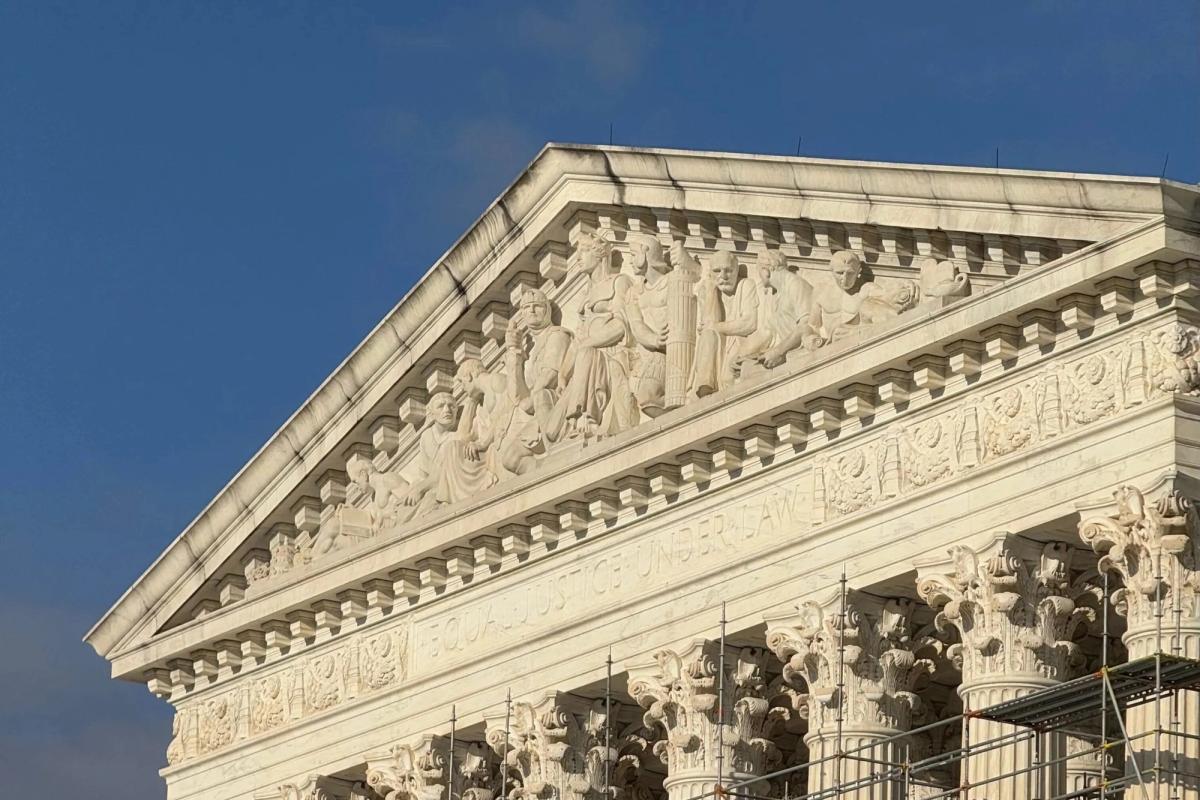
The Supreme Court ruled 8-1 Tuesday that a Colorado ban on conversion therapy for youth violates the free speech rights of a Christian counselor, clearing the way for a practice that goes against the recommendations of every major medical association in the country.

Human Rights Campaign President Kelley Robinson condemned the ruling as “cruel” in a statement to the media Tuesday.
“Today’s reckless decision means more American kids will suffer,” she said. “The Court has weaponized free-speech in order to prioritize anti-LGBTQ+ bias over the safety, health and wellbeing of children.”
Conversion therapy is a pseudoscientific practice in which providers attempt to change a youth’s sexual orientation or gender identity, often through extremely harsh methods including acts of physical, psychological and sexual abuse against minors — electric shock, masturbation reconditioning, starvation, chemically induced nausea and hypnosis, among others.
The United Nations has deemed conversion therapy torture and recommended it be banned. Twenty-three states and Washington, D.C., have laws banning conversion therapy for minors.
The decision comes on Transgender Day of Visibility, a global day celebrating transgender lives and culture every March 31.
Some LGBTQ+ advocates note that while the ruling favors a discredited practice, it leaves most avenues of regulating conversion therapy untouched.
“I think the most important thing to understand about the decision today is that it only takes one way of regulating conversion therapy off the table,” said Shannon Minter, legal director of the National Center for LGBTQ Rights.
Tuesday’s ruling throws out Colorado’s ban, but does not strike down bans in other states, which advocates feared could be a worst-case scenario. The case, Chiles v. Salazar, was brought by Christian counselor Kaley Chiles, who argued that the ban violated her free speech rights. Chiles says she only offers talk therapy and does not use physical interventions or prescribe medications.
The ruling does not declare conversion therapy safe or effective. It also leaves intact the ability of medical licensing boards’ to investigate conversion therapy practice as fraudulent.
Minter said in a statement that the ruling still leaves room to discipline providers in states where it is banned.
“This decision is narrowly about how conversion therapy can be regulated. It does not mean that conversion therapy is safe or legal. Conversion therapy is still medical malpractice and consumer fraud,” Minter said. “Every major medical organization in this country condemns it. Survivors can still bring malpractice and consumer fraud claims.”
Writing for the majority, Justice Neil Gorsuch argued that Colorado’s law applies beyond “physical interventions,” and restricts free speech.
“Colorado may regard its policy as essential to public health and safety. Certainly, censorious governments throughout history have believed the same,” the opinion read. “But the First Amendment stands as a shield against any effort to enforce orthodoxy in thought or speech in this country. It reflects instead a judgment that every American possesses an inalienable right to think and speak freely, and a faith in the free marketplace of ideas as the best means for discovering truth.”
The majority held that the right to free speech applies equally to licensed medical professionals as to all Americans.
As the lone dissent, Justice Ketanji Brown Jackson argued that the majority “failed to appreciate the crucial context” of Chiles’ case. “Chiles is not speaking in the ether; she is providing therapy to minors as a licensed healthcare professional,” she wrote.
Neither side disputed Colorado’s authority to regulate medical treatments and providers or claimed that a state doing so is unconstitutional, she said.
“So, in my view, it cannot also be the case that Colorado’s decision to restrict a dangerous therapy modality that, incidentally, involves provider speech is presumptively unconstitutional,” Jackson added. “In concluding otherwise, the Court’s opinion misreads our precedents, is unprincipled and unworkable and will eventually prove untenable for those who rely upon the long-recognized responsibility of states to regulate the medical profession for the protection of public health.”
This is the first of three LGBTQ+ blockbuster cases before the court this term. Two others, involving transgender athletes, were heard at the same time earlier this year.
Grace Panetta contributed reporting.