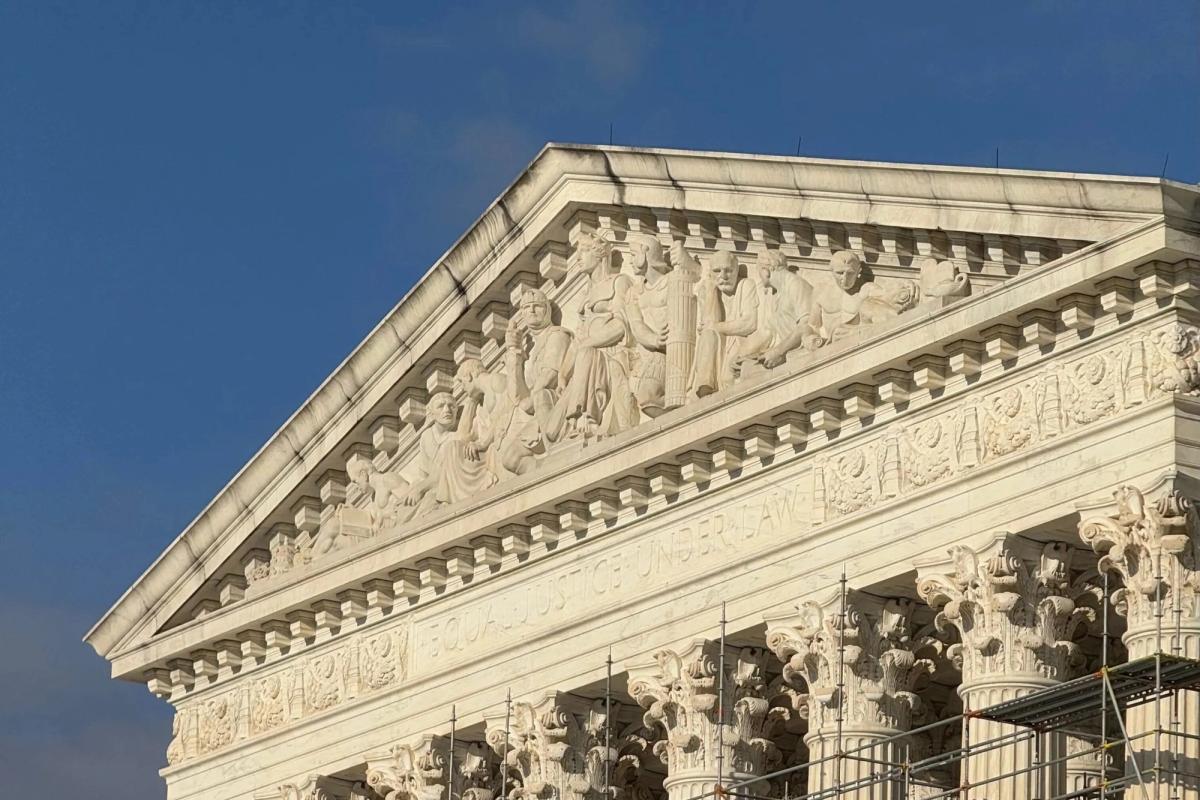
Today is Justice Elena Kagan’s birthday. Born in 1960 in New York City, Kagan has served on the Supreme Court since 2010.
At the Court
On Monday, the court announced that it will hear argument next term in Department of Labor v. Sun Valley Orchards, LLC, a case on the government’s response to violations of the terms of the H-2A visa program, which enables farms to hire immigrant workers for seasonal work. The court also announced that it will not review a case on school policies for parental notification when a student adopts a new gender identity. For more on Monday’s order list, see the On Site section below.
Also on Monday, the justices heard argument in Chatrie v. United States, on law enforcement’s use of geofence warrants, and Monsanto Company v. Durnell, on whether the federal law governing pesticide product labels supersedes state labeling requirements.
Today, the justices will hear argument in Cisco Systems, Inc. v. Doe I, on whether two federal laws that allow lawsuits in U.S. courts for torture and serious violations of international law permit private lawsuits for aiding and abetting such conduct.
Tomorrow morning beginning at 9:30 a.m. EDT, we will be live blogging as the Supreme Court possibly announces opinions and then hears argument in Mullin v. Doe, on the Trump administration’s effort to end Syrians’ and Haitians’ participation in the Temporary Protected Status program.
After Mullin, the justices will hear argument in Hikma Pharmaceuticals USA Inc. v. Amarin Pharma, Inc., a dispute between a manufacturer of medication and its generic substitute.
Mornings Reads
As US high court prepares ruling, Americans oppose ending birthright citizenship, Reuters/Ipsos poll finds
Jan Wolfe and Jason Lange, Reuters (paywalled)
A new Reuters/Ipsos poll explored Americans’ views on some of the most “polarizing issues” before the Supreme Court this term, including birthright citizenship and laws preventing transgender athletes from competing in girls’ and women’s sports. “The poll, conducted nationwide April 15-20, found that 64% of Americans oppose ending birthright citizenship, while 32% support scrapping it as Trump ordered in January 2025,” according to Reuters. It also identified “broad support for restrictions on transgender girls and women competing in women’s school and college sports. ... About 67% of survey respondents supported banning transgender people from competing in female school sports. Ninety-two percent of Republicans said they supported such bans, compared with 44% of Democrats.”
U.S. Supreme Court upholds Texas’ newly redrawn congressional map
Eleanor Klibanoff, The Texas Tribune
In December, the Supreme Court on its interim docket paused a lower court ruling that had prevented Texas from using its new congressional map. On Monday, the justices formally overturned that ruling, meaning that “Texas’ newly redrawn congressional map is officially cleared for use,” according to The Texas Tribune. “The ruling ends, for now, the lengthy legal battle over Texas’ efforts to add as many as five more Republican seats to the U.S. House,” a battle that centered on claims that the new congressional map “was racially discriminatory.”
James Broadnax's appeals: US Supreme Court denies 2 claims, confession pending
Jamie Landers, The Dallas Morning News
James Broadnax, 37, was sentenced to death “in 2009 for the deaths of Stephen Swan, 26, and Matthew Butler, 28, outside their” music studio and is scheduled to be executed in Texas on Thursday. On Monday, the Supreme Court “denied two of Broadnax’s appeals, one pertaining [to] the use of rap lyrics as evidence and another regarding allegations that prosecutors struck prospective Black jurors from serving at his capital murder trial,” according to The Dallas Morning News. “[M]ore than 30 artists, scholars and music industry leaders, including Killer Mike, Young Thug, T.I., Anthony Anderson and Kevin Liles” had joined an amicus, or “friend of the court,” brief urging the court to side with Broadnax in the petition addressing the rap lyrics.
Haitians, Syrians aren’t the only immigrants watching US Supreme Court arguments on temporary status
Gisela Salomon, Associated Press
On Wednesday, the Supreme Court will hear oral argument “on the Trump administration’s plans to stop shielding Haitians and Syrians from deportation,” but it’s not just Haitians and Syrians who have a stake in the case, according to the Associated Press. The AP highlighted the experiences of people from El Salvador who have had the ability to live and work in the U.S. under the Temporary Protected Status program for 25 years, noting that the court’s decision on Haiti and Syria could impact Salvadorans, who will lose their protected status later this year without an extension from the Trump administration. Around 200,000 Salvadorans are currently shielded from deportation under TPS.
The April Argument Calendar
Steve Vladeck, One First
In a post for his Substack, Steve Vladeck reflected on the future of the April argument session, suggesting that it may be time for the court to do away with it in order to ensure that the justices don’t have to rush to complete opinions in the cases that were argued last by the end of the term. “Historically, there have really been only two good arguments for keeping the April calendar, and both have arguably been overtaken by recent events. The first is that the Court would run out of argument slots without it. But as the total number of oral arguments has continued to stay below 60 each term since OT2019, that claim is increasingly incorrect as a matter of basic math,” Vladeck wrote. “The second is that some of these cases are both late-breaking and need to be resolved during the current term. ... But even if that’s a regular phenomenon (only the TPS cases arguably meet that standard from this argument session), it’s not an argument for keeping the entire April calendar.”
On Site
From the SCOTUSblog Team

Court decides to hear additional case next term, turns down petition from parents challenging school gender-identity policy
The Supreme Court on Monday morning agreed to decide whether the Department of Labor has the power to hold hearings rather than go before a federal district court to collect money from employers who violate the terms of the visa program for seasonal farm workers. And after repeatedly putting off their consideration of the petition for review, the court on Monday also declined to take up the case of a Florida couple who contend that their child’s school had encouraged the child to transition to nonbinary at school over their objections.
Argument Analysis

Justices appear mixed on whether geofence warrant violated the Fourth Amendment
The Supreme Court on Monday grappled in Chatrie v. United States with a Virginia man’s challenge to the use of a “geofence warrant” – a warrant that directed Google to provide location data for cellphone users who were near a particular place during a specific time period – to obtain evidence that was used to convict him of a 2019 bank robbery. After two hours of oral arguments, the justices appeared divided over whether prosecutors violated the Fourth Amendment when they used the warrant to find Okello Chatrie’s location data.
Case Preview

Supreme Court to hear argument on whether corporations can be held liable as accomplices in violations of international law
Nearly 240 years ago, Congress enacted the Alien Tort Statute, which allows foreigners to bring lawsuits in U.S. courts for serious violations of international law. On Tuesday, the court will hear oral arguments in the latest attempt to define the scope of the ATS. The case, Cisco Systems v. Doe, pits the California-based technology company against a group of Chinese and U.S. citizens seeking to rely on the ATS to hold the company responsible for what they say is its role in helping the Chinese government develop a powerful surveillance system used to target, detain, and torture practitioners of the Falun Gong religion.
Contributor Corner

When NASA made Scalia turn on judicial restraint
In her In Dissent column, Anastasia Boden revisited the 2011 case of NASA v. Nelson, in which a unanimous court ruled that the government’s interest in information about government workers’ private lives outweighed any constitutional right to privacy those workers have. Boden highlighted “a concurrence that reads like a dissent,” in which “two justices objected to the idea of ‘informational privacy’ altogether. And Justice Antonin Scalia, famous for judicial restraint, chastised the court for not going far enough.”
A Closer Look
Who can be a justice?
Sources close to Justices Samuel Alito and Clarence Thomas have told CBS News’ Jan Crawford that neither justice intends to retire this year, but that hasn’t stopped the ongoing debate over whom President Donald Trump should pick if he has a chance to appoint another justice to the Supreme Court.
Suggestions range from traditional candidates from the federal judiciary – like 5th Circuit Judge James Ho, 5th Circuit Judge Andrew Oldham, or D.C. Circuit Judge Neomi Rao – to U.S. Solicitor General D. John Sauer and less conventional (at least in modern times) picks from the Senate. For example, Sen. Chuck Grassley has urged Trump to pick Sen. Ted Cruz or Sen. Mike Lee.
In light of this lively debate, today we’re exploring who actually is eligible to be a Supreme Court justice. You may be surprised to learn that candidates technically don’t have to have judging experience – indeed, they don’t even have to have a law degree (as was the case with Justice Robert Jackson). In fact, as the Supreme Court notes on its website, “[t]he Constitution does not specify qualifications for Justices.” Among other things, that means there’s no minimum age or education level to meet, and also no requirement that a justice be a native-born U.S. citizen.
However, the absence of official eligibility rules does not mean that just anyone can be a justice (although we know you’d be simply darling at it). That’s because there are plenty of unofficial norms that have developed – so many that Sarah Isgur devoted a recent segment of her Advisory Opinions podcast to discussing her frustration with the increasingly narrow path one must travel to be nominated to the Supreme Court.
Specifically, modern nominees have almost always been circuit court judges who completed a Supreme Court clerkship after graduating from an Ivy League or equivalent law school after having received an Ivy League or equivalent undergraduate degree. And as Amy noted during our April 22 live blog, an upper limit of around the age of 50 may be emerging, as presidents are looking to nominate someone who will be on the court for multiple decades. These unofficial criteria and others very much limit the pool of potential nominees.
Such a state of affairs would likely shock justices from 50 or more years ago, who – as you might have noticed from my colleague Nora Collins’ great series of Closer Looks on past chief justices – often spent years in private practice or as an elected official before being nominated to the court. Whether our current expectations of Supreme Court nominees is a problem is a separate issue, and one that has fueled much debate.
SCOTUS Quote
JUSTICE ALITO: “Mr. Unikowsky, I'm struggling to understand why we are hearing this case other than the fact that at least four of us voted to take it.”
— Chatrie v. United States (2026)