The Supreme Court justice memoir, so lucrative for its authors, tends to be a less than illuminating genre. Justice Neil Gorsuch’s A Republic, If You Can Keep It reiterated the case for originalism and attempted to illustrate why he was a worthy successor to Justice Antonin Scalia. Justice Amy Coney Barrett’s Listening to the Law recited high school civics lessons. And in Lovely One, Justice Ketanji Brown Jackson described her family history and life in detail.
The promise of a justice telling his or her life story is that it will help us further understand the jurisprudence of the person who is shaping the path of the law. But, truth be told, each of these books does little more than buff the public image of the judge presented at their hearings.
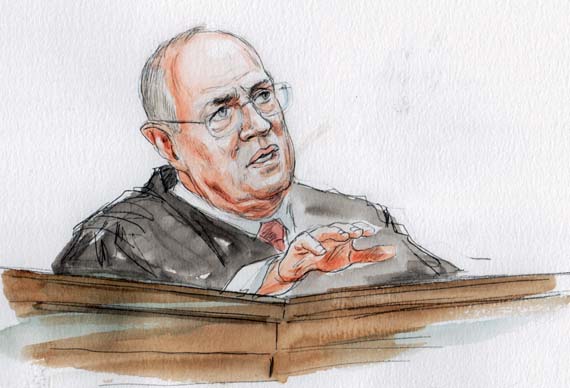
Hence, the pleasant surprises in reading Justice Anthony Kennedy’s memoir, Life, Law & Liberty, published last fall and promoted by Kennedy in an interview this year. Unlike so many other judicial memoirs, the retired justice provides a revealing portrait of the person who wore the robe. Just as surprising is the revelation that Kennedy loves literature – which, in his words, not only “document[s] human experience but also” seeks “to edify it” – and gracefully incorporates literary references throughout the text.
On the first page of the prologue, as Kennedy explains that his “view of the world was defined by the West,” he quotes from Willa Cather’s O Pioneers! to support his belief that the land shapes the people as much as people shape the land. Similarly, a Wallace Stegner quotation at the start of part one suggests the source of Kennedy’s inveterate, old-fashioned optimism: “One cannot be pessimistic about the West,” Stegner wrote. “This is the native home of hope.”
In describing Sacramento, where he grew up, Kennedy cites to authors as diverse as Mark Twain, Langston Hughes, and Ngũgĩ wa Thiong’o on the importance of rivers in defining a place. Kennedy observes that the city is at the confluence of the American River “coming down from the Sierra Nevada mountain range” and the Sacramento River, to which the American pours in and flows south and west to San Francisco Bay. His description flows effortlessly.
Kennedy left Sacramento to attend Stanford and Harvard Law School then began to practice law at a San Francisco law firm. In 1963, while he was an associate at that firm, his father died of a heart attack at the age of 61. Shortly thereafter, Kennedy and his wife, Mary, returned to Sacramento so that he could take over his father’s law practice.
In his chapter on that period, Kennedy refers to James Gould Cozzens’ The Just and the Unjust – a perfect literary reference to illustrate what it was like to practice law in a small town, which is what Sacramento felt like for Kennedy. “Sacramento’s leading attorneys and most of the judges had known my father and our family, as well as Mary’s family,” Kennedy writes. “They went out of their way to show that they were pleased that a younger attorney with those ties could continue the traditions of Sacramento’s bar.” Kennedy was an excellent attorney but nevertheless acknowledges the assistance he received from the “old-boy network” – and recognizes that its support was not available to all but only “those who were part of it.”
***
Perhaps more surprising than Kennedy’s engagement with the world of literature, however, is how it contrasts with his writing as a justice. In his memoir, Kennedy’s writing about his life is thoughtful and self-aware, precise, and elegant – at times even minimalist. As a justice, Kennedy’s prose could be sweeping and was often criticized as grandiose and imprecise.
Exhibit A is from Planned Parenthood of Southeastern Pa. v. Casey, the 1992 abortion decision in which the court upheld rather than overruled Roe v. Wade. Elaborating on constitutional protection for certain personal decisions, Kennedy and fellow Justices Sandra Day O’Connor and David Souter wrote: “At the heart of liberty is the right to define one’s own concept of existence, of meaning, of the universe, and of the mystery of human life.” While some celebrated Kennedy’s capacious understanding of liberty, others, notably Scalia, mocked it as so broad and vague as to be devoid of legal force or meaning. Adding insult to injury, Scalia tarnished the sentence by later referring to it as the “famed sweet-mystery-of-life passage.”
Undaunted, Kennedy repeated these same words in Lawrence v. Texas, the 2003 decision in which the court overruled Bowers v. Hardwick, and invalidated a Texas law criminalizing intimate sexual conduct between two persons of the same sex. In his majority opinion, Kennedy further added that “[f]reedom extends beyond spatial bounds” and that “[t]he instant case involves liberty of the person both in its spatial and more transcendent dimensions.”
Not surprisingly, Kennedy and Scalia squared off again in the same-sex marriage case, Obergefell v. Hodges, which Kennedy began with sweeping language on the “promises” of liberty and the ability of “persons, within a lawful realm, to define and express their identity.”Scalia’s dissent was perhaps the most disparaging that he ever lodged at another justice:
If . . . I ever joined an opinion for the Court that began: “The Constitution promises liberty to all within its reach, a liberty that includes certain specific rights that allow persons, within a lawful realm, to define and express their identity,” I would hide my head in a bag. The Supreme Court of the United States has descended from the disciplined legal reasoning of John Marshall and Joseph Story to the mystical aphorisms of the fortune cookie.
And although Scalia was the most acerbic critic of Kennedy’s writing, he was not alone. Adam Liptak, now chief legal affairs correspondent for the New York Times, noted in 2011 that Kennedy’s “opinions can meander.” Professor Eric Berger, who has written about judicial decision making in constitutional cases, in 2019 described Kennedy as “the most inscrutable of justices.” Professor Michael Dorf, a former law clerk for Kennedy who defended the justice’s “soaring rhetoric” in Obergefell, acknowledged that occasionally Kennedy’s judicial opinions could be “windy or even pompous.”
How, then, do we reconcile the modest yet elegant prose of Life, Law, & Liberty with the oft-criticized sweeping rhetoric of his judicial opinions?
The answer, I believe, follows from Kennedy’s role in each context. As a justice, Kennedy wrote law – literally, in many cases, as he so often was the author of the majority opinion. Accordingly, Kennedy penned his decisions to be authoritative, and, in doing so, he intended them to be decisive and conclusive, and, on occasion, inspiring and majestic. The rhetoric in Kennedy’s judicial opinions was informed by the values that shaped him: his optimism and patriotism and his confidence in courts and the rule of law. The voice in Justice Kennedy’s opinions was that of the law, not simply the musings of Anthony M. Kennedy of Sacramento, California.
In his memoir, by contrast, Kennedy uses a very different voice to write about himself rather than for the highest court in the nation. As an author accounting for his life, Kennedy is utterly human – gracious, personally modest, and well aware that each of us is fallible. This voice is more personal and precise, and because of that more convincing.
It is, of course, ironic that the judicial rhetoric of Kennedy’s opinions could be less compelling than the personal voice of his memoir. Perhaps more ironic is Kennedy’s failure to recognize this. In the chapter on gay rights in his memoir, for example, Kennedy states that the justices “must aspire to write so that all” – not just the parties – “can understand, and we hope, be persuaded” that the court properly reached its decision. Here, Kennedy may have been inspired by Chief Justice Earl Warren’s opinion in Brown v. Board of Education in 1954, in which the court held that segregation in public schools was unconstitutional. One of the “strengths” of Warren’s opinion, he writes, is that it was “neither intricate, nor lengthy, nor written in lofty rhetoric,” and could “be understood by those without a formal legal background.”
Indeed. Instead of attempting to invoke the majesty of the law in his judicial opinions and sounding high-flown and ornate, Kennedy could have been more persuasive as a jurist by drawing on his love of literature and writing in a way that reminded all of us that law is a human enterprise.
The post Law, memoir, and the mystery of Justice Anthony Kennedy’s writing appeared first on SCOTUSblog.