Kendra Sullivan was at her family’s cabin in the Allegheny Highlands region in late October “just planning on having a low-key country weekend.” But the cabin has internet, so messages kept coming in about her one-woman No Kings demonstration the prior weekend in Beckley, West Virginia.
“That weekend was crazy,” she said. “My dad, that morning, was like: ‘You’re on the news!’ Even though we were very isolated we were getting bombarded with: ‘Kendra is famous now!’”
Her aunt in Anchorage even texted to let Sullivan know that news of her protest had reached Alaska.
After a whirlwind three months, Sullivan filed paperwork in January to run for spots on the Democratic Party’s executive committees in West Virginia and in Harrison County, where she lives.
Sullivan was one of nearly 7 million people who attended some 2,700 No Kings protests on October 18, 2025. Independent estimates confirmed it was the largest single-day protest in American history. No Kings organizers are hoping to break that record Saturday, when more than 3,000 events are planned across all 50 states and the District of Columbia, with a main event in Minneapolis.
The No Kings movement is young and organized disproportionately by women. The October protest was the second national mobilization following one in June, when the main event in Philadelphia was one of 2,100 that drew more than 5 million to oppose President Donald Trump on his birthday. Since the No Kings days began, observers have questioned whether mobilizing people to protest in the streets can lead to lasting, societal change.
Early anecdotal evidence suggests that participating in No Kings events is motivating the women organizing them to think more about what they can do to support their country’s democracy. Some, like Sullivan, have decided to run for office: She will be on West Virginia’s May 12 primary ballots. It’s a similar, but amplified and geographically dispersed, dynamic to the influx of women who ran for office after the first Women’s March in early 2017.
“I’ve always been politically engaged to some degree, but I’d never considered running for elected office before,” Sullivan said.
After The 19th’s story about her one-woman protest, Sullivan got calls from party leaders. She spoke at a Democratic women’s meeting; then to a chapter of the group Drinking Liberally, part of the Living Liberally umbrella organization. She surveyed the political landscape to decide where she might make the biggest difference in a state where Trump won nearly 70 percent of the vote in 2024 and Republicans hold supermajorities in the state House and Senate. She settled on the party committees.
“Having a role there would be a way to help regrow the Democratic Party and make sure there is a focus on families, working families and women, because even [among] the Democrats we have in the legislature right now, there are only two women,” explained Sullivan, an educator and mother of a 7-year-old son.

Amanda Litman, the co-founder and president of Run For Something, a group that recruits and supports young progressive candidates vying for state and local offices, said that even when compared with Trump’s first term, there has been a notable uptick in the number of people interested in running for office.
“We had 80,000 sign up to run for office last year — that’s more than we had in the entirety of Trump’s first term. Then we had another 5,000 in the first 10 weeks of this year,” Litman said.
While the largest numbers of candidates are in the most populous states, Litman said there have been “way more rural folks than we expected,” and it reflects a set of priorities among would-be Democratic candidates that has shifted since Trump’s first term.
“The thing that we heard that was different is: ‘I’m sick and tired of the Democratic Party. I’m sick and tired of being told to wait my turn,’” Litman said. “We’re also hearing a lot of: ‘The Democrats haven’t been where I am, they don’t know what it’s like to be in my shoes.’”
“Trump is the water they’re swimming in but he is not the bait,” she added.
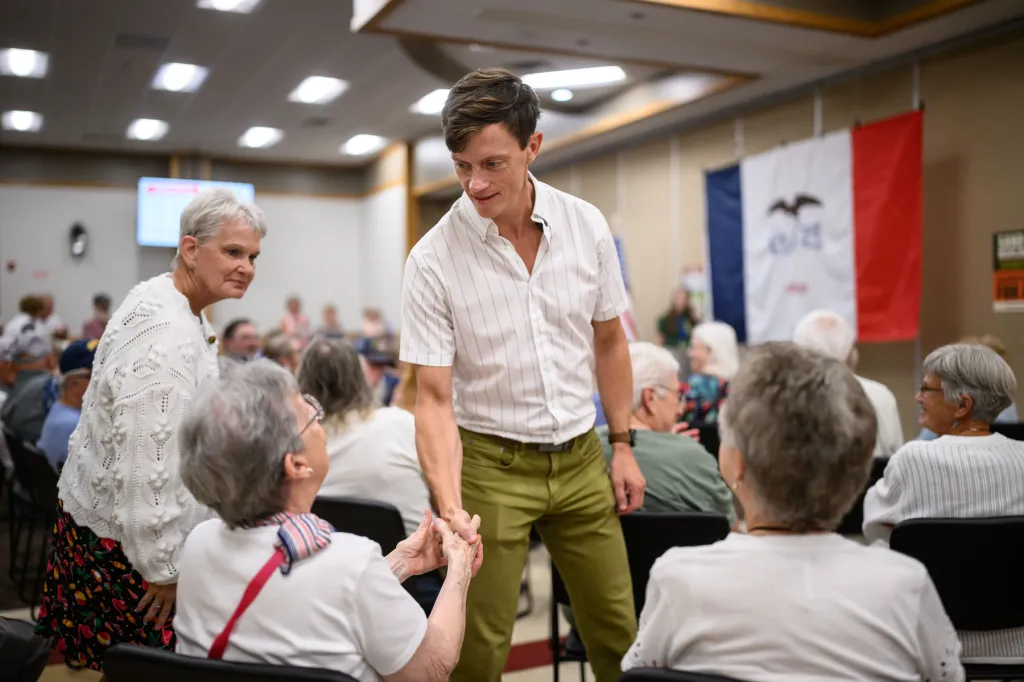
Run for Something is not affiliated with No Kings, but some of the organization’s endorsed candidates this year hail from the movement. Two are Katrina Manetta in Michigan’s politically swingy Macomb County and Leila Staton in north central Iowa, who both founded chapters of Indivisible, a national progressive movement started by former congressional staffers in 2016 to organize peaceful opposition to Trump’s presidency. Since Indivisible is a national partner in the leaderless No Kings movement, Manetta and Staton went on to organize No Kings events in their communities. Both are now running for seats in their respective state Houses.
Manetta, a 31-year-old server who was born and raised in the district where she is running, told The 19th that she was “devastated” after the 2024 presidential election. She remembers googling “what now” and found an Indivisible meeting in a nearby community. She went, then co-founded a chapter in her own neighborhood. Their first meeting in a coffee shop drew five people — the number Indivisible suggests a would-be organizer initially aim to marshal. The second, in the basement of the house Manetta shares with her mother, drew 10.
“Now, we consistently have over 100 people come to our meetings every month. It proves we understand what people are looking for: They want movement, they want action, they want a fight — and they don’t see that Democrats are currently fighting,” Manetta said.
Manetta abandoned her plan to apply to law school and decided to run for office. She read Litman’s book. She was recruited by the Great Lakes Leadership Academy, which since 2013 has trained progressive candidates. She will likely get through Michigan’s August primary and in November face off against first-term GOP incumbent Rep. Ron Robinson, who flipped the district with 53 percent of the vote in 2024.

“Because of the work we’re doing, I know what it takes to win in this area, to make sure that Democrats show up at the polls to vote. I felt like I would be the best chance at flipping the seat this year,” she said.
Staton, in Iowa, traversed a similar trajectory. The 22-year-old with a background advocating on behalf of childhood sexual assault victims said that after the 2024 elections she and her family were “really upset” about then-Vice President Kamala Harris’ loss to Trump. They had reached out to their local and state Democratic Party organizations asking how they might help — maybe doorknocking, or canvassing — but had not gotten a response. In the aftermath, they were “looking at things we could do to build a community of people who were like-minded and who just want better,” Staton said.
Staton’s family came across Indivisible. They made it a goal to find five people and form a small group “just so we could talk about all of the bad things that were happening.” Within a couple of months, the Insufferable Wenches of Iowa, the group founded by Staton and her mother, swelled to 450 people. They often meet online so Iowans anywhere in the state can participate and run mutual aid programs benefitting their local communities. The cheeky Midwestern T-shirt purveyor Raygun has an “Iowa Needs Insufferable Wenches” shirt that raises money for their efforts. Staton realized when researching state legislation that her two-term Republican state representative, Joshua Meggers, ran unopposed.
“Oftentimes, you’re the person that you’re looking for,” Staton said. “I decided I was going to do this last May and have knocked on doors every weekend since.”
Staton is running unopposed in the Democratic primary — but she knows that come November, prevailing in counties where Trump won by 35 to 40 points in 2024 will be tough for a Democratic newcomer just two years later. When she first decided to try, she “didn’t think there would be any chance at success,” she said.
“But after getting more and more involved in my community and listening to people and what they’re worried about, I’ve come to the summarization that everyone is worried about the same things, the Republican or Democrat after your name doesn’t matter,” she said.
“I don’t really concern myself with how Republicans have won in the district; I think now is the time when people are looking for something different, because this isn’t working,” Staton added.