In the midst of an international wave of authoritarianism and anti-queer sentiment, Indian lawmakers not-so-quietly passed a bill rescinding the right for people to self-identify their gender and requiring trans people to get certified by medical boards and local health authorities before getting gender-affirming surgery. Hundreds of protestors gathered in Mumbai to protest the March 2026 Transgender Persons Amendment Bill.
Just over a week later, on April 4, 2026, a different kind of gathering took place in New York City.
At the Queer Fake Shaadi, LGBTQ+ South Asians shook off cultural norms by visualizing their own weddings, also called shaadis, and customs. Dressed in full wedding attire—embroidered lehengas, saris, sherwanis, and pagdis—and embellished in gold from head to toe, brides and grooms of all genders proudly marched into 3 Dollar Bill in Brooklyn’s East Williamsburg neighborhood on a rainy Saturday night.
They were determined to banish the heteronormative status quo of South Asian wedding culture.
It’s not an entirely new idea: Fake shaadis have been around in the United States and in South Asia for years. BBC explains the fake wedding trend as a “wedding-themed party night,” making their mark in cities such as Delhi, Mumbai, and Bengaluru.
But New York City’s Queer Fake Shaadi—which, according to the event’s organizers, drew nearly 400 people—was more than just an excuse to celebrate. It served as a symbol of queer visibility, chosen family, and inclusive tradition.
Desire, marriage, and acceptance in South Asian cultures
Being queer and Desi are identities that often feel at odds with each other. In a culture heavily influenced by centuries of British colonization and casteism, queer livelihood has become second in priority to maintaining the status quo.
After the 1871 British penal code, Section 377, criminalized intercourse “against the order of nature,” the aftershocks rippled through the next two centuries of South Asian cultural norms. In 2013, 87 percent of Pakistanis surveyed by the Pew Research Center said homosexuality should be rejected. Similarly, in 2020, a separate Pew Research study found that only 37 percent of Indians say homosexuality should be accepted by society. That’s up from 2014, when 15 percent of Indians said homosexuality should be accepted by society.
But queer South Asians have always existed. India is home to the largest population in the world, with queer people living quietly on the sidelines of the country’s 1.4-billion-person society, constantly in danger. A 2025 study looking at data collected between 2014 and 2015 estimated that in the 12 months before being surveyed, 27.2 percent of trans people in India experienced physical violence and 22.3 percent experienced sexual violence.
“The issue is not just about the law: A whole culture helps make homosexuality taboo,” researcher Frédéric Martel wrote in his 2019 book, Global Gay. “Societal values, the caste system, arranged marriages, the high probability of being disinherited for coming out—everything runs counter to gay liberation.”
South Asian cultures place great importance on marriages—and, specifically, weddings. While arranged marriages, recently popularized into mainstream media by shows like Indian Matchmaking, are just one display, the weddings themselves, which often last multiple days, have created an economic sector in itself. South Asia, an expansive region including India, Nepal, Bangladesh, Pakistan, Sri Lanka, and Afghanistan, does not have one religion, language, or culture. South Asian weddings, however, often share common elements.
The wedding industry has become deeply embedded in South Asian culture. Lavish weddings exist not only as a celebration of family unions, but also as a show of class, caste, and status across the subcontinent.
But at the Queer Fake Shaadi, queer South Asians, who often feel left out of this display of privilege, celebrated their culture in their own unique way.
Focusing on joy
The Queer Fake Shaadi packed many of the core components of a South Asian wedding into one lively night, starting with the mehndi, or henna ceremony. Attendees showed off their mehndi throughout the night, before the baraat, or the groom’s procession, strolled through the venue.
A dhol blared ahead of the baraat as the fake brides and grooms made their royal entrance, parading their way to the main hall of the venue. Attendees and performers acted as the audience, tossing petals toward the soon-to-be “newlyweds” as garlands of marigold hung from the ceiling.
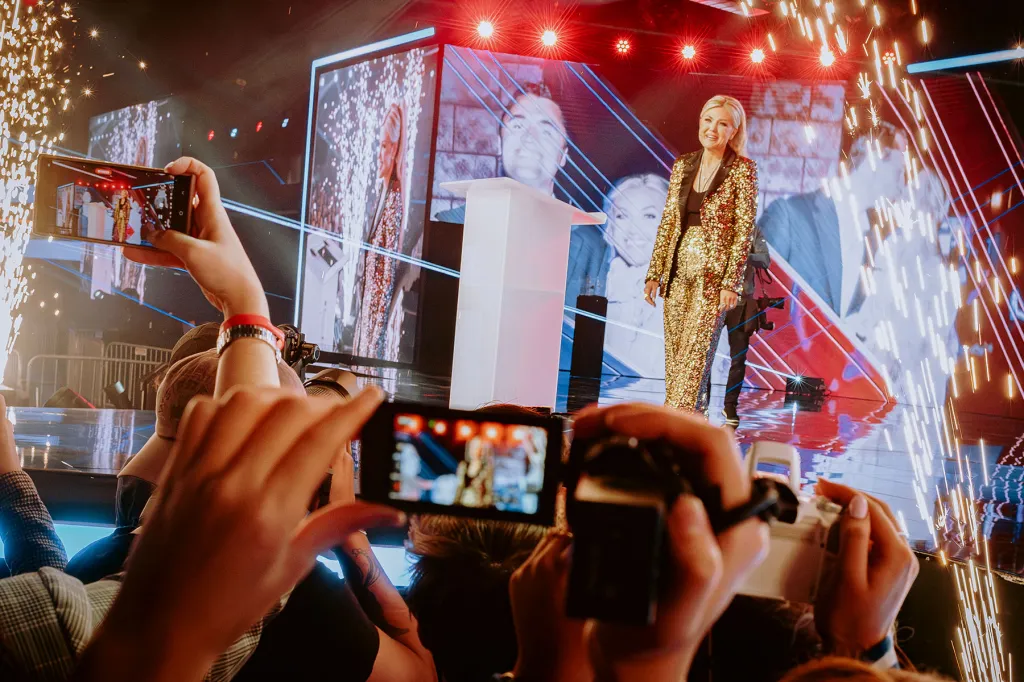
Next came the sangeet, or the dancing and singing portion of the night. Hundreds of audience members cheered, danced, and sang along as Lal Batti and Tamasha Bhosle performed their choreographed Bollywood-style drag renditions, followed by a burlesque act by Mercy Masala.
As party-goers wandered in and out of the main pit of the venue, comedian and drag performer Lady Bushra, who traveled from California, emceed the event until 1 a.m. The performances even included a joota chupai, a traditional wedding game where friends and family hide the groom’s shoes.
The party lasted until 4 a.m. After, attendees roamed the Brooklyn streets afterward to grab a bite at Karachi Kabab Boiz, the event’s official food vendor.
Religious aspects of a traditional South Asian wedding were intentionally kept out.
“Instead of recreating religious ceremonies, we’re really focusing on the cultural and symbolic elements of a shaadi—things like the joy or the rituals in general,” explained Mehreen Khan, one of the event’s organizers.
The event started as an idea written on a paper napkin and evolved into months of planning. While so many South Asian immigrants have a plan set out for their lives, queer South Asians often cannot visualize a similar future for themselves, Khan and Simone Nayak, who co-led the event, noticed. The pair was designing a vision that had rarely been explored before.
Ali Abbas, a Queer Fake Shaadi attendee visiting from Pakistan who asked to not use his full name, recounted his experience as part of a (real) queer wedding in Karachi. Abbas said it was “really special in its own way, but it was much more intimate and low-key.”
“What made this event in New York stand out was the scale and visibility,” he added. “It felt louder, more public, and more openly celebratory.”
Abbas said the Queer Fake Shaadi shifted his perspective on getting married.
“I’ve always wanted to get married, and I’ve always loved the idea of a big Desi wedding,” Abbas said. “But for a long time, I didn’t fully believe that was something I could have as a queer person.”
The Queer Fake Shaadi, Abbas said, changed that.
“Seeing such a large, joyful community come together made me realize how much love and support exists, even if it’s not always visible,” he said. “It reminded me that queer people create their own spaces, their own traditions, and show up for each other in powerful ways.”
‘There’s so many other people like me who exist’
Khan, a product manager living in New York City, grew up in Northern Pakistan, near where activist Malala Yousafzai was shot in 2012 for advocating for girls’ education.
As a queer woman, Khan felt isolated from her culture for most of her life.
Many first and second generation immigrants can feel a “race for survival,” Khan told Rewire News Group—from having the correct papers and securing a job and education, to sending money back home to learning a new culture, all while carrying the hidden baggage of cultural identity and sexuality.
“We grew up dreaming of these big, beautiful shaadi moments. But for us, there has been a quiet understanding that spaces like these are not really made for us,” Khan, 31, said. “And over the period of time, I think it creates distance from the culture, tradition, and even from celebration itself.”
Khan had withdrawn herself from the idea of having a typical Big Fat Desi wedding—until she met Nayak, who joked that they would make it happen some day.
Khan and Nayak met in April 2025, while working together at Samsung. Nearly one year later, on April 4, 2026, they would see the results of their friendship and community come to fruition in the form of a 400-person event celebrating love and chosen family: the Queer Fake Shaadi.
“I realized there’s so many other people like me who exist,” said Khan. “I’m not a diseased person, I’m not a sin. I’m not the last walking sign of the day of the judgment. So that really drives my passion to do all the work that I do for the queer community.”
The post Queer South Asians Get Their Own Big Fat Desi Wedding appeared first on Rewire News Group.