Supreme Court decision could undo decades of gains by Black women lawmakers

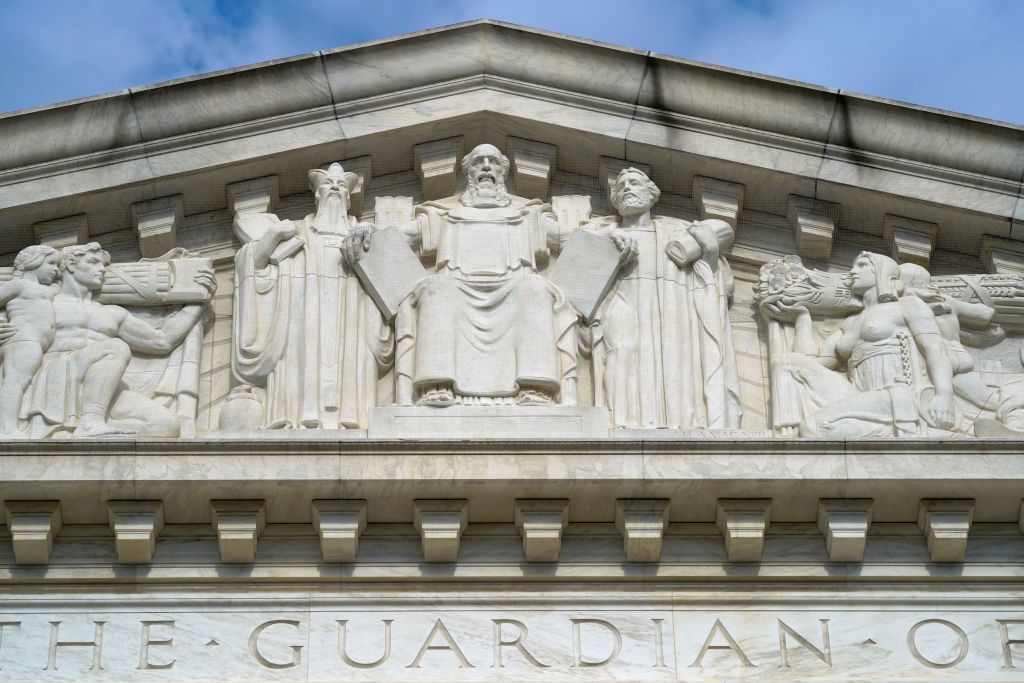
The U.S. Supreme Court’s decade-long effort to gut the Voting Rights Act reached its “now-completed demolition” with a ruling on Wednesday from its conservative majority in a case related to Louisiana’s voting maps, Justice Elena Kagan wrote in a scathing dissent.


Supreme Court decision could undo decades of gains by Black women lawmakers

The U.S. Supreme Court’s decade-long effort to gut the Voting Rights Act reached its “now-completed demolition” with a ruling on Wednesday from its conservative majority in a case related to Louisiana’s voting maps, Justice Elena Kagan wrote in a scathing dissent. 

The 6-3 ruling in the case Louisiana v. Callais, written by Justice Samuel Alito on behalf of the court’s conservative bloc, tossed out a Louisiana voting map creating a second majority-Black congressional district in a state with six total U.S. House districts. About one-third of voters in Louisiana are Black. 

“The Voting Rights Act is — or, now more accurately, was — ‘one of the most consequential, efficacious, and amply justified exercises of federal legislative power in our Nation’s history,’” Kagan wrote.

Kagan’s dissent ran longer than the ruling itself and she read from the bench to underscore her disagreement.

Though Alito framed the ruling as an “update” that did not undo the underlying “framework” of the Voting Rights Act, voting rights advocates immediately warned that it all but undid the portion of the civil rights statute known as Section 2. That provision has for decades been used by voters of color to challenge voting maps that intentionally diluted their ability to impact elections. 

Sophia Lin Lakin with the American Civil Liberties Union (ACLU) said in a press call that the ruling makes Section 2 “difficult, if not impossible to enforce in the vast majority of cases.”

Now, Kagan noted, states can draw maps that disenfranchise minority voters so long as the underlying intent isn’t overtly racially motivated. It “eviscerate[s] the law,” contradicts Congress’ intent, she wrote, and “minority voters can now be cracked out of the electoral process.” 

Civil rights experts fear Wednesday’s decision has the potential to undo decades’ worth of progress in electing Black lawmakers and leave minority voters, particularly those in the South, with no meaningful representation in local, state and federal governments. The impact could be greatest on Black women, who have made historic gains in representation in elected office since Section 2 was updated by Congress in the 1980s. 

Based on 2024 data, 148 U.S. House districts — or about 34 percent — are considered majority-minority. Women of color voters are disproportionately concentrated in these districts, particularly in the South and Pacific West. In 1980, one Black woman was serving in the House and none in the Senate. Now, there are 27 Black women in the lower chamber of Congress and two in the upper chamber. Historically, Black women legislators have had the most success being elected in majority-Black districts, though in recent years some Black women have been elected in more racially diverse or majority-White districts.

Kagan noted that in Louisiana, where the case originated, as little as 12 percent of the White electorate would support a Black voter-preferred candidate in a statewide contest, making majority-minority districts essential for Black voters’ ability to elect candidates who represent their interests. 

“Essentially, the court majority says that if you draw maps in a way that diminishes or even eviscerates the ability to elect candidates of choice for voters of color, that’s okay, so long as you do it for partisan reasons,” said Danielle Lang, vice president for voting rights at the advocacy group Campaign Legal Center.

Rep. Terri Sewell, a Democrat from Alabama whose district includes most of the predominantly Black parts of Birmingham and Tuscaloosa, reiterated how in a country with a two-party system in which Black voters largely back Democratic candidates, the decision could be used to draw partisan districts that would have the same impact as if they were drawn based on race. 

The Supreme Court dealt its first major blow to the Voting Rights Act in 2013 when it decided a case from Alabama challenging another major provision of the statute, Section 5, which required areas with a history of racial discrimination to preclear any changes to voting procedures with the Justice Department.

Sewell called Wednesday’s Callais decision another “devastating blow to American democracy. It really just exposes the hypocrisy that we can actually draw lines based on partisan politics, but not protect voters [from] discrimination and racial discrimination.” 

“So it’s a gift. It’s a gift to Donald Trump and his voter suppression scheme,” she added. 

The ruling came as both major U.S. political parties are in a back-and-forth war over congressional redistricting ahead of the 2026 midterm elections. It could pave the way for Republican-drawn maps that diminish Black voters’ power at the ballot box. 

“What the Supreme Court has done today with this decision is to ensure that we will never get to parity, that we will never get to adequate representation that reflects the diversity of this country. And not only that, but we are now on a fast track to go backwards and to have a white male dominated leadership structure in this country,” Janai Nelson, president of the NAACP Legal Defense Fund, told The 19th.

She cited Florida, Louisiana, Alabama, Mississippi and Tennessee, as states poised to “potentially wipe out every district that has provided an opportunity for Black voters and, in some cases, Latino voters as well.”

Kagan has often taken the lead in dissenting to the Supreme Court’s gradual undoing of the Voting Rights Act and its most salient provisions, often centering the country’s long history of disenfranchising voters who aren’t White or are women.

In her dissent, she wrote that the court’s conservative majority “avails itself again of the tools used before to dismantle the Act: untenable readings of statutory text, made-up and impossible-to-meet evidentiary requirements, disregard for precedent, and disdain for congressional judgment.” 

Kagan noted that Wednesday’s ruling was “part of a set” and the “last piece” in a decade-long push to gut the law that has protected Black voters since the country’s Jim Crow era, calling the consequences “far-reaching and grave.” 

“I dissent because Congress elected otherwise. I dissent because the Court betrays its duty to faithfully implement the great statute Congress wrote. I dissent because the Court’s decision will set back the foundational right Congress granted of racial equality in electoral opportunity. I dissent,” Kagan concluded.

Grace Panetta contributed reporting.

Need Support?

Find verified resources for reproductive healthcare, support services, and advocacy organizations.

Find Resources