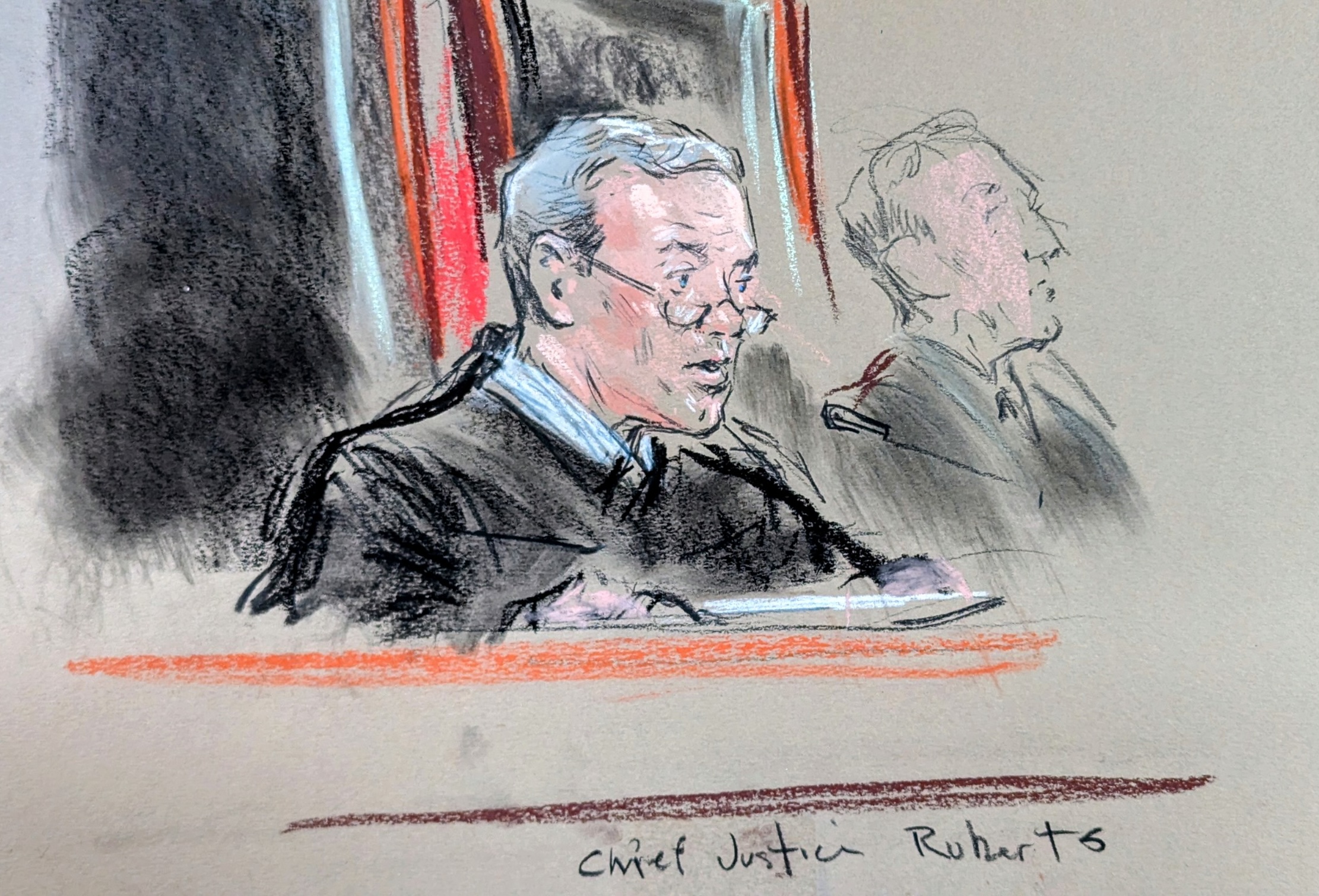
As much of the legal media (including SCOTUSblog) reported last month, Chief Justice John Roberts offered some rare public remarks in an appearance at Rice University, rebuking personal attacks on judges.
“Personally directed hostility is dangerous,” he said, “and it’s got to stop.”
The comments came a day and a half after President Donald Trump posted on Truth Social that the Supreme Court is “little more than a weaponized and unjust Political Organization” whose members are “hurting our Country.” The president’s posts were in response to the court’s February ruling, which Roberts authored, striking down Trump’s global tariffs. Trump has also called Roberts and other justices, including two he appointed, “disloyal” and “unpatriotic,” and said the decision was “not written by smart people.”
Roberts did not refer to any of these comments directly at Rice – stating that personal attacks on the judiciary have come from “not just any one political perspective,” and that certain criticism of the court’s work is both inevitable and appropriate. “It does come with the territory,” he said. “It can very much be healthy. We don’t believe that we’re flawless in any way. It is important that our decisions are subjected to scrutiny, and they are.” What concerned him, he stated, was when the criticism shifts from the court’s legal interpretations to individuals.
Bare bones as these remarks may have been, they were still somewhat remarkable coming from Roberts. Perhaps more than any other justice, the chief rarely speaks in public, and when he does so, he seems to studiously avoid saying anything particularly memorable.
Roberts’ public service
Since he was confirmed in 2005, Roberts’ public appearances have been infrequent and guarded. His biographer Joan Biskupic (who wrote about him in her 2019 book, The Chief: The Life and Turbulent Times of Chief Justice John Roberts) describes him as “his own enigma,” a justice who has sought to “hone[]” the character of an “umpire,” seeking to protect the Supreme Court as an institution while keeping “his personal convictions largely hidden.”
The umpire reference is Roberts’ own. At his 2005 confirmation hearing, he famously delivered what became an oft-quoted summary of the judicial role: “Judges are not politicians who can promise to do certain things in exchange for votes. … I will remember that it’s my job to call balls and strikes, and not to pitch or bat.” The metaphor drew criticism from some legal scholars who argued it was naïve and understated the discretion that judging requires, but it has served as an organizing principle for Roberts’ public persona – umpires, after all, do not typically hold press conferences or do many interviews.
But Roberts’ “umpire philosophy” also has a more elaborate intellectual foundation than the sports metaphor may suggest. In a 2006 interview with legal scholar Jeffrey Rosen, Roberts described his decision to model his tenure on Chief Justice John Marshall as a response to “the personalization of judicial politics.” From Marshall, Roberts said he had learned that “personal trust in the chief justice’s lack of an ideological agenda was very important.” This institutional goal, Roberts remarked, requires the suppression of personal ones, if they exist: “What you’re trying to establish — wearing black robes and, in earlier times, wigs — [is] that it’s not the person; it’s the law.”
Another apparent influence on Roberts is Daniel Webster, constitutional lawyer (and two-time Secretary of State) who sought to hold the Union together prior to the Civil War. While in college, Roberts wrote a prize-winning essay on Webster – to whom Roberts was drawn to for his “constancy, his ability to engage in politics while behaving as if he were above politics … and pragmatism,” journalist Matthew Continetti noted in 2005.
In this vein, Roberts has been explicit about the limits he places on his public role. In 2023, declining an invitation to appear before Senate Democrats over a judicial ethics scandal involving Justice Samuel Alito, he wrote that “apart from ceremonial events, only on rare occasions in our Nation’s history has a sitting Chief Justice met with legislators, even in a public setting (such as a Committee hearing) with members of both major political parties present.”
The public record
Viewed in full, Roberts’ public statements form a narrow but consistent philosophy. Across his year-end reports (now 21 of them), written statements, speeches at circuit conferences, and public conversations he has granted since 2005, a few themes recur – the most persistent perhaps being the asserted nonpartisan character of the judiciary.
One of Roberts’ most referenced statements came in November 2018, after Trump referred to a judge who ruled against the administration’s asylum policy as an “Obama judge.” Somewhat surprisingly, after a question from the Associated Press about Trump’s remarks, Roberts replied in a written statement released by the court’s Public Information Office. He asserted that “[w]e do not have Obama judges or Trump judges, Bush judges or Clinton judges. What we have is an extraordinary group of dedicated judges doing their level best to do equal right to those appearing before them.” Indeed, that 2018 statement was the first time Roberts had issued (or indicated) any public criticism of Trump.
In March 2025, following Trump’s call for the impeachment of Chief Judge James Boasberg of the U.S. District Court for the District of Columbia, after Boasberg had temporarily blocked the administration’s deportations, Roberts felt it necessary to issue another written statement: “For more than two centuries, it has been established that impeachment is not an appropriate response to disagreement concerning a judicial decision. The normal appellate review process exists for that purpose.”
Roberts’ second (and related) refrain, noted above, is his attempt to distinguish between criticizing court decisions and attacking individual judges. Roberts did so even before the Trump administration; for instance, at the University of Alabama School of Law in 2010, after President Barack Obama criticized the Citizens United decision during his State of the Union address (and Alito mouthed the now-famous “not true” line), Roberts remarked that officials were entitled to criticize the court’s decisions. But in what NPR described as “a rare public display of temper,” Roberts then questioned the “setting” Obama chose and the “decorum” of the occasion.
In his 2024 year-end report, Roberts cited four areas of “illegitimate activity” – violence, intimidation, disinformation, and threats to defy court orders – and wrote that because “judges typically speak only through their decisions” and “do not call press conferences or generally issue rebuttals,” the courts are “peculiarly ill-suited” to respond to disinformation about their rulings. “Public officials certainly have a right to criticize the work of the judiciary, but they should be mindful that intemperance in their statements when it comes to judges may prompt dangerous reactions by others,” he wrote.
And in June 2025, Roberts again addressed threats to judges and connected them to civic ignorance. “The idea that we’re responsible for whatever somebody is angry about — it just doesn’t make any sense, and it’s very dangerous,” he said. Roberts also added that “sharp” language sometimes found in end-of-term opinions distracts from the true nature of the court’s work, and that a well-written dissent hones the majority opinion rather than simply opposing it. (One wonders what he might think of the recent, viral dissent by Judge Lawrence VanDyke.)
His colleagues on the court
Roberts’ public reticence is also notable in how it contrasts with some of his colleagues. The court’s newest member, Justice Ketanji Brown Jackson, has been on CBS Mornings, appeared at the Grammy Awards, and even accepted invitations to go on a parenting podcast and a Broadway show. Justice Sonia Sotomayor speaks frequently at schools and community events. Justices Neil Gorsuch and Elena Kagan have also given several interviews and appeared on podcasts.
Justices Clarence Thomas and Alito differ slightly. Thomas gives very few public speeches but tends to make pointed comments when he does. For example, during the 2021 11th Circuit Judicial Conference, he said that “[w]e can’t be an institution that can be bullied into giving you just the outcomes you want.”
Like Thomas, Alito has spoken at the Federalist Society’s annual lawyers’ convention. He has also given interviews to the Wall Street Journal and delivered a speech at a Notre Dame event – though he has at times barred recordings, and on at least one occasion asked a host institution not to live tweet his remarks. And in a 2023 Wall Street Journal interview, Alito was direct in a way that Roberts rarely is, speaking of individual decisions and saying that “[s]ome decisions—and I think that Roe and Casey fell in this category—are so egregiously wrong, so clearly wrong, that’s a very strong factor in support of overruling.”
The content of Roberts’ public remarks differs from his colleagues’ as well. For instance, while Jackson and Justice Amy Coney Barrett have discussed their paths to the court and experiences as a justice, particularly in events to promote their recent books, Roberts’ comments are almost entirely institutional. Even at Rice, his most personal disclosures (recalling clerkships for Judge Henry Friendly and then-Justice William Rehnquist as well as his first nomination, in 1992, to the U.S. Court of Appeals for the District of Columbia Circuit, which lapsed without the Senate ever holding a vote) were related to broader, institutional lessons.
Roberts is also an outlier among his fellow justices for not participating in “book tour-palooza“: On the current court, Kagan and Roberts are the only justices who have not either written books or currently have book deals in the works.
An institutionalist in name only?
Of course, none of this answers where Roberts’ professed institutionalism and studied silence have gotten him. Or – more importantly – the court itself.
In terms of public opinion, the picture is certainly not rosy. When Roberts was confirmed, the court’s approval rating regularly exceeded 60%. This has dropped dramatically throughout this tenure. As the court opened its 2025-26 term, only 42% of Americans approved of the job the court was doing, and 52% disapproved. And the partisan approval gap (79% of Republicans versus 14% of Democrats) is the largest Gallup has so far recorded. While Roberts has spent two decades insisting there are no Obama judges or Trump judges, the public has apparently reached the opposite conclusion.
Roberts’ other goal, achieving unanimity within the court itself, has also yielded mixed results. From 2010 to 2016, unanimous rulings frequently accounted for half of the court’s decisions, with a peak of 64% during the 2013 term. By the 2024-25 term, that figure was down to 42%. While Roberts was in the majority in 95% of all cases last term and did not write a single separate opinion, his fellow justices have thus taken a very different approach.
Finally, Roberts’ supposed institutionalism itself has faced considerable criticism, with some claiming this is little more than a farce. Back in 2019, Democratic Sen. Sheldon Whitehouse wrote that “the Roberts Court’s output through OT 2017-2018 … speaks to a Roberts Court that, far from calling ‘balls and strikes,’ appears intractably captured by powerful forces of special-interest influence.” Others, such as legal commentator Jeffrey Toobin, at one point deemed Roberts “[t]he Supreme Court’s stealth hard-liner” who “has served the interests, and reflected the values, of the contemporary Republican Party.”
Some of this is unfair. It is true that Roberts predominantly votes with the conservative wing of the court, and has written for them in some of its most profound decisions – from presidential immunity to affirmative action and voting rights. But he has broken from them in other deeply important rulings (although in Dobbs, for example, sought a more narrow outcome as opposed to joining the liberal wing of the court). Nor can Roberts be fully blamed for the court’s loss of public trust, as this is faced by nearly every major institution in our polarized times.
And as for reining in his fellow justices, there is a clear limit to what any one chief justice can do. While the chief justice is “first among equals” and able to assign opinions when in the majority, he can only influence his colleagues (or temper their policy opinions) so much. If enough of his colleagues decide that their individual votes matter more than a court super-majority, the umpire’s philosophy becomes just that, a philosophy, not a guiding principle.
Ultimately, Roberts appears to deeply believe, which his remarks at Rice underscored, that the court’s legitimacy rests on the country’s willingness to embrace it as a legal rather than a political institution. Whether saying relatively little and cultivating the image of an umpire truly helps to promote this goal is an open question, but his legacy – and that of the Roberts court itself – likely depends on it.
The post The inscrutable Chief Justice John Roberts appeared first on SCOTUSblog.