As of last Friday, SCOTUStoday (our weekday newsletter — subscribe here!) finished providing brief biographies of each chief justice of the United States, starting with John Jay and ending with John Roberts. In light of that achievement (and based on reader requests), we figured we’d provide a synopsis of each biography in one place, so that you can not only impress your friends (and what friends they must be!) but answer a question Roberts himself has admitted that he’s struggled with. So, without further ado, meet each of the 17 men who have led the Supreme Court.
Chief Justice John Marshall may get all the attention, but John Jay was there first. A successful lawyer in private practice, Jay first made his mark on history as the tensions between Great Britain and the colonies escalated and then exploded. Among other duties, Jay chaired New York’s Committee for Detecting and Defeating Conspiracies, and directed agents to expose Loyalist schemes, which included a plot to assassinate General George Washington. He also joined secret talks in Paris in 1782, securing terms in the (appropriately-named) Treaty of Paris that formally ended the Revolutionary War.
In 1789, George Washington appointed Jay as the first chief justice. At the time this was a rather sleepy job: the nascent court decided just four cases in six years. Having relatively little to do, Jay was able to continue his diplomatic duties, including acting as secretary of foreign affairs and negotiating the 1794 “Jay Treaty” with Britain (which dealt with unresolved issues following American independence). As for Jay’s actual court duties, perhaps his most famous decision was in Chisholm v. Georgia, written in 1793, in which the court declared that sovereignty rested with the people as a unified nation, not individual states, thus allowing citizens to sue states in federal court. (This ruling prompted ratification of the Eleventh Amendment limiting suits against states.)
In 1795, Jay resigned from the court to serve as New York’s governor, where he signed a 1799 act for the gradual abolition of slavery in the state. And although in 1800 President John Adams offered to appoint him again as chief justice, Jay turned it down, stating the court lacked the “energy, weight, and dignity” essential for public respect (or at least the respect that John Jay deserved).
The story of John Rutledge, the nation’s second chief justice, is a rather depressing one. But it didn’t start out that way: Rutledge began his political career as a delegate to the Stamp Act Congress, railing against Parliament’s taxes (oh, how they would rail in those days!). He then served as South Carolina’s first president and governor from 1776-1778 and 1779-1782, with broad emergency powers – he could effectively do anything but execute a citizen without trial. Rutledge also played a significant role in the nation’s founding as a delegate at the 1787 Constitutional Convention, where he chaired the Committee of Detail, producing the first complete draft of the U.S. Constitution (written as a report).
In 1789, President George Washington tapped Rutledge as one of the original associate justices. Rutledge did not hear a single Supreme Court case, however, and a year later he resigned after having to ride the grueling Southern Circuit. But Rutledge was not done with the court. When John Jay resigned as chief in 1795, Rutledge lobbied Washington for the top spot and was made chief during a congressional recess. Unfortunately, Rutledge almost immediately burned his bridges with a fiery speech disparaging the Jay Treaty with Britain as a “death warrant” for the nation, and that he’d “rather see [the president] dead than to see him sign [it].” When Congress reconvened, Federalist senators, already whispering of Rutledge’s financial woes and apparent depressive spells (likely exacerbated by his wife’s death in 1792), denied his nomination to serve as chief justice 14-10, the first rejection of a Supreme Court nominee in Senate history. In 1795, Rutledge tried to drown himself off a Charleston dock but was reportedly saved by two slaves who saw him in the water.
Honestly, we did not remember this fellow was a chief justice when putting these bios together. And that irony is not lost on us, given that we entitled his closer look “The Rather Memorable Chief Justice Ellsworth.” While “memorable” may be false advertising in terms of his court tenure, the same cannot be said of his broader contribution to American politics. At the Constitutional Convention of 1787, when the convention couldn’t agree on how states should be represented in the new government, Ellsworth helped engineer the “Great Compromise” (also known as the Connecticut Compromise). As some likely remember from their high school American history classes, the deal established a bicameral legislature: a House with proportional representation (good for large states) and a Senate with two members per state (good for small states). Ellsworth was subsequently elected one of Connecticut’s first two senators. While in that role, he wrote the Judiciary Act of 1789 – which established the structure and jurisdiction of the federal court system and created the position of attorney general.
In March 1796, Washington nominated Ellsworth to be chief justice. Perhaps most notably, Ellsworth favored issuing per curiam opinions rather than the court’s practice of “seriatim” ones, where each justice wrote their own separate opinion. In 1799, President John Adams sent Ellsworth, while he was chief justice, to France as a diplomat to negotiate with Napoleon an end to the “Quasi-War,” an undeclared naval conflict between that country and the United States. He did so successfully. But while abroad, Ellsworth fell ill. Citing his poor health, he resigned from the Supreme Court in December 1800.
John Marshall was the only chief justice who we dedicated two closer looks to, and for good reason. Both his life before becoming chief and his time occupying the center seat were momentous.
As the oldest of 15 children, Marshall was raised in rural Virginia in a two-room log cabin (because of course he was). In attending the local school he supposedly walked 60 miles by himself (because of course he did). At 19, Marshall left home to serve in the Virginia Continental regiment. After the war’s end, he joined the Virginia House of Delegates in 1782, supporting both ratification of the Constitution and stronger federal powers – positions that clashed with those of his second cousin once removed Thomas Jefferson, who strongly favored states’ rights.
Approximately seven months after assuming the office of Secretary of State in June 1800, Marshall was appointed chief justice by outgoing President John Adams. As chief, Marshall lost no time in making his mark: During the first session in which he presided over the court, he supposedly introduced the tradition of black judicial robes.
Marshall’s most famous case remains – for good reason – Marbury v. Madison, where in 1803 the court declared that part of the Judiciary Act of 1789 was unconstitutional and, in doing so, established the power of judicial review. But this was far from Marshall’s only notable decision. His opinion in 1819’s McCulloch v. Maryland helped establish the supremacy of federal law over state law by holding that Maryland could not tax the Second Bank of the United States and affirmed Congress’ implied powers under the necessary and proper clause.
Beyond penning such landmark opinions (he participated in over 1,000 decisions and wrote more than 500), Marshall continued to host the justices for dinners in a D.C. boarding house – and would quip that the court’s vast jurisdiction surely included some rainy spot, justifying a drink.
Roger Taney was a complicated man with a horrific legacy.
Prior to serving on the court, Taney was (like most of his predecessors) a talented lawyer and successful politician. Specifically, he served multiple terms in the Maryland House of Delegates as a member of the Federalist party and led a section of the Federalists that supported the War of 1812 against Britain. After moving to Baltimore, Taney was appointed the attorney general of Maryland in 1827 – and staunchly supported (and campaigned for) both President Andrew Jackson and the Democratic Party, leading Jackson to name Taney as U.S. attorney general in 1831. (For a short period of time, Taney simultaneously acted as Jackson’s secretary of war.) Taney, like Jackson, was a ferocious critic of the Second Bank of the United States – and after Jackson nominated him for treasury secretary in 1833, helped to cripple the institution, requiring that funds be withdrawn from the bank and thereby “sealing [its] fate.”
In 1836, Taney was nominated by Jackson as the court’s fifth chief justice. Today, Taney’s notoriety comes from his 1857 decision in Dred Scott v. Sandford, where he ruled that 1) Scott, an enslaved man who spent time in free territory, was not free; 2) Black Americans, whether enslaved or free, were not and could not be citizens; and 3) the Missouri Compromise – which banned slavery in certain territories – was unconstitutional. The decision intensified the abolition movement and aggravated tensions between the states and the federal government, culminating in the Civil War. The end of Taney’s career on the court was a contentious one (to put it mildly), in which he and Lincoln sparred over the president’s authority during the Civil War – with Taney’s efforts ending in defeat.
Like some other chiefs, what Chase did before getting on the court was arguably more impressive than his tenure on the court.
Believing from an early age that the Constitution was fundamentally anti-slavery, Chase led Ohio’s abolitionist Liberty Party – creating an antislavery coalition that would ultimately contribute to a U.S. Senate nomination in 1848, where Chase would serve one (six-year) term representing Ohio. Following this, he was elected as governor of the state in 1855. As governor, Chase supported anti-slavery actions, public education, prison reform, and women’s rights, and was reelected to the Senate in 1860 – but left his Senate seat after just two or three days to become secretary of the treasury, to which he was appointed by President Abraham Lincoln. Chase served as treasury secretary until 1864, when he resigned after a series of political and personal conflicts with Lincoln.
Lincoln didn’t take it too personally, and shortly thereafter, Chase was nominated by him to the position of chief justice following the death of Taney. As chief justice, Chase ruled in the 1868 case of Texas v. White that the “Constitution, in all its provisions, looks to an indestructible Union composed of indestructible States” and the Southern states had therefore never departed from the Union. But Chase’s heart was not really in the center seat: In 1868, Chase attempted and failed in a presidential bid, and was defeated again in 1872 on a second run. Chase also presided over the 1868 impeachment trial of President Andrew Johnson (he was acquitted by one vote).
Chase’s face still appears on the $10,000 bill, although one may cost you upwards of $480,000.
Morrison Waite had at least two things going for him: impressive facial hair – and a great nickname (“Mott”). Less spectacular was his early political career, which consisted of two unsuccessful runs for the U.S. House of Representatives, in 1846 and 1862. Then, in 1871, President Ulysses S. Grant appointed Waite to an international commission in Geneva tasked with settling U.S. claims against Britain from the Civil War. Apparently impressed by the results, Grant appointed Waite as chief justice – although only after several others passed.
The Waite court made its mark enhancing national economic authority (in general, its decisions on economic regulation supported federal commerce powers), and narrowly interpreting the Reconstruction Amendments, prioritizing state sovereignty over federal power. Also of note: in 1888, it upheld Alexander Graham Bell’s telephone patents in what are known as the Telephone Cases.
Despite having a breakdown in 1885 from overwork and the court’s massive backlog (Waite appealed publicly for relief for the public against the “tedious and oppressive delays” of federal justice in 1887), he refused retirement. He died three years later.
Although today relatively unknown, Melville Fuller presided over some of the most important cases in the history of the Supreme Court. (He also instituted the practice of having the justices shake hands before private conferences and before taking the bench.)
Fuller passed the bar after a brief stint (six months) at Harvard Law School, and then moved west to manage Stephen Douglas’ 1860 presidential campaign. Fuller also served in the Illinois House of Representatives for two years, was elected president of the state bar association, and was a delegate to the Illinois constitutional convention of 1862. (His Illinois House colleagues reportedly were left unhappy when Fuller publicly opposed their gold pens as a waste of public spending.)
President Grover Cleveland nominated Fuller to be chief justice in April 1888. The Senate took three months to confirm him, with concerns over his perceived favoritism towards corporations and questionable loyalty to the Union. Two other rather unusual topics came up during Fuller’s confirmation: his facial hair (Fuller sported quite a mustache), and his penchant for poetry. According to the Journal of Supreme Court History: “articles asserted that Fuller was a mediocre amateur poet and, as such, was not fit to sit on the high Bench.” Despite these apparent lapses, Fuller was confirmed, and took his judicial oath in October 1888.
Some of Fuller’s better-known cases include the controversial Lochner v. New York (which struck down – on the basis of substantive due process – New York’s law making it illegal for bakers to work over a certain number of hours) and United States v. E.C. Knight Co., which limited – under the interstate commerce clause – the scope of the Sherman Antitrust Act that Congress passed to break up unfair monopolies. But by far the most notorious case of the Fuller court came in 1896 with Plessy v. Ferguson, which held that state-mandated segregation laws were not unconstitutional so long as the separate accommodations were “equal” for the “white and colored races,” and which was not reversed until Brown v. Board of Education almost 60 years later. Fuller joined in the majority decision.
Fuller served on the court for approximately 22 years, and died in office from heart disease in July 1910.
The first associate justice to be elevated to chief justice, White has the distinction of being nominated by two separate presidents: Grover Cleveland (as an associate justice) and William Howard Taft (as chief).
When the Civil War broke out, the future chief justice, then 15 years old and born and raised in southern Louisiana, joined the Confederate Army. He was captured twice, and imprisoned in New Orleans – where he would remain for about a month until Robert E. Lee surrendered at Appomattox on April 9, 1865. Thereafter, White began practicing law, briefly served in the Louisiana state senate, and was appointed to the Louisiana Supreme Court in 1878 (though was kicked out shortly after his appointment for not meeting the minimum age requirement of 35 – he was 33). Ten years later, White was chosen by the state legislature to represent Louisiana in the U.S. Senate, partly due to his role in abolishing the corrupt Louisiana Lottery, which had been granted a charter in 1868 based on supposed bribes to state legislatures.
White’s best-known cases include those on race and civil rights. He authored the ruling in Guinn v. United States that rejected certain “grandfather clauses,” which allowed those whose grandfathers had been able to vote before the 15th amendment was ratified to register to vote without first passing a literacy test. As with his predecessor, however, White joined the majority in Plessy v. Ferguson. His court also restrained war-related speech (holding that under Debs, Schenck, and Abrams, speech or activities interfering with the war could be criminalized), and the “Insular Cases,” which held that only some Bill of Rights protections apply within the U.S. territories and remain in effect to this day.
It’s hard to easily encapsulate the larger-than-life story of William Howard Taft. The 10th chief justice was born in Cincinnati in 1857, the son of a former secretary of war and U.S. attorney general under Grant. Following a resoundingly successful legal and political career, in 1904 Taft agreed to become Roosevelt’s secretary of war, and in 1908 defeated the Democratic candidate, William Jennings Bryan, to become president. Taft served one term, in which the public regarded him as a “large, genial” fellow. (After being on the court for a few years, he remarked, “I don’t remember that I ever was President.”).
After Republican President Warren Harding won the 1920 election, Harding nominated him to the chief justiceship in 1921 – which Taft gladly accepted. Taft’s most recognized legal contributions to the court include rulings restricting Congress’ power, such as through Bailey v. Drexel Furniture Co. in 1922, which voided a federal law taxing products made with child labor. In the same year, Taft ruled in Stafford v. Wallace that the federal government can regulate certain activities through the commerce clause to prevent unfair competition. And then there is his 1926 decision in Myers v. United States, which supported the president’s power to remove “administrative officers” – an issue at the heart of several cases this very term.
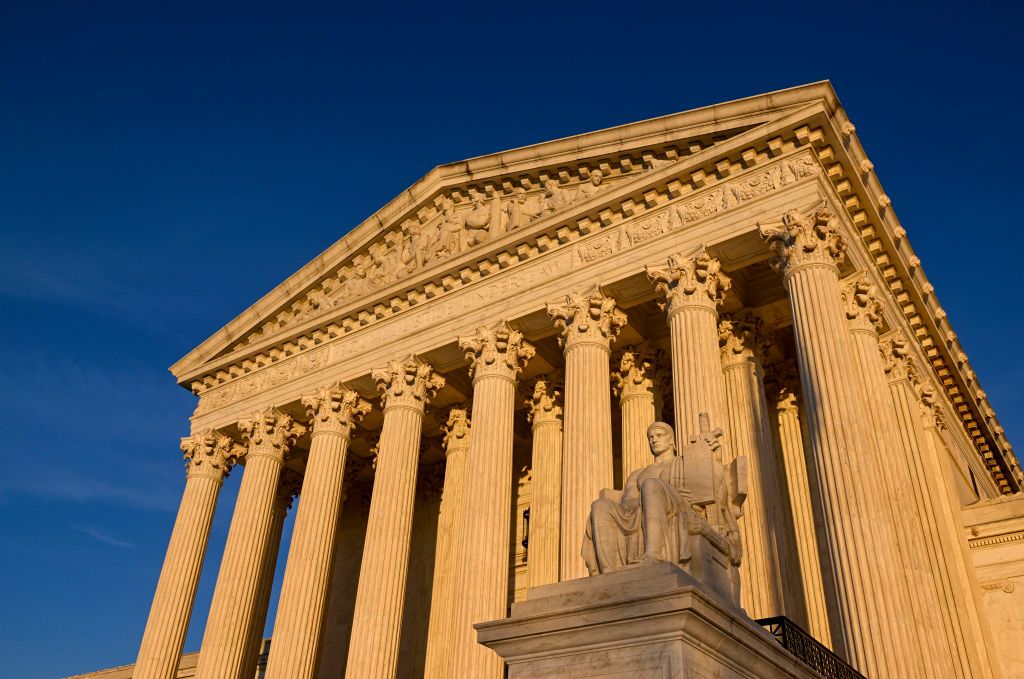
But perhaps Taft’s greatest impact as chief justice was in the realm of judicial administration, which has earned him the designation as “father of the modern U.S. Supreme Court.” Among other things, Taft established the court’s practice of controlling its own caseload, reorganized the structure of the lower courts, and oversaw the construction of the Supreme Court Building – telling architects to create something “of dignity and importance” (before this, the court was confined to a small space in the U.S. Capitol).
Taft was the first former president, and the first Supreme Court justice, to be interred at Arlington National Cemetery, and remains the only justice to have a state funeral.
As Justice Robert Jackson once put it, “Hughes looked like God and talked like God.” But he was very human.
After several years in private practice, Hughes forged a public career in the early 1900s after leading a pair of high-profile investigations – one into abuses in New York’s public utilities industry, and the other in the life insurance business. Garnering the support of President Theodore Roosevelt, Hughes ran for governor of New York and was elected in 1906. In 1910, President Taft nominated Hughes to the court, “in part to remove a likely challenger from the 1912 presidential election.” If Taft thought he had politically neutralized Hughes, however, he was wrong: Hughes ran for president in 1916, reportedly wanting to dispel the notion that he was a man “who placed his own comfort and preference for the life of a judge above his duty to the nation.” In this, Hughes became the first (and to date, only) sitting justice to be nominated for the presidency by a major party – though he resigned from the court after being nominated. After running a seemingly successful campaign, Hughes went to sleep on election night after being told by his advisers that he had won – only to lose California by a few thousand votes, which swung the Electoral College for Woodrow Wilson.
In 1930, Hughes was nominated as chief justice by President Herbert Hoover to fill the seat vacated by Taft. Perhaps the greatest test of Hughes’ tenure came in 1937, when he navigated President Franklin Roosevelt’s “court packing plan” to increase the number of justices on the court so as to fill it with sympathetic justices. During this, Hughes worked with Sen. Burton Wheeler of Montana, a Democrat who agreed to lead the opposition to the court-packing bill – and with the approval of both liberal Justice Louis Brandeis and conservative Justice Willis Van Devanter, Hughes sent a letter to the Senate Judiciary Committee countering the president’s argument that the court needed to be made larger because of the slow pace of its decision-making (“calmly point[ing] out that the Court was keeping up with its work”). The plan was killed in the Senate that July, and FDR grudgingly remarked that Hughes was the best politician in the nation.
Stone’s classmates predicted that he would “proceed to be the most famous man” of their 1894 class – and they were (probably?) right.
Born on a farm in Chesterfield, New Hampshire, in 1872, Stone grew up in Amherst, Massachusetts, and graduated from Amherst College in 1894, where he played football alongside his fellow student (and future President) Calvin Coolidge (it’s good to have friends who go on to high places). After law school, Stone divided his time between private practice and academia, eventually becoming dean of Columbia Law School in 1910, where he remained for 13 years until Coolidge appointed him attorney general in 1924 and nominated him to the court the following year.
On the bench, Stone aligned himself with the liberal wing anchored by Justices Louis Brandeis and Benjamin Cardozo, and the three came to be labeled the “Three Musketeers.” In particular, Stone was known for his willingness to dissent alone when he believed the court had gone astray. In 1940, for example, he was the sole dissenter in Minersville School District v. Gobitis, which held that public schools’ mandatory flag salute did not violate the First and 14th Amendments. (Three years later, the court sided with Stone and overturned Gobitis 6-3 in West Virginia Board of Education v. Barnette.)
Yet Stone’s most enduring contribution may have come in 1938 in “[t]he footnote that broke constitutional law.” In United States v. Carolene Products Co., a case about a ban on “filled milk,” Stone added what would become the famous footnote four: a suggestion, as explained by SCOTUSblog recurring columnist Anastasia Boden, that “laws should be presumed constitutional unless they interfered with ‘the corrective political processes which can ordinarily be expected to bring about repeal of undesirable legislation.’” This would come to take on a life of its own as a general standard for evaluating a measure’s constitutionality.
After several years on the court, Stone was appointed chief justice in 1941 by Roosevelt to succeed Hughes. The role of chief proved harder to manage than his years as an associate justice, however, as Stone struggled to contain rivalries among his strong-willed colleagues. In April 1946, Stone suffered a cerebral hemorrhage while presiding over a session of the Supreme Court and died a few hours later at the age of 73.
Very few Americans have held prominent positions in all three branches of the federal government. The 13th chief justice was one of them.
Frederick Moore Vinson was born in 1890 in Louisa, Kentucky, a small town near the border of West Virginia and Kentucky, to a southern family of “reduced circumstances.” While on the campaign trail a few decades later, Vinson would joke that he was “born in jail” – which was not entirely untrue, given his father worked as the county jailer and the family lived in front of it.
In a special January 1924 election, Vinson was elected to Congress as a Democrat. In Congress, he was known as an expert on fiscal policy and became a reliable ally of the New Deal. In 1938, Roosevelt appointed Vinson to the U.S. Court of Appeals for the District of Columbia Circuit. But the country’s involvement in World War II led Vinson to move to the executive branch; in 1943, Vinson became director of the office of economic stabilization, where he helped oversee the wartime American economy and control inflation.
On June 6, 1946, Truman nominated Vinson to the center seat. Vinson preferred a restrained judiciary, encouraging the court to defer to the executive branch when evaluating its actions, whether in matters of free speech (of which he was partly successful) or the president’ seizure of steel mills during the Korean War (of which he completely failed). Nor was Vinson able to tame a fractured court: although he was in the majority a staggering 97% of the time in one term, only around 30% of his court’s decisions proved unanimous (during the Roberts era, that figure is around 42%).
Vinson’s more enduring legacy, however, lies in the realm of civil rights. In 1948’s Shelley v. Kraemer, for example, Vinson held that enforcement of “racially restrictive [housing] covenants” violated the equal protection clause. Two years later, in Sweatt v. Painter, Vinson wrote for a unanimous court that a qualified Black law school applicant could not be constitutionally denied admission to the University of Texas Law School under the “separate, but equal” doctrine. And although Vinson heard Brown v. Board of Education, he never got to decide it – just before Brown was scheduled for reargument, the chief justice died of a heart attack at the age of 63.
Unlike some of the other fellows on this list, Earl Warren is a man who needs no introduction.
After earning his law degree from UC Berkeley in 1914, Warren spent virtually his entire career in public office, first as Alameda County’s district attorney – where in 13 years he apparently never had a conviction overturned by a higher court – and then as California’s attorney general. Warren’s record as attorney general is marred by his advocacy of the forced internment of over 100,000 persons of Japanese descent during World War II. (In his memoirs, Warren said that he had “since deeply regretted the removal order and my own testimony advocating it, because it was not in keeping with our American concept of freedom and the rights of citizens.”)
Warren was elected California governor for three consecutive terms, and in 1948 joined Thomas Dewey on the Republican presidential ticket as its vice-presidential nominee (but only after turning down Dewey twice). That turned out to be the only time Warren lost in an election.
When Chief Justice Vinson died suddenly in September 1953, President Dwight D. Eisenhower, honoring a promise to Warren that he would make him his first appointment to the Supreme Court (Warren had campaigned for Eisenhower in the general election despite initially running as a potential candidate), named Warren as chief justice.
From the get-go, Warren was able to forge relative solidarity on the court by pragmatically appealing to the different justices. Indeed, in his very first term, Warren authored the unanimous opinion in Brown v. Board of Education, declaring racially segregated public schools inherently unequal under the 14th Amendment and overturning the “separate but equal” doctrine that had prevailed since Plessy v. Ferguson in 1896.
Warren also participated in, or wrote, several other rulings which dramatically altered the legal and political landscape. In 1964’s Reynolds v. Sims, Warren established the “one person, one vote” principle, holding that representation in state legislatures must be apportioned equally on the basis of population – a ruling Warren said was his most important contribution to American law. In the criminal realm, Miranda v. Arizona required police to advise suspects of their rights before questioning – a ruling shaped in part by Warren’s “close association” with August Vollmer, the Berkeley chief of police and an early advocate for interrogation reform. Loving v. Virginia struck down bans on interracial marriage, and Gideon v. Wainwright guaranteed the right to counsel for all criminal defendants. And on First Amendment grounds, the Warren court produced New York Times Co. v. Sullivan and Brandenburg v. Ohio – which, respectively, held that a public official can only recover damages in a civil defamation suit if the statement was made with “actual malice,” and determined that a state cannot prohibit speech unless the advocacy is “directed at inciting or producing imminent lawless action” and is “likely to produce such action.”
Warren is buried at Arlington National Cemetery and was posthumously awarded the Presidential Medal of Freedom in 1981. Although no fan of the Warren Court, even President Richard Nixon said on the night of Warren’s death that “America has lost one of her finest public servants.”
The first thing to note is that the next chief shared both a first and middle name with his predecessor – which should be illegal.
In any event, the 15th chief justice was born in 1907 in St. Paul, Minnesota to a working-class family. To get through night school at the University of Minnesota, Burger sold insurance. Actively involved in Republican politics, one of Burger’s most consequential political acts came at the 1952 GOP convention, where he helped deliver the state’s votes to Eisenhower. The following year, he was appointed by Ike as assistant attorney general and, in 1955, to a seat on the U.S. Court of Appeals for the D.C. Circuit. As a judge, Burger became known as promoting “law-and-order” principles amicable to the Nixon administration.
On May 21, 1969, Nixon nominated Burger to replace the retiring Warren. Although Nixon expected Burger to serve as a “conservative constructionist,” the chief justice proved a bit more complicated. As some note, the Burger court did move the nation to the right (as compared to the Warren court) – but it also expanded protections for privacy and sex equality. Perhaps most prominently, Burger himself voted with the majority in Roe v. Wade in 1973 (indeed, three of Nixon’s four appointees joined the 7-2 ruling).
Justice Sandra Day O’Connor once singled Burger out alongside Taft as one of the chief justices who “really deeply cared about judicial administration.” This led to some significant changes under his tenure – among other things, Burger discouraged justices from reading their full opinions or “lengthy summaries” aloud from the bench (estimating the practice wasted 300 hours of their time each year), cut the time allotted for oral arguments in half (from two hours to one), changed the physical bench to a U-shape (which reduced interruptions during oral argument), and began distributing written opinion summaries alongside decisions. Burger was not Mr. Popular among his colleagues, however, who could find him “manipulative and aloof,” doing such things as miscounting his own conference votes to control opinion assignments.
Burger retired in 1986, after 17 years on the court, to chair the Commission on the Bicentennial of the United States Constitution, which took up so much of his time that his wife reportedly asked whether he could get his old job back. He died on June 25, 1995, at 87, of heart failure, and (like his predecessor) is buried at Arlington National Cemetery.
When Rehnquist's elementary school teacher asked him what he wanted to do when he was older, the future chief justice supposedly replied: “I'm going to change the government.” He most certainly did.
After high school, Rehnquist served as a weather observer in North Africa during World War II and then attended Stanford under the GI Bill, where he graduated in 1948 with bachelor's and master's degrees in political science. Rehnquist then received a master's degree in government from Harvard in 1950, after which he returned to Stanford and graduated first in his law school class in 1952 – just two places ahead of his classmate Sandra Day O’Connor, who would later join him on the court (and who Rehnquist had once dated and proposed to).
Rehnquist’s heavy involvement in Republican politics eventually brought him to the Nixon administration’s Justice Department in 1969 as assistant attorney general. Nixon, who called him “Renchberg” in the Watergate tapes, nominated Rehnquist to the court as an associate justice in 1971, and the Senate confirmed him 68–26.
On the court, Rehnquist relied on three “related constitutional ideas”: “strict construction” of the Constitution’s text, judicial deference to Congress on questions of policy, and a robust defense of states’ rights. Those convictions put him at great odds with most of his colleagues – in his first five terms he wrote 24 solo dissents (among 72 total), which earned him the nickname “the Lone Ranger.” (By 1975, a more conservative court allowed Rehnquist to write an increasing number of majority opinions.)
When Burger retired and President Ronald Reagan nominated Rehnquist as Burger’s successor in 1986, the confirmation fight was contentious. In particular, critics raised a memo Rehnquist had written as a law clerk to Justice Robert Jackson urging that Plessy v. Ferguson’s “separate but equal” doctrine not be overturned in Brown v. Board of Education, and pointed to racially restrictive covenants in the deeds to his homes. The Senate nevertheless confirmed him 65–33, and he was sworn in on the same day Antonin Scalia was unanimously confirmed to fill Rehnquist’s vacated associate justice seat.
Despite having once been a lone ranger, Rehnquist presided over an increasing rate of unanimous cases. In terms of major decisions, Rehnquist is perhaps most remembered for his efforts to limit Congress’ power – the chief justice wrote the majority opinion striking down the Gun-Free School Zones Act and applied the same logic five years later in United States v. Morrison to invalidate a provision of the Violence Against Women Act. Rehnquist also joined the court’s per curiam decision in Bush v. Gore, stopping Florida’s recount in a 5-4 decision that effectively allowed the election to be certified for George W. Bush.
According to his colleagues (who proved significantly more complimentary toward him than Burger), Rehnquist “steered the Court along a path of responsibility and careful analysis throughout his 19 years as Chief Justice … and he was able to secure the cooperation and admiration of all of the Justices for the years in which he served” (Sandra Day O’Connor), “was a good man who epitomized fairness, dignity, and strength of character” (Clarence Thomas), and “was the fairest, most efficient boss I have ever had” (Ruth Bader Ginsburg).
And then there is the current chief.
Born in January 1955 in Buffalo, New York, Roberts attended La Lumiere School, a Catholic boarding school in La Porte, Indiana, in which he captained the football team, wrestled, and graduated first in his class. Roberts then attended Harvard College as a history major, and went on to Harvard Law School.
After a clerkship for then-Justice Rehnquist, Roberts spent two stints at the Reagan White House, first as Special Assistant to the Attorney General and then as Associate Counsel to President Ronald Reagan, before entering private practice at the law firm Hogan & Hartson. Roberts left Hogan to serve as Principal Deputy Solicitor General under Ken Starr from 1989 to 1993, becoming, by Starr’s account, “my very closest, most trusted adviser.” Returning to Hogan in 1993, Roberts argued 39 cases before the Supreme Court, winning 25 of them.
After serving on the U.S. Court of Appeals for the District of Columbia Circuit for several years, Bush nominated Roberts to the Supreme Court in July 2005, initially to fill the vacancy of retiring Justice Sandra Day O’Connor. When Rehnquist, who was by then chief justice, died on Sept. 3, 2005, Bush withdrew that nomination and re-nominated Roberts to the center chair.
On the bench, Roberts has authored more than his share of significant opinions – to put it mildly. But here are a few. In 2012, Roberts wrote the majority opinion in National Federation of Independent Business v. Sebelius, which upheld the Affordable Care Act by finding the individual mandate to be unconstitutional under the commerce clause, but valid as a tax. In 2013, Roberts’ majority opinion in Shelby County v. Holder struck down the Voting Rights Act’s pre-existing coverage formula. In 2023, Roberts wrote the 6-2 opinion in Students for Fair Admissions v. Harvard, which held that race-conscious admissions at colleges and universities violated the equal protection clause of the 14th Amendment. In 2024, Roberts authored, for a 6-3 majority, Loper Bright Enterprises v. Raimondo, overturning the 40-year old Chevron doctrine, which had courts defer to federal agencies’ interpretations of ambiguous statutes. And later that year, in Trump v. United States, Roberts wrote for a 6-3 court holding that former presidents receive absolute immunity from prosecution for acts within their core constitutional powers and “presumptive immunity” for other official acts. And most recently, Roberts authored Learning Resources v. Trump, which struck down President Donald Trump’s tariffs in a 6-3 decision. (Roberts also wrote a concurrence in Dobbs v. Jackson Women’s Health Organization, in which he would have declined to overrule Roe v. Wade, and penned the lead dissent in Obergefell v. Hodges, in which the court recognized a constitutional right to same-sex marriage.)
Last term, Roberts was in the majority in 95% of all cases – the most of any justice – and did not write a single separate opinion. And although Roberts typically speaks through his opinions, he has been somewhat outspoken (by his own standards, at least) in defending judicial independence. After Trump called a judge an “Obama judge” in 2018, for example, Roberts issued a written statement noting that “[w]e do not have Obama judges or Trump judges, Bush judges or Clinton judges.” Roberts also presided over Trump's first impeachment trial in 2020 – making him, like Chief Justice Salmon P. Chase and Rehnquist before him, one of only three chief justices in history to perform that duty. And, no doubt to Roberts’ chagrin, there has been no shortage of drama during his tenure, from the Dobbs leak to recent tension between the justices themselves – all during a time where the public is largely skeptical of how the court is fulfilling its duties.
***
If you’ve made it this far (and, heck, even if you haven’t) please sign up for our newsletter, SCOTUStoday, for news articles and commentary on the court, and even more justice bios to come.