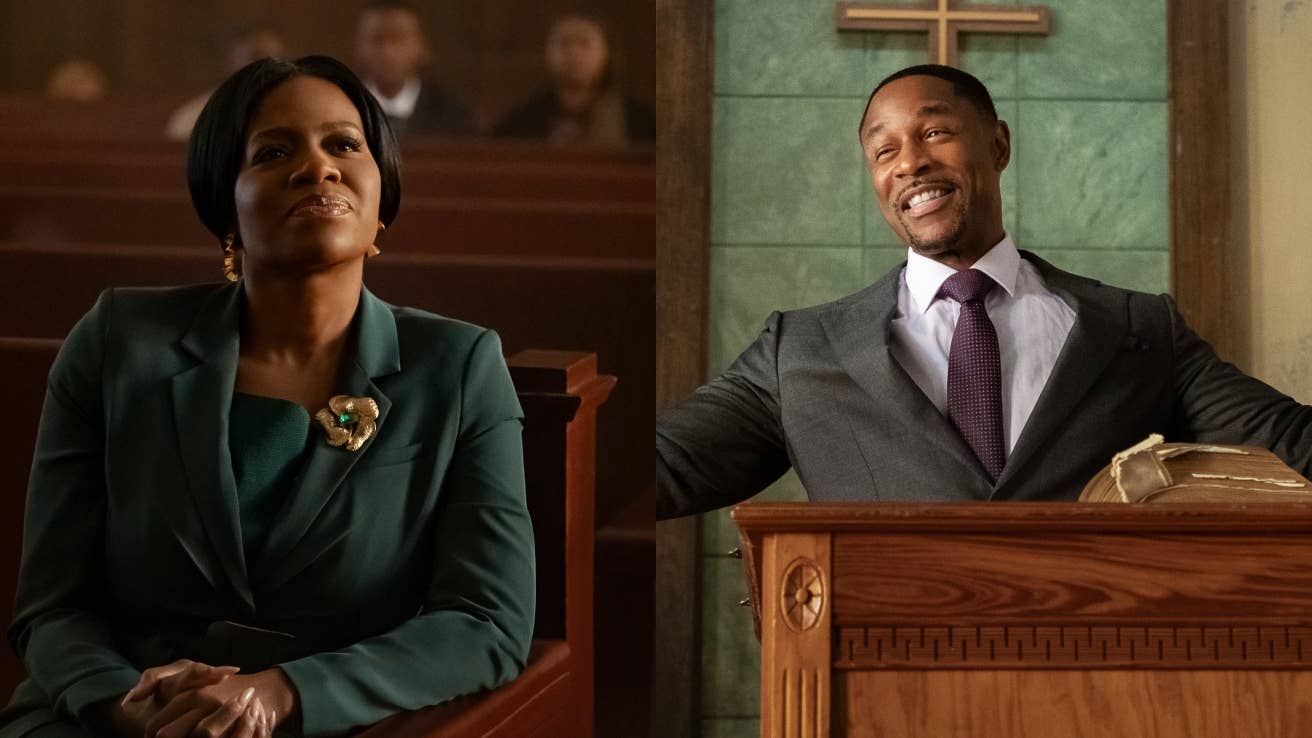
It’s no secret that when you hear the words reality television, the first thing that comes to mind is The Real Housewives. Images of NeNe Leakes, Porsha Williams, Phaedra Parks, Karen Huger overwhelm the senses followed by their iconic lines, such as “Close your legs to married men!” Yes, the Black women who comprise the Bravo universe have been a part of our daily lives for almost 20 years, but a new generation of Black talent, specifically Black men, are marking their mark on the network. And Bradley Carter of Southern Hospitality is one of them.
SOUTHERN HOSPITALITY — Pictured: Bradley Carter — (Photo by: Terry Kuzniar/Bravo) The VIP server has been an integral part of the Southern Charm spinoff since the series debuted in 2022. Over the past three seasons, Bradley has followed the trajectory of every reality tv star. He’s been subjected to rumors from his fellow cast members. His character has been called into question. Now, he’s been characterized as the series’ villain, not by the production company, but by a minority of his cast members who took issue with his decision to tell the truth, an unpopular decision in the unscripted television space, but great for a reunion. He’s not the only cast member subjected to the vilification of his peers. Fellow cast member TJ Dinch is on the receiving end of backlash as well.
However, allegations about engaging in crude sexual acts in public, behind your place of work looks different if you’re a Black man in the South. When Bradley entered the series, he was joined by Mikel Simmons, another Black male cast member, along with two Black women, Mia Alario and Lucía Peña. As the series, Simmons and Pena exited the series, while Michols Peña and Lake Rucker joined in season three. Compared to a number of other series on the network, Southern Hospitality has not only been diverse in terms of race but sexual orientation as well.
“ Our show is really unique and dynamic in the sense that we showcase a little bubble in Charleston where we are in the Deep South,” said Carter. “There are some dark long storied roots to Charleston and how America became what it is today. Our show is showing that we’re trying to move forward while still honoring our past. We still have that southern touch to it, but this is a new age. We have queer castmates. We have the LGBTQ community represented and it’s more than just one person. I think that’s really cool and special. It shows that the youth is trying to move the needle forward.”
Like many shows which came to air in the post-George Floyd and Breonna Taylor era, there was an effort to increase diversity among film and tv programming. This was evident on Southern Charm, where the predominantly white cast began to have conversations about race and slavery in Charleston, a major port city in the transatlantic slave trade. Although those conversations have subsided nationwide, as efforts to dismantle DEI increased across industries, Southern Hospitality remains to be one of the few shows where multiculturalism feels genuine and authentic. Bradley attributes this to the real relationships he has with his fellow cast members.
Another source of support for Bradley has been Venita Aspen of Southern Charm. As the only Black cast member on the Charleston, South Carolina-based reality tv series, she has encountered a plethora of anti-Black and anti-woman sentiments from the audience. “We’ve had those conversations and lean on each other and really express how we’re feeling, which is really nice,” he said. “She’s been able to point me in the right direction and give me guidance.”
As a four season veteran, Bradley is no stranger to the commentary from fans online and across social media about his performance during the season, specifically the reunion, where his attempts to take accountability and atone for his actions were met with disdain. “ I felt like I needed to explain myself to anything and everything. I realized that it may not have come across in the most non-guilty way. If anything, it seemed a little bit more guilty. I realized that I needed to be defensive. Twice as good for half as much.”
In lieu of being on the defense for this season, he gave himself the ability to showcase moments of vulnerability with his fellow cast members. “I didn’t want to show up as weak. I have a tough time not defending myself or saying something,” he said. “Masculinity can be soft too and that doesn’t make you not a man.” This shift in mindset has been years in the making. As a young man who spent the majority of his life playing sports from grade school to college, the decision is not only reflective of his own personal growth, but to display a type of Black masculinity that is not frequently seen in unscripted and scripted television.
“When it comes to holding space for people, you don’t need to dominate the space or feel like you’re in control in order to show your masculinity. It doesn’t make you an alpha male. Helping people, being kind, showing compassion, and emotional maturity is what really makes you a man,” he said. Wise words from the 28 year old man, who started his reality tv journey at 24.
Bradley does miss the presence of Simmons on the series. “I think the one thing that is missing in reality tv is seeing the brotherly relationship between two young Black men,” he said. Despite the addition of KJ Dillard to Summer House, there is a significant lack of Black male relationships and talent on the network, and its presence is felt. “When I was at Bravocon, I was looking at our pictures on the side of the building and realized that I’m the only Black male cast member on Bravo,” he recalled. “I took a lot of pride in that. Not in a negative way, but it gives me a chance to represent myself, show my life, and share my story with people, so that others can be seen.”
Outside of Charleston, he has accepted sweet messages from Black viewers of the series who have thanked him for his presence on the series. To him, the responsibility of representation is not a burden, but a source of joy and perseverance. It is his hope that young Black people like him do not feel the need to leave the South to feel seen and heard, but to take advantage of the opportunities and be the person to hold the door open for the next generation of Black reality tv stars. Or at least the door of Republic on King Street.
The post Bradley Carter On Villain Labels And Being Bravo’s Only Black Man appeared first on Essence.